

Technologies
I Stuck My Face Into Nintendo’s New Virtual Boy and Felt Oddly Comforted
This bulky, bizarre accessory for your Switch isn’t exactly VR, but it is a lot more fun than I expected.

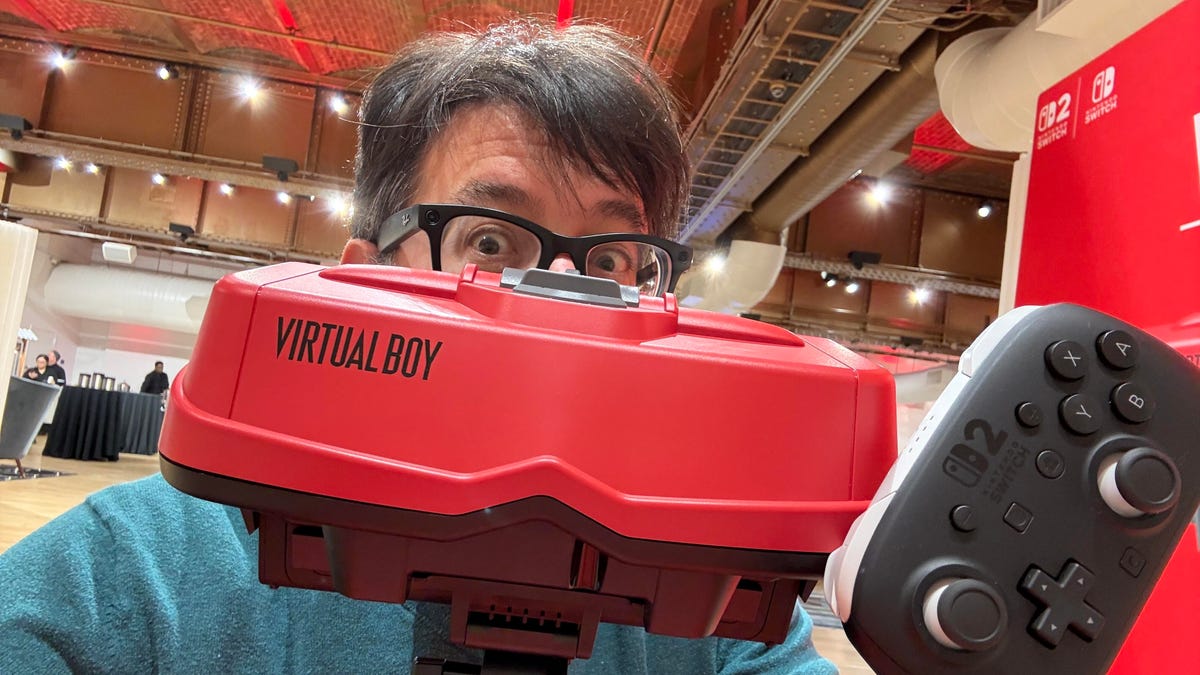
I’ve owned a lot of Nintendo systems over the years as a tech reviewer, gamer and VR-obsessed individual, but I’ve never owned a Virtual Boy. It’s always made me feel wistful. So finally here I am, playing the newest version. My face is stuck into a large red plastic visor, standing on a tripod on a table at Nintendo’s preview event. My takeaway? Nintendo’s latest weird retro move feels like an odd success.
I’m old enough to have owned Nintendo Game & Watch handhold games, and I remember the original Virtual Boy when it popped up in Electronics Boutique at my local mall. The red-and-black monochrome 3D game console wasn’t fully wearable, and it wasn’t TV-connected. It’s a tabletop game machine, something closer in spirit to the old Vectrex. Calling the Virtual Boy «VR» isn’t really accurate. It’s more like a 3D viewer for retro games.
Nintendo’s bringing this niche system back as a plastic recreation that turns your Nintendo Switch into the Virtual Boy, along with games you can play on Nintendo’s Virtual Console via a Switch Online subscription. It only works on a small subset of retro titles specifically designed for 3D — Nintendo promises 14 by the end of the year, with roughly half available at launch. You need the full Switch Online and Expansion Pack subscription ($50 a year, or $80 for a family subscription) to use it. That’s a lot of money for a little slice of strange retro gaming history.
Leaning into a weird tabletop goggle-thing
The $100 viewer and holster for the Switch is absurd. It’s like an optical appliance at Tron’s eye doctor. It’s larger than I thought it would be and not really portable. Instead of strapping it to your head like a VR headset, you set it up on a table with the included tripod, lean in and play.
After a few moments inside the Virtual Boy, I found it surprisingly comfortable. The large eyepiece is big enough to easily fit chunky glasses inside, yet has light-blocking sides that keep the viewing experience relatively glare-free. It feels like peeking into those old antique stereoscope machines that would show 3D photos or flip-films.
The Switch (or Switch OLED or Switch 2, but sorry, no Switch Lite compatibility) display acts as the Virtual Boy screen, splitting into a 3D view in the headset. It’s like how Nintendo turned the Switch into a pair of VR goggles with Labo VR way back when, but the Virtual Boy feels better than that. I was looking via a Switch 2 display, which is higher-res than Nintendo’s original Switch systems, but these games are low-res by default, so the 3D effects don’t seem degraded. Imagine a red-and-black 3D Game Boy, because that’s basically what it feels like.
Keeping the whole thing in one stable place also helps. No motion lag sickness, because you’re not moving (and neither are the games, really). Playing while leaning into the goggles for a half hour or so didn’t tire me out.
There are even some comfort settings. You can adjust the IPD (interpupillary distance) in the app to adjust the clarity, and you’ll be able to change the color scheme to other colors. I only got to play in the OG red-and-black mode, though, which feels very nocturnal and cozy to me, like being submerged in a gaming cave.
Games are retro bunches of fun
I played with a Switch Pro controller, although you can also use Joy-Cons. I played a bunch, and they’re all pretty fun. Teleroboxer is a 3D Punch-Out game with robots. WarioLand is a lost gem, a Wario game with 3D effects and depth layers. Galactic Pinball feels like all those NES and Game Boy pinball games with a 3D tilt. Golf is kind of a letdown, since the course views are static, but it’s cute. Red Alert is a wireframe Star Fox-like shooter, and it feels kind of like a perfect fit for this retro indie gaming moment we’re in.
A Japanese port of The Mansion of Innsmouth — a game I’ve never heard of before — is a simple 3D dungeon crawler with Lovecraftian monsters. And there’s 3D Tetris, which actually lets you flip pieces in all directions to drop into a deep 3D well. Nintendo is promising 14 Virtual Boy games released over time this year, including two never-released ones. Will there be more after that? Well, the system only had 22 games that were ever released for it in the first place, so we’ll see.
You also choose a cheaper Virtual Boy accessory to play these games, a $25 cardboard pair of goggles that I wasn’t allowed to demo. I’m sure it’s not as comfortable, but it does let you just hold the Switch up to your face, grab the side controllers to play.
During my time with the Virtual Boy, it really surprised me. It ended up feeling a lot more fun, and even «of the weird moment,» than I expected. I’ve been obsessed with retro indie games that feel like they’ve come from a parallel timeline, from UFO 50 to the odd Panic Playdate console. The Virtual Boy feels like Nintendo dug up a weird magic item from 1995. I’m ready to play some more, because I feel a desperate need to cocoon back in game time.
Technologies
Fitbit Launches Luffu, AI-Powered Health Tracking for the Whole Family
Soon, you may be able to access every family member’s health data in one place.

If you’ve ever wanted a way to keep all of your family’s health records in place, Fitbit may have come up with a solution. Fitbit, well-known for its fitness wearables, announced the launch of its own health care system on Wednesday.
Luffu, which translates to the Old English word for «love,» uses AI to create what it calls an «intelligent family care system.» The platform allows family members to share all their health information through an app.
It’s unclear when Luffu will be officially available, but you can sign up for the waitlist to get access to the limited public beta. Pricing or other details have not been announced.
Luffu will allow families to keep track of everyone’s doctor’s appointments, test results, vaccine records, medications, symptoms, diet and more. The platform uses AI to learn your family’s health history and patterns, and to alert you to any changes that should be addressed, such as missed medications or abnormal vitals. The AI function organizes the data submitted into the system. The app will also connect to third-party apps and wearables, such as the Fitbit.
Luffu is meant to lighten the mental load of family care by organizing all this health data in one place, its co-founder said.
«I was caring for my parents from across the country, trying to piece together my mom’s health care across various portals and providers, with a language barrier that made it hard to get a complete, timely context from her about doctor visits,» said Luffu co-founder James Park.
Luffu will include alerts and a space to log health and medication information via voice, text, photos, and other health portals and devices. The key medical information can be shared across the platform with spouses, caregivers and parents.
A representative for Fitbit did not immediately respond to a request for comment.
Technologies
These New AI Transcription Models Are Built for Speed and Privacy
Mistral AI’s new Voxtral Mini Transcribe 2 and Voxtral Realtime are intended to run on your device, meaning your conversations never find their way to a data center.

Sometimes you want to transcribe something, but don’t want it to be hanging out on the internet for any hacker to see. Maybe it’s a conversation with your doctor or lawyer. Maybe you’re a journalist, and it’s a sensitive interview. Privacy and control are important.
That desire for privacy is one reason the French developer Mistral AI built its latest transcription models to be small enough to run on devices. They can run on your phone, on your laptop or in the cloud.
Voxtral Mini Transcribe 2, one of the new models announced Wednesday, is «super, super small,» Pierre Stock, Mistral’s vice president of science operations, told me. Another new model, Voxtral Realtime, can do the same thing but live, like closed captioning.
Privacy is not the only reason the company wanted to build small open-source models. By running right on the device you’re using, these models can work faster. No more waiting on files to find their way through the internet to a data center and back.
«What you want is the transcription to happen super, super close to you,» Stock said. «And the closest we can find to you is any edge device, so a laptop, a phone, a wearable like a smartwatch, for instance.»
The low latency (read: high speed) is especially important for real-time transcription. The Voxtral Realtime model can generate with a latency of less than 200 milliseconds, Stock said. It can transcribe a speaker’s words about as quickly as you can read them. No more waiting two or three seconds for the closed captioning to catch up.
The Voxtral Realtime model is available through Mistral’s API and on Hugging Face, along with a demo where you can try it out.
In some brief testing, I found it generated fairly quickly (although not as fast as you’d expect if it were on device) and managed to capture what I said accurately in English with a little bit of Spanish mixed in. It’s capable of handling 13 languages right now, according to Mistral.
Voxtral Mini Transcribe 2 is also available through the company’s API, or you can play around with it in Mistral’s AI Studio. I used the model to transcribe my interview with Stock.
I found it to be quick and pretty reliable, although it struggled with proper names like Mistral AI (which it called Mr. Lay Eye) and Voxtral (VoxTroll). Yes, the AI model got its own name wrong. But Stock said users can customize the model to understand certain words, names and jargon better if they’re using it for specific tasks.
The challenge of building small, fast AI models is that they also have to be accurate, Stock said. The company touted the models’ performance on benchmarks showing improved error rates compared to competitors.
«It’s not enough to say, OK, I’ll make a small model,» Stock said. «What you need is a small model that has the same quality as larger models, right?»
Technologies
Don’t Miss Out on Xbox Game Pass Ultimate for $25 Per Month
With this StackSocial offer, you’re getting access to hundreds of games for either $25 for one month or $74 for three months.

Right now at StackSocial, you can get a three-month membership for just $74, which brings each month to $25. Normally $30 per month, you can also opt for a single-month plan for $25. I’ve been following Xbox Game Pass pricing for a while, so this is a great deal. Just keep in mind, once you get your download code via email, the purchase cannot be changed or returned.
Xbox Game Pass Ultimate lets you access games not only on your console but also on a PC or mobile device. Basically, you can play what you want, when you want, where you want. Game Pass adds new games all the time, with not only older titles making their way to the service but also brand-new Xbox games, including releases from Microsoft’s own studios on the day of release.
Hey, did you know? CNET Deals texts are free, easy and save you money.
Xbox Game Pass Ultimate is a brilliant way to save cash while playing fantastic games, including Black Ops 6, Halo: Infinite, Hellblade 2, Starfield and tons more. While the lineup changes each month, more than 500 games are available to play. It’s the closest thing to a Netflix for games.
Please note that Microsoft allows prepayment for up to 36 months of access, so 12 is the maximum number of subscriptions you should purchase. You can check out our full roundup of all the best Xbox deals for more savings on games and accessories.
Why this deal matters
The last time we saw the Game Pass subscription discounted was around the holiday season. Right now, you can get access to hundreds of games for essentially the price of one. Whether you choose the one- or three-month option, the price is the same at $25 per month. Since most games aren’t usually priced below $25, this is a steal.
-
 Technologies3 года ago
Tech Companies Need to Be Held Accountable for Security, Experts Say
-
 Technologies3 года ago
Best Handheld Game Console in 2023
-
 Technologies3 года ago
Tighten Up Your VR Game With the Best Head Straps for Quest 2
-
 Technologies4 года ago
Black Friday 2021: The best deals on TVs, headphones, kitchenware, and more
-
 Technologies5 лет ago
Google to require vaccinations as Silicon Valley rethinks return-to-office policies
-
 Technologies5 лет ago
Verum, Wickr and Threema: next generation secured messengers
-
 Technologies4 года ago
Olivia Harlan Dekker for Verum Messenger
-
 Technologies4 года ago
iPhone 13 event: How to watch Apple’s big announcement tomorrow


