
Technologies
Grammarly Adds Superhuman Email App to Expand Its AI Platform. Here’s What That Could Mean for You
The grammar enforcer’s latest purchase suggests it intends to do more than fix your awkward phrases.
Show of hands: Who’d like to spend less time going through their email? That could be in the offing from Grammarly, which announced it’s expanding its suite of workplace tools with the purchase of Superhuman, an email efficiency tool.
Grammarly, the company behind the popular grammar enforcement app of the same name, has acquired the AI-powered Superhuman app as part of its push to build out its business productivity offerings, the company said in a press release today.
«Email is the main communication tool for billions of people worldwide and the number-one use case for Grammarly customers,» Rahul Vohra, CEO of Superhuman, said in a statement. «By joining forces with Grammarly, we will invest even more in the core Superhuman experience, as well as create a new way of working where AI agents collaborate across the communication tools that we all use every day.»
The news follows the grammarian’s 2024 purchase of Coda, a productivity platform that offers a suite of products including document software and spreadsheets. Both acquisitions point to Grammarly’s potential desire to break free of its grammatical roots and compete on a bigger stage with tech titans Google and Microsoft, which have launched their own AI tools (Google Gemini and Microsoft Copilot) that operate across all their software products.
Started in 2009, Grammarly is a Ukraine-founded cloud-based typing assistant. It uses AI to help correct basic writing errors, detects plagiarism and suggest edits for your writing across multiple platforms. It even assesses the tone of your writing, although Grammarly, the product, has told me many times that my writing is too sarcastic. Thanks for that brilliant insight, Grammarly. Oh wait, I see what you mean there.
Superhuman‘s website boasts that its email productivity app can help you save four hours every week on email by organizing your inbox and drafting email messages.
Here’s what you need to know about Grammarly’s expansion.
Could Grammarly replace Google Suite?
Grammarly’s recent purchases raise a larger question about the grammar app. Reuters reports that the company is working on a name change that sells it as more than just a writing improvement tool. But could its collection of Coda and Superhuman really make it a viable competitor with the likes of Google Suite?
«My sense is that Grammarly is trying to position itself as the company that sells the next layer on top of workplace software for companies,» said Jon Reed, a CNET senior editor who covers AI.
While versions of generative AI have been criticized for inaccuracies and hallucinations, tech giants continue to invest and expand the use of this technology across all platforms, including chatbots and image generators. To set itself apart from grammar-focused competitors like ProWritingAid and Wordtune, Grammarly may be feeling the heat as it anticipates increased AI adoption.
Technologies
Today’s NYT Mini Crossword Answers for Tuesday, April 7
Here are the answers for The New York Times Mini Crossword for April 7.

Looking for the most recent Mini Crossword answer? Click here for today’s Mini Crossword hints, as well as our daily answers and hints for The New York Times Wordle, Strands, Connections and Connections: Sports Edition puzzles.
Need some help with today’s Mini Crossword? Read on for all the answers. And if you could use some hints and guidance for daily solving, check out our Mini Crossword tips.
If you’re looking for today’s Wordle, Connections, Connections: Sports Edition and Strands answers, you can visit CNET’s NYT puzzle hints page.
Read more: Tips and Tricks for Solving The New York Times Mini Crossword
Let’s get to those Mini Crossword clues and answers.
Mini across clues and answers
1A clue: Informative commercial, for short
Answer: PSA
4A clue: Something you trace to draw a Thanksgiving turkey
Answer: HAND
5A clue: ___ Johnson, former Prime Minister of the U.K.
Answer: BORIS
6A clue: Opposite of include
Answer: OMIT
7A clue: Crosses (out)
Answer: XES
Mini down clues and answers
1D clue: City with the Notre-Dame Cathedral
Answer: PARIS
2D clue: Bad mood
Answer: SNIT
3D clue: About eight minutes of the average half-hour sitcom
Answer: ADS
4D clue: Remote worker’s office, perhaps
Answer: HOME
5D clue: Word that can follow each group of circled letters (and hints at its shape)
Answer: BOX
Technologies
NASA’s Artemis II Breaks Record With Trip Around The Moon
Technologies
In Honor of the Artemis II Mission, Explore the Moon in Fortnite Now
You might not be able to see the moon the way the Artemis II team is, but there’s an educational Fortnite simulation that will get you onto the celestial body’s surface.
You may not be able to explore the vast majesty of space in the same way that the four-person crew of the Artemis II is, but you can still get an up-close-and-personal view of the moon… in Fortnite, at least.
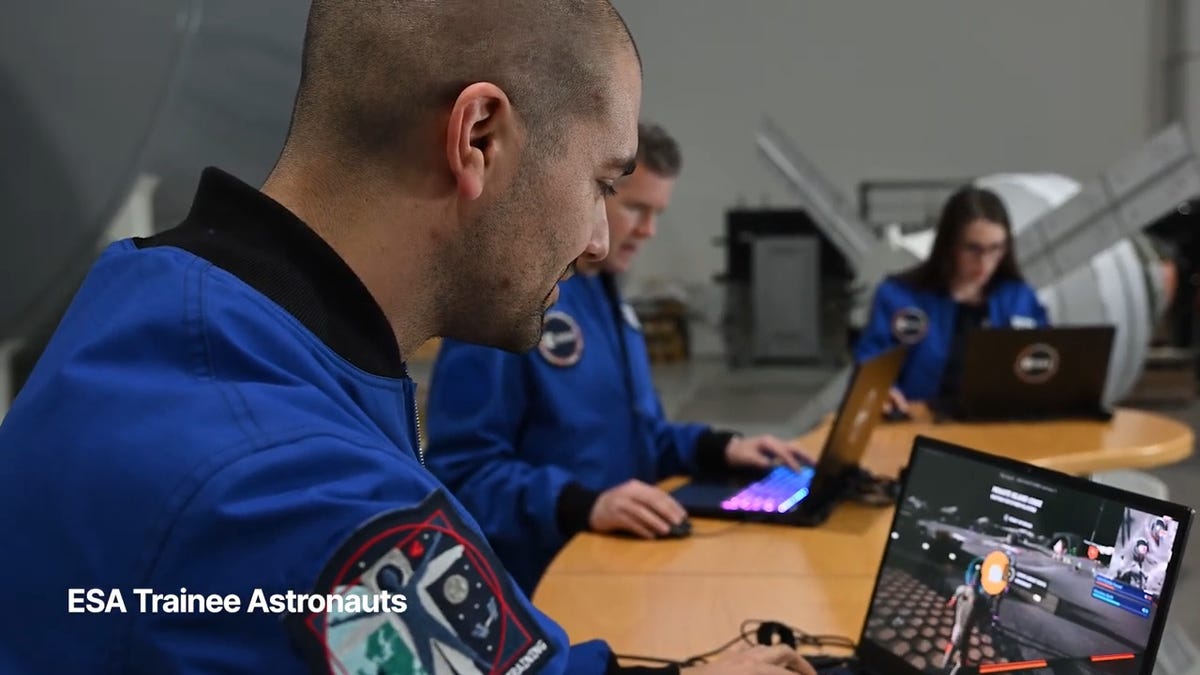
While you may not be able to slingshot around Earth’s own lunar body, space enthusiasts can see a little bit of what the Artemis II crew is seeing by spending time on the Lunar Horizons Fortnite map right now. The map is a creative collaboration between Fortnite’s creator, Epic Games, and the European Space Agency. Lunar Horizons was released in 2024 after extensive testing and play from ESA trainee astronauts.
If you’re looking to learn more about our own orbiting body, the Lunar Horizons map is an educational simulation of the surface of the moon’s South Pole.
It blends game mechanics with learning, as players get to build up their own sterile lunar habitat bases, interact with ESA astronauts and roll around with robotic rovers as they discover informative plaques that contain information about the moon and international space agencies. There are still dangers to navigate, too — a solar storm may strike when you least expect it.
If you’re interested in exploring the moon, we’ve got all the information you need to join in on the Fortnite fun below. And if you’re looking for a more serious livestream during this momentous human achievement, tune into NASA’s feed here.
How to join the Moon Fortnite island while you follow the Artemis II mission
The Lunar Horizons Fortnite map is a great educational simulation that shares details about ESA’s work and catalogs information about humanity’s lunar research.
These three simple steps will get you up and running (or more accurately, taking slow leaps and bounds) on the surface of the Lunar Horizons Fortnite map:
Download Fortnite
If you haven’t played Fortnite before, but you want to check out this limited-time event, you’ll have to download the game. If you’re on PC, you can download Fortnite for free from the Epic Games Store. Console players can navigate the PlayStation Store, Microsoft Store or Nintendo eShop in order to download Fortnite on their devices.
Navigate the in-game menus until you reach the Search button
Once you’re in the game, scroll down past the different official Fortnite game modes and the Discover tab until you find the Search button.
Input the Lunar Horizons island code
In the search bar, you can input a map’s name or its distinct search code in order to find it in the map directory. You can search for the Lunar Horizons map or input the code 3207-0960-6428 to explore this map in time.
Correction, 3:35 p.m. PT: This story initially was in error about the features available in the Lunar Horizons map. There is no Artemis II-specific mission in Fortnite. Rather, the Lunar Horizons map is an educational simulation of part of the moon’s surface.
-
 Technologies3 года ago
Tech Companies Need to Be Held Accountable for Security, Experts Say
-
 Technologies3 года ago
Best Handheld Game Console in 2023
-
 Technologies3 года ago
Tighten Up Your VR Game With the Best Head Straps for Quest 2
-
 Technologies4 года ago
Black Friday 2021: The best deals on TVs, headphones, kitchenware, and more
-
 Technologies5 лет ago
Google to require vaccinations as Silicon Valley rethinks return-to-office policies
-
 Technologies5 лет ago
Verum, Wickr and Threema: next generation secured messengers
-
 Technologies4 года ago
Olivia Harlan Dekker for Verum Messenger
-
 Technologies4 года ago
The number of Сrypto Bank customers increased by 10% in five days