
Technologies
How Galaxy AI Camera Tools Help You Take Better Photos Automatically on the S25
From photobomb fixes to better low-light shots, Galaxy AI1 helps you get polished, post-worthy photos without a heavy manual lift.

Summary:
- The Samsung Galaxy S25 and S25 Ultra are packed with new AI-powered camera
features. - The Scene Optimizer feature will automatically adjust settings like exposure and contrast to optimise for different scenes and lighting conditions.
- Editing tools like Object Eraser and Generative Edit
let users remove, move, or resize elements in photos
with just a tap. - Super HDR enhances dynamic range, delivering richer detail and truer color in both stills and previews.
- AI-driven search
capabilities make it easier to find photos and get pro-quality results without navigating complex menus or learning new skills.
If you’ve ever missed a perfect photo
op because you were fussing with settings, you’re the kind of photographer Galaxy S25 is built for. In Samsung’s
latest flagship device, the brand embeds intelligent enhancements throughout the camera experience—from photo capture to editing and sorting.
What’s so compelling about these Galaxy AI* updates is that they don’t require you to watch hours of tutorials to master—they just work. The S25 marks a step forward for the way AI quietly works in the background to elevate your photography, without you needing to do anything special.
Here’s how Galaxy AI helps make great photos happen automatically.
Smarter settings in real time
One of the most low-key powerful features of the S25 is Scene Optimizer, which uses AI to identify what you’re shooting—landscapes, food, people, pets—and automatically fine-tune settings like exposure, contrast, and saturation to make it looks its best. Simply enable the feature in the camera app settings to turn it on indefinitely.
Thanks to AI, the S25 also produces more balanced photos in tricky lighting scenarios. For instance, in low light, Samsung’s Nightography feature reduces noise while preserving sharpness
and color. (Results may vary depending on lighting, subject, and shooting conditions.) In broad daylight, the device’s built-in Galaxy AI compensates for harsh contrast and reflective surfaces.
That means the S25 can adapt instantly to your environment, making quick decisions that improve image quality without slowing you down. Shooting your dinner in a dim restaurant? When you turn on Scene Optimizer in your settings, Galaxy S25 kicks in to enhance brightness without making it look like a flash went off. Snapping a mountain range in peak sun? The S25 will naturally balance the sky and landscape so neither gets washed out. No toggling between modes, no extra effort—just a well-adjusted shot, ready to send to your friends or post online.
Take a clean shot, every time, with Object Eraser and Generative Edit
We’ve all had great shots ruined by a stranger walking into the frame
—or a power line cutting across an otherwise pristine skyline. The Galaxy S25‘s Object Eraser handles those intrusions with ease.
Powered by advanced AI and Samsung’s ProVisual Engine, users can simply tap on an object they want removed, and the phone fills in the background. In seconds, the tool recreates patterns, textures, and lighting to make it look like the offending object was never there.
Generative Edit, the broader suite of AI tools included on the S25, also lets users move or resize elements in their photos—for instance, you can reposition a subject for better framing, or scale down a distracting element in the background. The AI fills in any gaps for a seamless final result.
Super HDR for richer detail in every pic
Dynamic range is one of the toughest things for smartphone cameras to get right. Bright skies and dark shadows often lead to blown-out highlights or murky details. Super HDR on the S25 addresses this common problem by capturing multiple exposures nearly simultaneously, and blending them with AI to preserve detail across the full tonal range.
Super HDR doesn’t apply solely to stills in the camera app; it also enhances preview and playback in the Gallery. It even extends to social media apps like Instagram, so what you share is more representative of what you actually shot.
Better and more intuitive search
The Galaxy S25 also makes it easier to find the photos you’ve already taken without spending half an hour in a conversation-interrupting endless scroll. Thanks to Galaxy AI-enhanced search in the Gallery app, you can now type natural queries like «dog playing fetch» or «spring break at the beach,» and the phone will parse both visual elements and metadata to surface exactly what you’re looking for.
AI that’s there when you need it—and invisible when you don’t
One of the best parts about Galaxy AI is that it doesn’t require a learning curve. Even if it’s your first-ever Samsung device, you can pick up the phone and just start using it. Most of the photography tools activate automatically or appear at the precise time you need them with minimal interruption.
You don’t need to fiddle with menus or sliders; the phone quietly does the heavy lifting. Behind the scenes, the device’s AI is making thousands of tiny decisions—tweaking exposure by fractions, choosing the right tone curves, sharpening only where it helps—in mere milliseconds.
Whether you’re taking, editing, or sharing a photo, Galaxy AI helps eliminate the friction between your vision and the final result. You don’t have to overthink it—the S25 helps you get a great shot, then gets out of the way.
It flips, it folds, it’s anything but expected: the Galaxy Foldable is coming.
*Samsung account login is required for certain AI features.
Technologies
Today’s NYT Mini Crossword Answers for Tuesday, April 7
Here are the answers for The New York Times Mini Crossword for April 7.
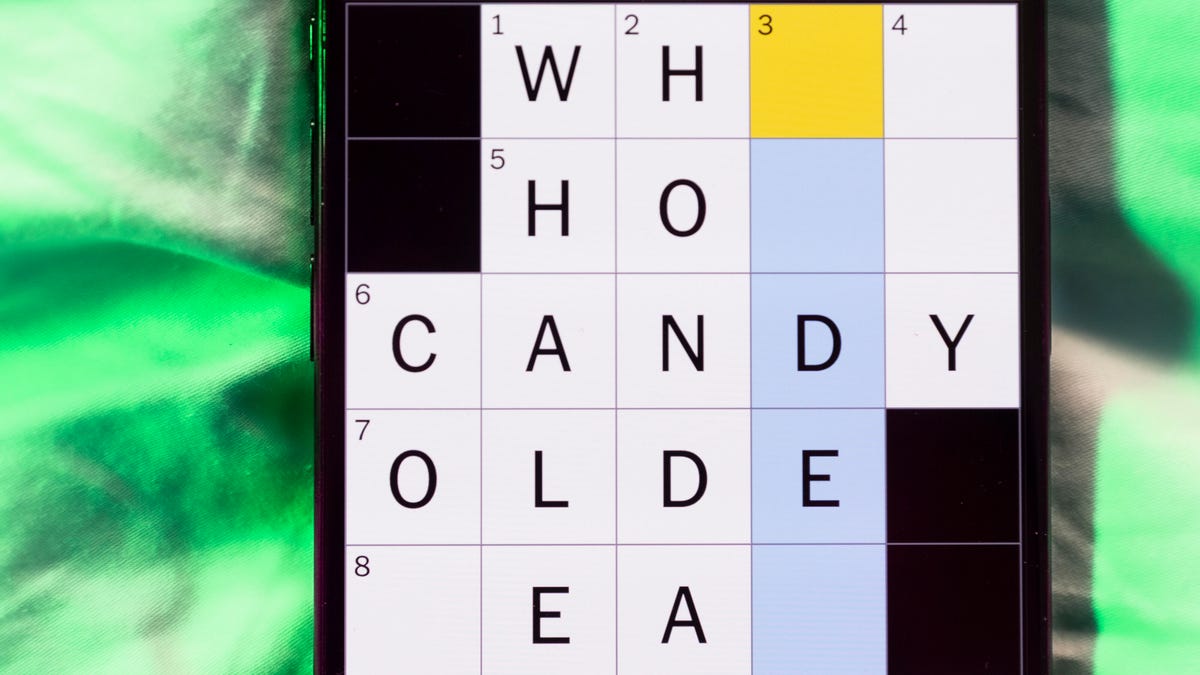
Looking for the most recent Mini Crossword answer? Click here for today’s Mini Crossword hints, as well as our daily answers and hints for The New York Times Wordle, Strands, Connections and Connections: Sports Edition puzzles.
Need some help with today’s Mini Crossword? Read on for all the answers. And if you could use some hints and guidance for daily solving, check out our Mini Crossword tips.
If you’re looking for today’s Wordle, Connections, Connections: Sports Edition and Strands answers, you can visit CNET’s NYT puzzle hints page.
Read more: Tips and Tricks for Solving The New York Times Mini Crossword
Let’s get to those Mini Crossword clues and answers.
Mini across clues and answers
1A clue: Informative commercial, for short
Answer: PSA
4A clue: Something you trace to draw a Thanksgiving turkey
Answer: HAND
5A clue: ___ Johnson, former Prime Minister of the U.K.
Answer: BORIS
6A clue: Opposite of include
Answer: OMIT
7A clue: Crosses (out)
Answer: XES
Mini down clues and answers
1D clue: City with the Notre-Dame Cathedral
Answer: PARIS
2D clue: Bad mood
Answer: SNIT
3D clue: About eight minutes of the average half-hour sitcom
Answer: ADS
4D clue: Remote worker’s office, perhaps
Answer: HOME
5D clue: Word that can follow each group of circled letters (and hints at its shape)
Answer: BOX
Technologies
NASA’s Artemis II Breaks Record With Trip Around The Moon
Technologies
In Honor of the Artemis II Mission, Explore the Moon in Fortnite Now
You might not be able to see the moon the way the Artemis II team is, but there’s an educational Fortnite simulation that will get you onto the celestial body’s surface.
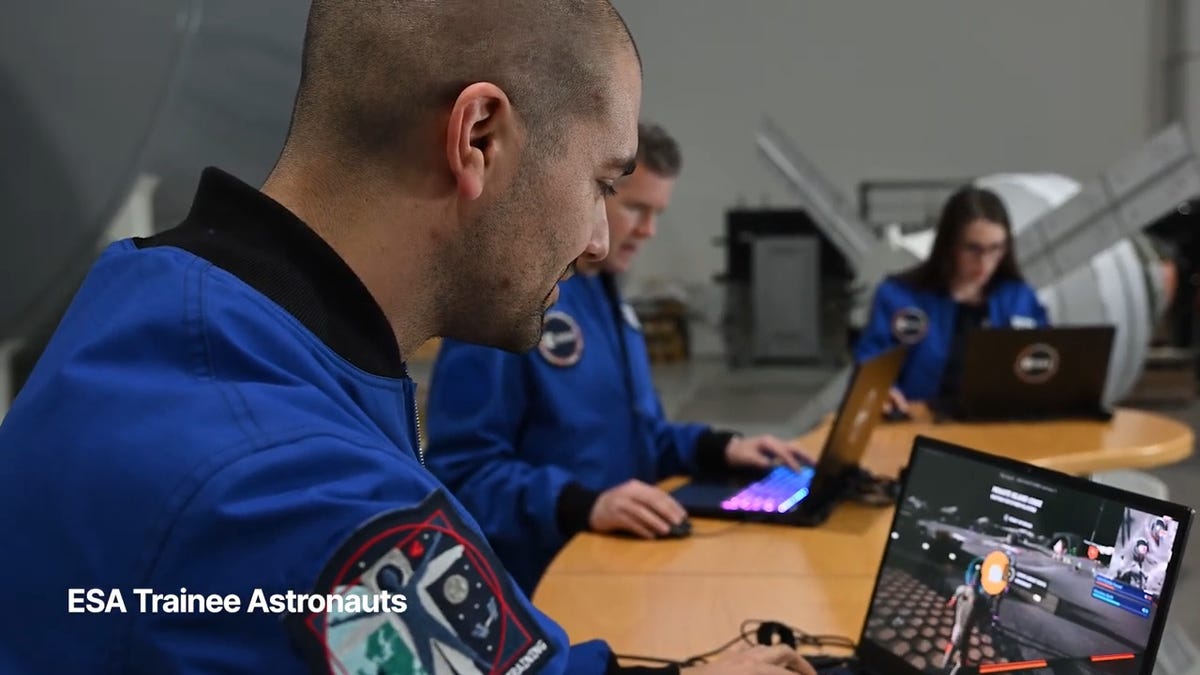
You may not be able to explore the vast majesty of space in the same way that the four-person crew of the Artemis II is, but you can still get an up-close-and-personal view of the moon… in Fortnite, at least.
While you may not be able to slingshot around Earth’s own lunar body, space enthusiasts can see a little bit of what the Artemis II crew is seeing by spending time on the Lunar Horizons Fortnite map right now. The map is a creative collaboration between Fortnite’s creator, Epic Games, and the European Space Agency. Lunar Horizons was released in 2024 after extensive testing and play from ESA trainee astronauts.
If you’re looking to learn more about our own orbiting body, the Lunar Horizons map is an educational simulation of the surface of the moon’s South Pole.
It blends game mechanics with learning, as players get to build up their own sterile lunar habitat bases, interact with ESA astronauts and roll around with robotic rovers as they discover informative plaques that contain information about the moon and international space agencies. There are still dangers to navigate, too — a solar storm may strike when you least expect it.
If you’re interested in exploring the moon, we’ve got all the information you need to join in on the Fortnite fun below. And if you’re looking for a more serious livestream during this momentous human achievement, tune into NASA’s feed here.
How to join the Moon Fortnite island while you follow the Artemis II mission
The Lunar Horizons Fortnite map is a great educational simulation that shares details about ESA’s work and catalogs information about humanity’s lunar research.
These three simple steps will get you up and running (or more accurately, taking slow leaps and bounds) on the surface of the Lunar Horizons Fortnite map:
Download Fortnite
If you haven’t played Fortnite before, but you want to check out this limited-time event, you’ll have to download the game. If you’re on PC, you can download Fortnite for free from the Epic Games Store. Console players can navigate the PlayStation Store, Microsoft Store or Nintendo eShop in order to download Fortnite on their devices.
Navigate the in-game menus until you reach the Search button
Once you’re in the game, scroll down past the different official Fortnite game modes and the Discover tab until you find the Search button.
Input the Lunar Horizons island code
In the search bar, you can input a map’s name or its distinct search code in order to find it in the map directory. You can search for the Lunar Horizons map or input the code 3207-0960-6428 to explore this map in time.
Correction, 3:35 p.m. PT: This story initially was in error about the features available in the Lunar Horizons map. There is no Artemis II-specific mission in Fortnite. Rather, the Lunar Horizons map is an educational simulation of part of the moon’s surface.
-
 Technologies3 года ago
Tech Companies Need to Be Held Accountable for Security, Experts Say
-
 Technologies3 года ago
Best Handheld Game Console in 2023
-
 Technologies3 года ago
Tighten Up Your VR Game With the Best Head Straps for Quest 2
-
 Technologies4 года ago
Black Friday 2021: The best deals on TVs, headphones, kitchenware, and more
-
 Technologies5 лет ago
Google to require vaccinations as Silicon Valley rethinks return-to-office policies
-
 Technologies5 лет ago
Verum, Wickr and Threema: next generation secured messengers
-
 Technologies4 года ago
Olivia Harlan Dekker for Verum Messenger
-
 Technologies4 года ago
The number of Сrypto Bank customers increased by 10% in five days