
Technologies
AT&T’s $177 Million Settlement Will Pay Victims of Two Huge Data Breaches. Learn Who Qualifies
If your data was leaked in two massive AT&T data breaches, you could be eligible for a payout.
Of the 1,350,835,988 notices sent to subjects of data breaches in 2024, almost a tenth of those came from a hack of AT&T servers in April, according to to the Identity Theft Resource Center’s 2024 Annual Data Breach Report. The telecom giant now plans to settle a lawsuit for that breach and another in 2019 for a whopping $177 million.
On Friday, June 20, US District Judge Ada Brown granted preliminary approval to the terms of a proposed settlement from AT&T that would resolve two lawsuits related to the data breaches. The current settlement would see AT&T pay $177 million to customers adversely affected by at least one of the two data breaches.
The settlement will prioritize larger payments to customers who suffered damages that are «fairly traceable» to the data leaks. It will also provide bigger payments to those impacted by the larger of the two leaks, which began in 2019. While the company is working toward a settlement, it has continued to deny that it was «responsible for these criminal acts.»
For all the details we have about the settlement right now, keep reading, and for more info about other recent settlements, find out how to claim Apple’s Siri privacy settlement and see if you’re eligible for 23andMe’s privacy breach settlement.
What happened with these AT&T data breaches?
AT&T confirmed the two data breaches last year, announcing an investigation into the first in March before confirming it in May and confirming the second in July.
The first of the confirmed breaches began in 2019. The company revealed that about 7.6 million current and 65.4 million former account holders had their data exposed to hackers, including names, Social Security numbers and dates of birth. The company first began investigating the situation last year after it reported that customer data had appeared on the dark web.
The second breach began in April of 2024, when a hacker broke into AT&T cloud storage provider Snowflake and accessed 2022 call and text records for almost all of the company’s US customers, about 109 million in all. The company stressed that no names were attached to the stolen data. Two individuals were arrested in connection with the breach.
Both of these incidents sparked a wave of class action lawsuits alleging corporate neglect on the part of AT&T in failing to sufficiently protect its customers.
How will I know if I’m eligible for the AT&T data breach settlement?
As of now, we know that the settlement will pay out to any current or former AT&T customer whose data was accessed in one of these data breaches, with higher payments reserved for those who can provide documented proof that they suffered damages directly resulting from their data being stolen.
If you’re eligible, you should receive a notice about it, either by email or a physical letter in the mail, sometime in the coming months. The company expects that the claims process will begin on Aug. 4, 2025.
How much will the AT&T data breach payments be?
You’ll have to «reasonably» prove damages caused by these data breaches to be eligible for the highest and most prioritized payouts. For the 2019 breach, those claimants can receive up to $5,000. For the Snowflake breach, the max payout will be $2,500. It’s not clear at this time how the company might be handling customers who’ve been affected by both breaches.
AT&T will focus on making those payments first, and whatever’s left of the $177 million settlement total will be disbursed to anyone whose data was accessed, even without proof of damages. Because these payouts depend on how many people get the higher amounts first, we can’t say definitively how much they will be.
When could I get paid from the AT&T data breach settlement?
AT&T expects that payments will start to go out sometime in early 2026. Exact dates aren’t available right now. The recent court order approving the settlement lists a notification schedule of Aug. 4 to Oct. 17, 2025.
The deadline for submitting a claim is currently set at Nov. 18, 2025. The final approval of the settlement needs to be given at a Dec. 3, 2025, court hearing in order for payments to begin.
Stay tuned to this piece in the coming months to get all the new details as they emerge.
For more money help, check out CNET’s daily tariff price impact tracker.
Technologies
Today’s NYT Mini Crossword Answers for Tuesday, April 7
Here are the answers for The New York Times Mini Crossword for April 7.
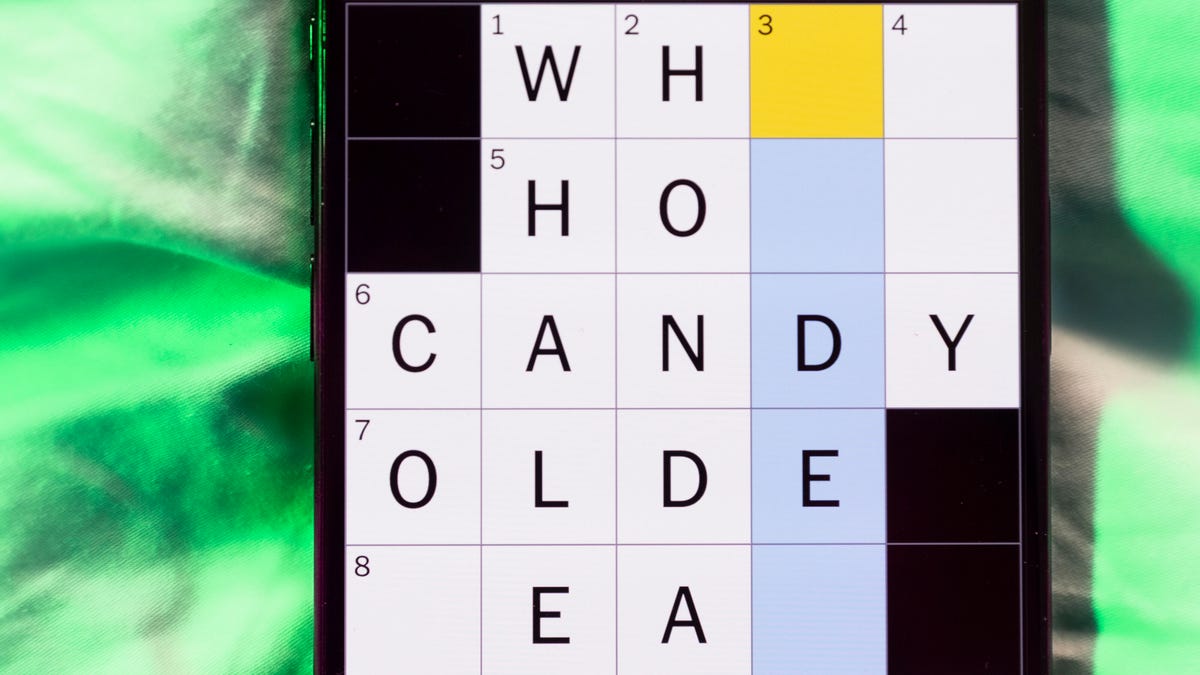
Looking for the most recent Mini Crossword answer? Click here for today’s Mini Crossword hints, as well as our daily answers and hints for The New York Times Wordle, Strands, Connections and Connections: Sports Edition puzzles.
Need some help with today’s Mini Crossword? Read on for all the answers. And if you could use some hints and guidance for daily solving, check out our Mini Crossword tips.
If you’re looking for today’s Wordle, Connections, Connections: Sports Edition and Strands answers, you can visit CNET’s NYT puzzle hints page.
Read more: Tips and Tricks for Solving The New York Times Mini Crossword
Let’s get to those Mini Crossword clues and answers.
Mini across clues and answers
1A clue: Informative commercial, for short
Answer: PSA
4A clue: Something you trace to draw a Thanksgiving turkey
Answer: HAND
5A clue: ___ Johnson, former Prime Minister of the U.K.
Answer: BORIS
6A clue: Opposite of include
Answer: OMIT
7A clue: Crosses (out)
Answer: XES
Mini down clues and answers
1D clue: City with the Notre-Dame Cathedral
Answer: PARIS
2D clue: Bad mood
Answer: SNIT
3D clue: About eight minutes of the average half-hour sitcom
Answer: ADS
4D clue: Remote worker’s office, perhaps
Answer: HOME
5D clue: Word that can follow each group of circled letters (and hints at its shape)
Answer: BOX
Technologies
NASA’s Artemis II Breaks Record With Trip Around The Moon
Technologies
In Honor of the Artemis II Mission, Explore the Moon in Fortnite Now
You might not be able to see the moon the way the Artemis II team is, but there’s an educational Fortnite simulation that will get you onto the celestial body’s surface.
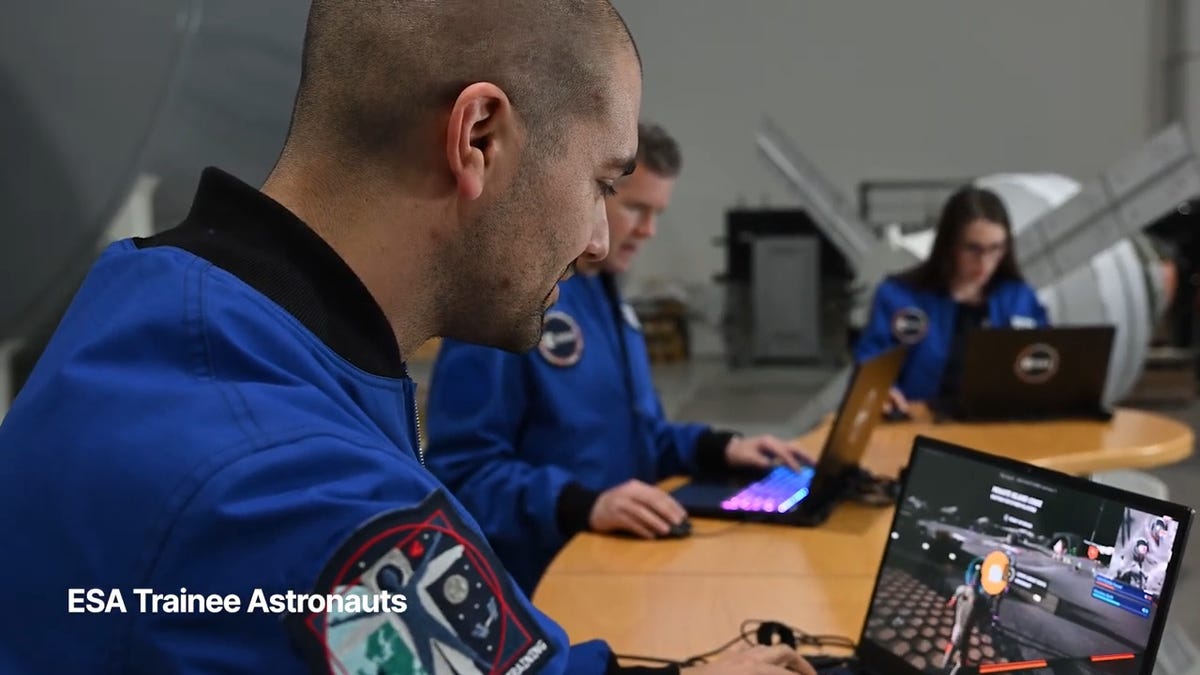
You may not be able to explore the vast majesty of space in the same way that the four-person crew of the Artemis II is, but you can still get an up-close-and-personal view of the moon… in Fortnite, at least.
While you may not be able to slingshot around Earth’s own lunar body, space enthusiasts can see a little bit of what the Artemis II crew is seeing by spending time on the Lunar Horizons Fortnite map right now. The map is a creative collaboration between Fortnite’s creator, Epic Games, and the European Space Agency. Lunar Horizons was released in 2024 after extensive testing and play from ESA trainee astronauts.
If you’re looking to learn more about our own orbiting body, the Lunar Horizons map is an educational simulation of the surface of the moon’s South Pole.
It blends game mechanics with learning, as players get to build up their own sterile lunar habitat bases, interact with ESA astronauts and roll around with robotic rovers as they discover informative plaques that contain information about the moon and international space agencies. There are still dangers to navigate, too — a solar storm may strike when you least expect it.
If you’re interested in exploring the moon, we’ve got all the information you need to join in on the Fortnite fun below. And if you’re looking for a more serious livestream during this momentous human achievement, tune into NASA’s feed here.
How to join the Moon Fortnite island while you follow the Artemis II mission
The Lunar Horizons Fortnite map is a great educational simulation that shares details about ESA’s work and catalogs information about humanity’s lunar research.
These three simple steps will get you up and running (or more accurately, taking slow leaps and bounds) on the surface of the Lunar Horizons Fortnite map:
Download Fortnite
If you haven’t played Fortnite before, but you want to check out this limited-time event, you’ll have to download the game. If you’re on PC, you can download Fortnite for free from the Epic Games Store. Console players can navigate the PlayStation Store, Microsoft Store or Nintendo eShop in order to download Fortnite on their devices.
Navigate the in-game menus until you reach the Search button
Once you’re in the game, scroll down past the different official Fortnite game modes and the Discover tab until you find the Search button.
Input the Lunar Horizons island code
In the search bar, you can input a map’s name or its distinct search code in order to find it in the map directory. You can search for the Lunar Horizons map or input the code 3207-0960-6428 to explore this map in time.
Correction, 3:35 p.m. PT: This story initially was in error about the features available in the Lunar Horizons map. There is no Artemis II-specific mission in Fortnite. Rather, the Lunar Horizons map is an educational simulation of part of the moon’s surface.
-
 Technologies3 года ago
Tech Companies Need to Be Held Accountable for Security, Experts Say
-
 Technologies3 года ago
Best Handheld Game Console in 2023
-
 Technologies3 года ago
Tighten Up Your VR Game With the Best Head Straps for Quest 2
-
 Technologies4 года ago
Black Friday 2021: The best deals on TVs, headphones, kitchenware, and more
-
 Technologies5 лет ago
Google to require vaccinations as Silicon Valley rethinks return-to-office policies
-
 Technologies5 лет ago
Verum, Wickr and Threema: next generation secured messengers
-
 Technologies4 года ago
Olivia Harlan Dekker for Verum Messenger
-
 Technologies4 года ago
The number of Сrypto Bank customers increased by 10% in five days