
Technologies
Why You Might Want to Blur Your Home on Google Maps
It’s about your privacy.
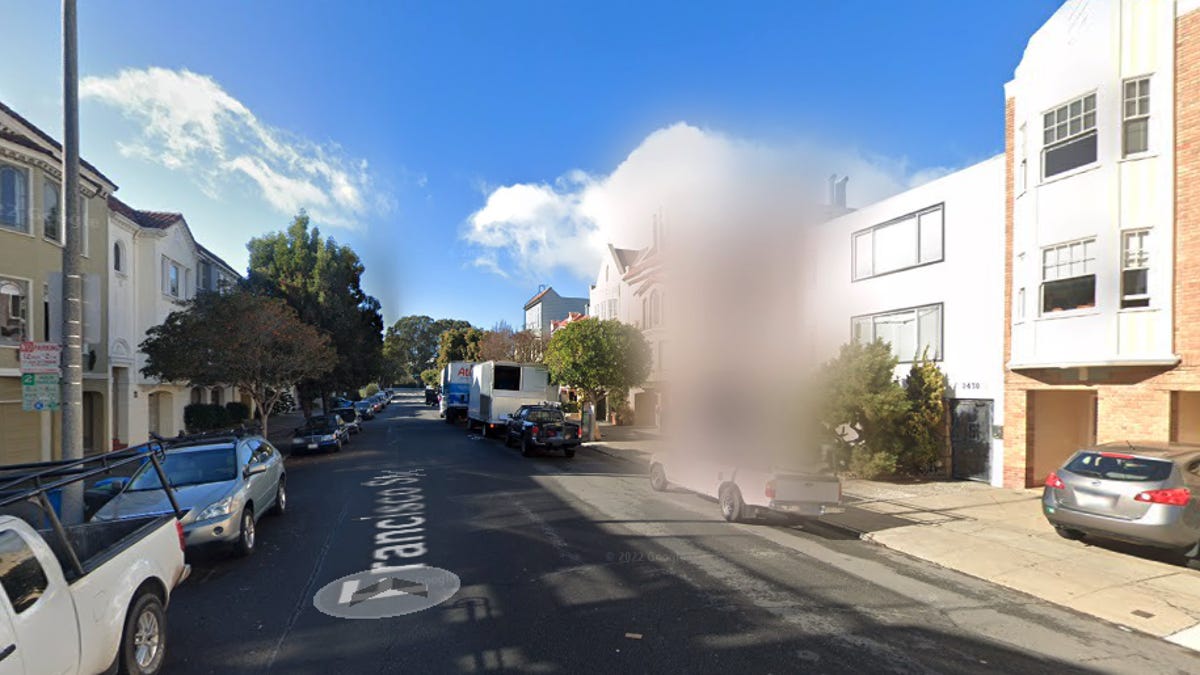
Google Maps’ Street View lets you enter nearly any address, like that of a restaurant or concert venue, and check out a recent image of that location, captured by one of the Google Street View cars you’ll occasionally see roaming about. The feature is useful for knowing what building or landmark to look for when you arrive, in case the entrance is hard to find or you want to know where the best place to park is, but Street View also makes it easier for stalkers or criminals to plan their way inside your home.

Street View gives anyone a free ticket to examine your home over the internet — maybe they want to look for any cameras or find a side window to pry open. And sure, anyone can walk or drive by your home and do this in person, but Google Maps makes this process much simpler. Anyone with a phone or computer can do it.
Fortunately, there’s an easy way to blur your home on Google Maps and help prevent others from seeing too many details of where you live. Here’s how to do it.
For more, here’s how to discover the past with Google Maps and how Google Maps can help you figure out dinner.
How to blur your home on Google Maps
You’ll need to do this on your computer, as the blurring feature isn’t available in the Google Maps application on iOS or Android, and while it is accessible through the web browser on your mobile device, it’s rather difficult to use, so use a trusted web browser on your Mac or PC instead.
At maps.google.com, enter your home address in the search bar at the top-right, hit return, then click the photo of your home that appears.
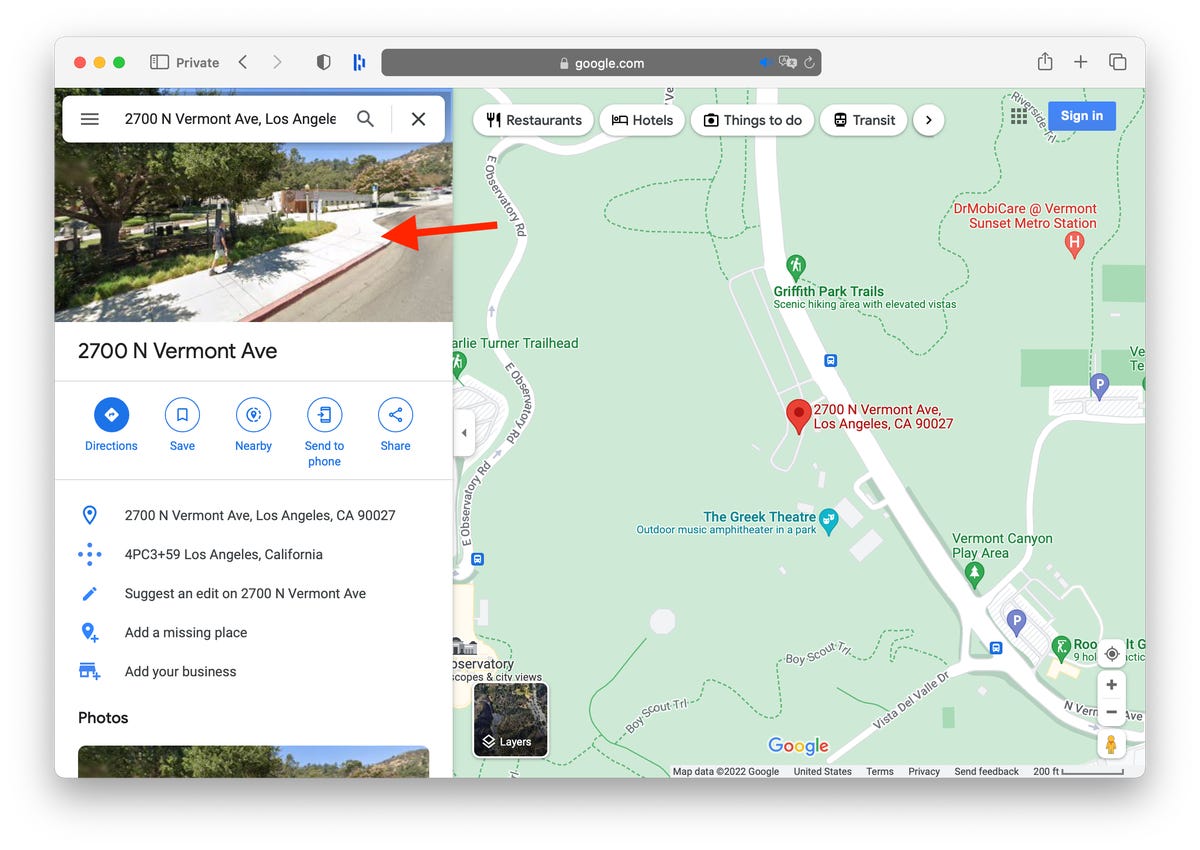
Click on the photo of your home, right above your address, on the top-left part of the page.
Next, you’ll see the Street View of your location. Click Report a Problem at the bottom-right. The text is super tiny, but it’s there.
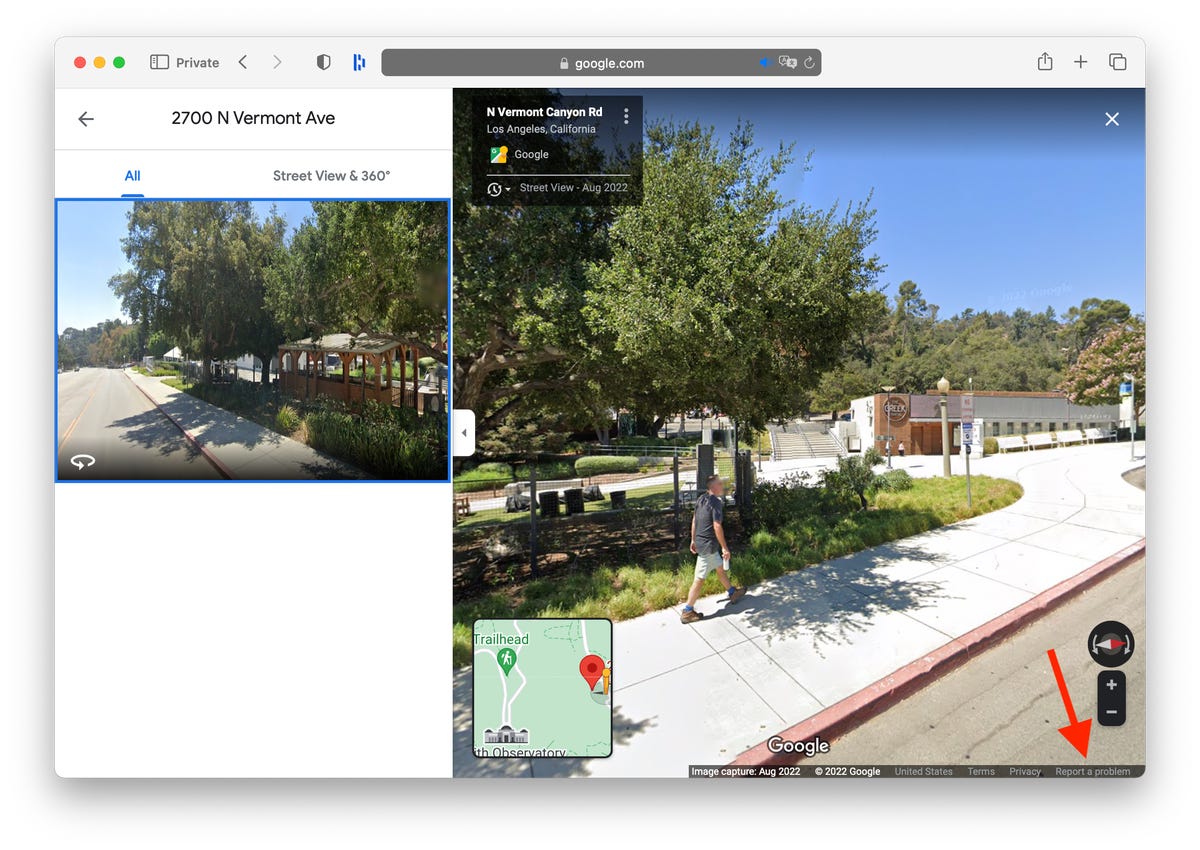
This is the Street View of your location.
Now, it’s up to you to choose what you want Google to blur. Using your mouse, adjust the view of the image so that your home and anything else you want to blur is all contained within the red and black box. Use your cursor to move around and the plus and minus buttons to zoom in and out, respectively.
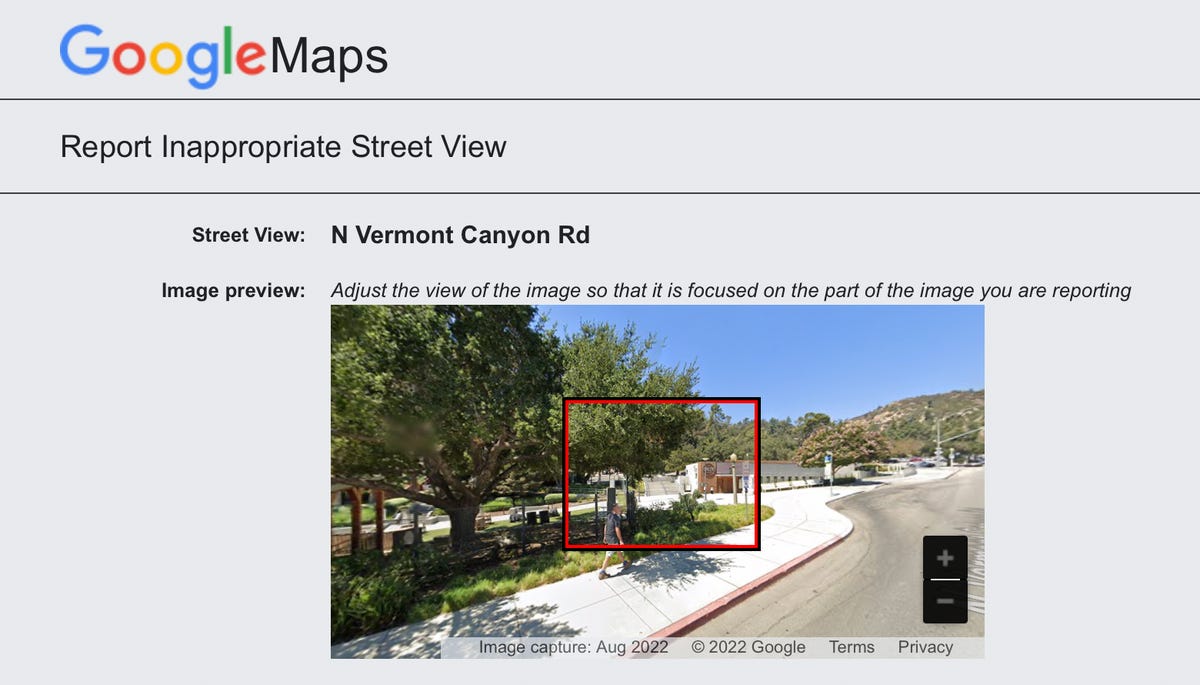
If you want to blur more than what’s in the black/red box, use the + button to zoom in.
Once you’re finished adjusting the image, choose what you’re requesting to blur underneath:
- A face.
- Your home.
- Your car/license plate.
- A different object.
You’ll be asked to give a bit more detail as to what exactly you want blurred, in case the image is busy with several cars, people and other objects.
Also, be completely sure that what you select is exactly what you want blurred. Google mentions that once you blur something on Street View, it’s blurred permanently.
Finally, enter your email (this is required), verify the captcha (if needed) and click Submit.
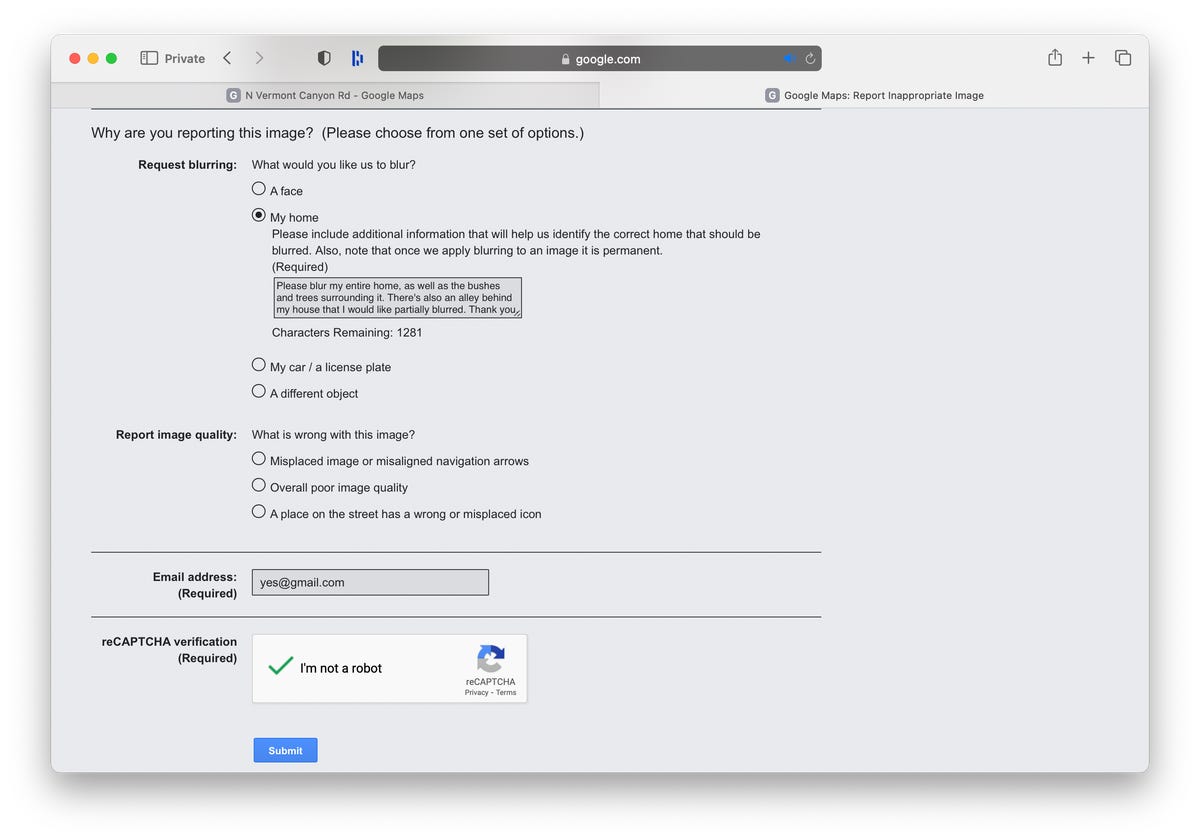
You’re required to provide additional information about what you want to blur, so be thorough.
You should then receive an email from Google that says it’ll review your report and get back to you once the request is either denied or approved. You may receive more emails from Google asking for more information regarding your request. Google doesn’t offer any information on how long your request will take to process, so just keep an eye out for any further emails.
For more, here’s how Google Maps can help you avoid crowded public transit.
Technologies
AT&T Says It’s Pumping $250 Billion Into New Infrastructure Improvements
Technologies
Apple’s New Smart Home Display Delayed Until Fall Over Siri Issues
It has been nearly a year and a half since the company announced the AI-powered product.
Your home could get smarter with Apple’s Siri, but it will have to wait a few more months. Bloomberg reported the iPad-shaped AI home hub won’t be ready until September, several months after the company was hoping to launch it this spring. Apple engineers first need to complete work on a new and improved Siri assistant for the home device, code-named J490, according to Bloomberg.
Apple was hoping to release J490 this month, along with a slew of other new devices, including the iPhone 17e, MacBook Neo, MacBook Air M5, new Pro models, and iPad Air M4. Apple first teased the smart home display in November 2024.
A representative for Apple did not immediately respond to a request for comment.
Siri is Apple’s virtual assistant that uses voice recognition and AI to fulfill a variety of tasks and commands, along with intriguing uses. You might use Siri to find your iPhone — «Hey Siri, where are you?» — or to hear the weather forecast — «Siri, what will the weather be today?» Siri is available on iPhones, MacBooks and iPads. It was launched in 2011 as a feature of the iPhone 4S.
As CNET reported last month, Apple engineers have struggled to push the upgraded Siri assistant out the door. It isn’t fast enough, gets confused by complex commands and doesn’t interact well with other Apple AI models. The company is also wrestling with how much personal data to access to inform the AI, and the new Siri is not yet able to complete in-app tasks, such as finding a photo and posting it to socials, all with one command.
It has been nearly two years since Apple announced that it would give Siri a major upgrade. In the meantime, competitors like Alexa Plus and Gemini for Home have entered the marketplace.
Tech tester Jon Rettinger, whose YouTube channel has 1.66 million subscribers, says the repeated delays in upgrading Siri can «erode» confidence in Apple’s ability to keep up in the AI race.
«Apple as a whole is still one of the strongest companies on the planet. But their AI play is clearly the weakest link in an otherwise very strong chain,» Rettinger told CNET.
Rettinger said he has had issues getting Siri to complete basic commands, such as setting two alarms at the same time, and that it’s a bit of «a mess» right now.
«Having said that, the iPhone has such massive market penetration that I’m not sure it will actually matter in the end. Which is kind of wild when you think about it,» Rettinger said.
Facial recognition for residents
The hardware for the forthcoming smart home display has already been finished. It resembles an iPad and can be either attached to a wall or rest on a half-domed-shaped base, the Bloomberg report said.
The device will be equipped with facial recognition, so when residents walk up to it, they will be shown personalized data such as music preferences, news headlines, appointments, reminders, tasks and so on.
The screen interface will include a bunch of circular app icons, similar to the display on an Apple Watch. The Bloomberg report said the smart home display will be the first of several home devices by Apple. Future products include a tabletop robotic limb with a 9-inch screen, a smart security camera and a Face ID-enabled smart doorbell.
Technologies
The Pixel 10A Is Available. Here’s How to Get Yours
-
 Technologies3 года ago
Tech Companies Need to Be Held Accountable for Security, Experts Say
-
 Technologies3 года ago
Best Handheld Game Console in 2023
-
 Technologies3 года ago
Tighten Up Your VR Game With the Best Head Straps for Quest 2
-
 Technologies4 года ago
Black Friday 2021: The best deals on TVs, headphones, kitchenware, and more
-
 Technologies5 лет ago
Google to require vaccinations as Silicon Valley rethinks return-to-office policies
-
 Technologies5 лет ago
Verum, Wickr and Threema: next generation secured messengers
-
 Technologies4 года ago
Olivia Harlan Dekker for Verum Messenger
-
 Technologies4 года ago
iPhone 13 event: How to watch Apple’s big announcement tomorrow