
Technologies
iOS 16.5 Brings These Major Security Fixes to Your iPhone
The latest iPhone software update patches a few bugs that might be actively exploited.
Though Apple announced iOS 17 at its Worldwide Developers Conference, you should still download the latest iOS update now. The tech giant released iOS 16.5 on May 18, and the update gives your device a lot of security patches and fixes, including for three security issues that might be actively exploited.

To download iOS 16.5, go to Settings > General > Software Update and follow the onscreen prompts.
The latest iPhone update patches almost 40 issues and bugs, Apple said in its patch notes, including three security issues that might be actively exploited. These three security issues relate to WebKit, the internet browser engine used in Safari and developed by Apple.
One of these issues could disclose sensitive information to a third party, and another could allow a third party to execute commands on your device without your knowledge. Fixes for these issues are in 16.5 for anyone who missed the release of the first iPhone Rapid Security Response, iOS 16.4.1 (a). The third issue could allow a third party access to more information across your device than is allowed.
The iOS update also patches an issue where someone could access your contacts from your lock screen. While Apple has provided ways to customize your lock screen, some people have run into issues where the lock screen can allow others to access some iPhone features, like replying to messages and even your Wallet.
Other patches in the update include stopping some apps from bypassing privacy preferences, blocking some apps from reading sensitive location information and preventing app termination when opening a PDF file.
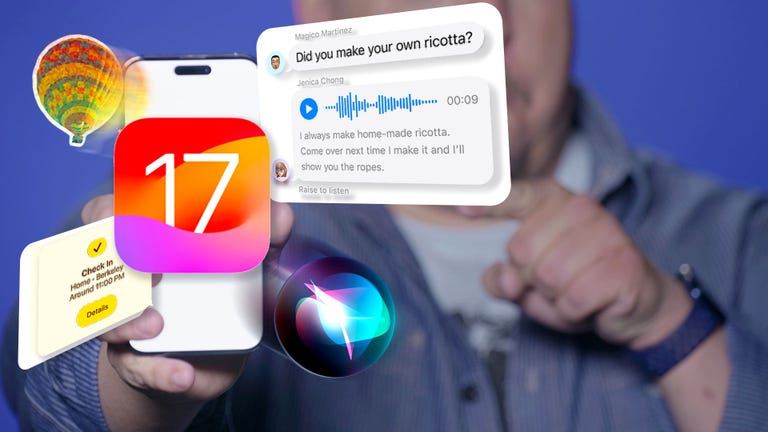
For more, you can check out what iOS 17 features I’m excited about. You can also take a look at the new features iOS 16.5 brings to your iPhone and what could be coming to your iPhone with iOS 16.6.
06:31
Technologies
Look Out Below! A 1,300-Pound NASA Satellite Is on Its Way Back to Earth
After 14 years in orbit, NASA’s Van Allen Probe A satellite is expected to begin re-entering Earth’s atmosphere on Tuesday.
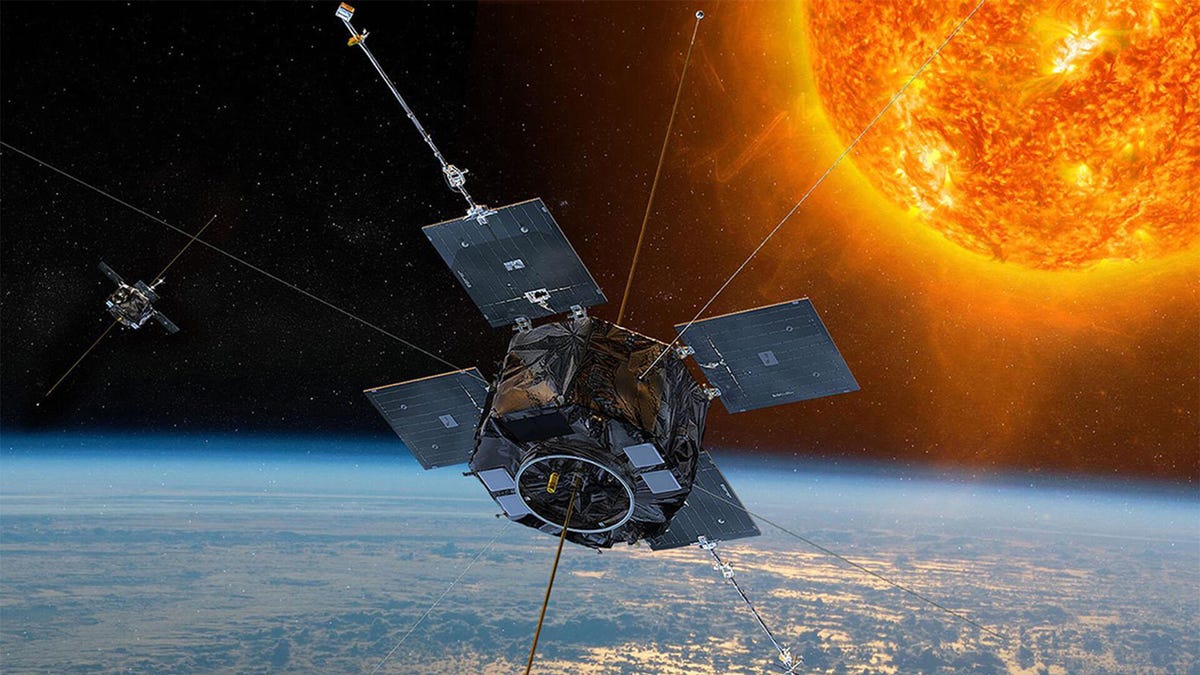
All things that go up must eventually come down. NASA expects the Van Allen Probe A satellite to come crashing back to Earth after a 14-year journey through space. The agency predicts that the probe will begin re-entry around 7:45 p.m. ET on Tuesday but says that time may be off by as much as 24 hours, meaning it could come down at any point in the next day or two.
Launched in 2012, the Van Allen Probe A is one of two satellites that NASA launched into orbit around the Van Allen radiation belt, which exists around Earth due to solar winds caught in the Earth’s magnetosphere. The probes were supposed to remain in space for only two years, but ultimately measured radiation for seven years before running out of fuel in 2019. Without fuel, the probes couldn’t orient themselves toward the sun to power their solar panels, and both shut down.
Once the mission ended, NASA originally calculated the probes would fall back to Earth sometime in 2032. The agency admits it did not account for the current solar maximum. The solar maximum is a period of increased instability on the sun, which leads to more intense space weather events. NASA says the extra solar wind caused drag on the probe, hastening its descent faster than initial calculations predicted.
Data from these probes is still used today to measure and predict the impact of solar winds and radiation on communications systems, navigation satellites, power grids and even astronauts in space. The radiation that the Van Allen Probes studied is also the same radiation responsible for all of those gorgeous auroras Earth has been getting lately.
Will the probe hurt anyone when it comes back?
NASA says that most of the spacecraft will likely burn up as it re-enters the atmosphere, but some components are expected to survive the trip back to Earth.
The components probably won’t hit anyone. NASA says the current odds of the debris causing harm to humans are about one in 4,200, which is minimal. The Space Force will continue to monitor Van Allen Probe A’s progress through the day in case those odds change.
The probe’s partner, Van Allen Probe B, is also scheduled to crash back into Earth, but it isn’t expected to arrive until sometime after 2030.
Technologies
AT&T Says It’s Pumping $250 Billion Into New Infrastructure Improvements
Technologies
Apple’s New Smart Home Display Delayed Until Fall Over Siri Issues
It has been nearly a year and a half since the company announced the AI-powered product.
Your home could get smarter with Apple’s Siri, but it will have to wait a few more months. Bloomberg reported the iPad-shaped AI home hub won’t be ready until September, several months after the company was hoping to launch it this spring. Apple engineers first need to complete work on a new and improved Siri assistant for the home device, code-named J490, according to Bloomberg.
Apple was hoping to release J490 this month, along with a slew of other new devices, including the iPhone 17e, MacBook Neo, MacBook Air M5, new Pro models, and iPad Air M4. Apple first teased the smart home display in November 2024.
A representative for Apple did not immediately respond to a request for comment.
Siri is Apple’s virtual assistant that uses voice recognition and AI to fulfill a variety of tasks and commands, along with intriguing uses. You might use Siri to find your iPhone — «Hey Siri, where are you?» — or to hear the weather forecast — «Siri, what will the weather be today?» Siri is available on iPhones, MacBooks and iPads. It was launched in 2011 as a feature of the iPhone 4S.
As CNET reported last month, Apple engineers have struggled to push the upgraded Siri assistant out the door. It isn’t fast enough, gets confused by complex commands and doesn’t interact well with other Apple AI models. The company is also wrestling with how much personal data to access to inform the AI, and the new Siri is not yet able to complete in-app tasks, such as finding a photo and posting it to socials, all with one command.
It has been nearly two years since Apple announced that it would give Siri a major upgrade. In the meantime, competitors like Alexa Plus and Gemini for Home have entered the marketplace.
Tech tester Jon Rettinger, whose YouTube channel has 1.66 million subscribers, says the repeated delays in upgrading Siri can «erode» confidence in Apple’s ability to keep up in the AI race.
«Apple as a whole is still one of the strongest companies on the planet. But their AI play is clearly the weakest link in an otherwise very strong chain,» Rettinger told CNET.
Rettinger said he has had issues getting Siri to complete basic commands, such as setting two alarms at the same time, and that it’s a bit of «a mess» right now.
«Having said that, the iPhone has such massive market penetration that I’m not sure it will actually matter in the end. Which is kind of wild when you think about it,» Rettinger said.
Facial recognition for residents
The hardware for the forthcoming smart home display has already been finished. It resembles an iPad and can be either attached to a wall or rest on a half-domed-shaped base, the Bloomberg report said.
The device will be equipped with facial recognition, so when residents walk up to it, they will be shown personalized data such as music preferences, news headlines, appointments, reminders, tasks and so on.
The screen interface will include a bunch of circular app icons, similar to the display on an Apple Watch. The Bloomberg report said the smart home display will be the first of several home devices by Apple. Future products include a tabletop robotic limb with a 9-inch screen, a smart security camera and a Face ID-enabled smart doorbell.
-
 Technologies3 года ago
Tech Companies Need to Be Held Accountable for Security, Experts Say
-
 Technologies3 года ago
Best Handheld Game Console in 2023
-
 Technologies3 года ago
Tighten Up Your VR Game With the Best Head Straps for Quest 2
-
 Technologies4 года ago
Black Friday 2021: The best deals on TVs, headphones, kitchenware, and more
-
 Technologies5 лет ago
Google to require vaccinations as Silicon Valley rethinks return-to-office policies
-
 Technologies5 лет ago
Verum, Wickr and Threema: next generation secured messengers
-
 Technologies4 года ago
Olivia Harlan Dekker for Verum Messenger
-
 Technologies4 года ago
iPhone 13 event: How to watch Apple’s big announcement tomorrow