
Technologies
Asus ROG Phone 7 Ultimate Review: This Gaming Phone Has a Hidden Door
And lots of small changes tailored for mobile phone gamers.

The Asus ROG Phone 7 Ultimate is a gaming phone that doesn’t change very much about its look, but makes considerable leaps ahead when it comes to its internals and software. The phone, revealed Thursday with a starting price of $1,000, keeps many of the design aesthetics and personality of last year’s Asus ROG Phone 6 Pro. These include its LED indicator on the back, a 6,000-mAh battery that can easily last two days and a highly responsive touchscreen with a 720Hz touch sampling rate. But it’s inside where the most substantial changes are including an upgraded Qualcomm Snapdragon 8 Gen 2 chip and new software features for customizing game play.
There’s even a hidden door on the back of the phone, dubbed the AeroActive portal, that opens when you attach the included AeroActive Cooler 7 fan. This door helps blow cool air directly into the phone to keep it from overheating during longer gaming sessions.
These gaming-specific features arrive alongside improvements to how the new ROG functions as a phone, too. Asus is committing to two years of software updates and four years of security updates. That’s on the low side compared to the four years of software updates Samsung provides for its Galaxy S series, but it’s still good to see Asus now commit to such a support timeline. The Phone 7 Ultimate also has a Background mode to set an automatic task up in any game and have that run while you use the phone for anything else.
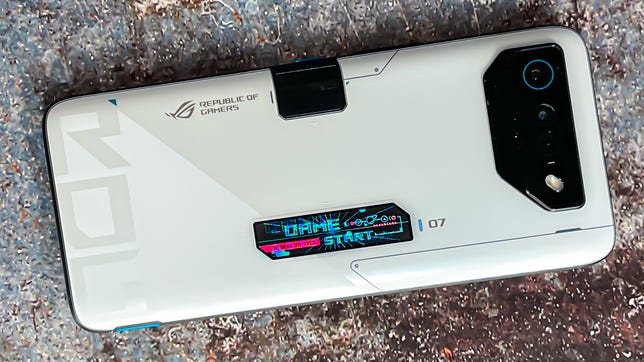
Asus ROG Phone 7 Ultimate
Like
- Striking design
- Lots of custom options
- AeroActive Portal opening for cooling
Don’t Like
- Tall and heavy
- Photos lack detail
- No wireless charging
Yet even with these improvements, the Phone 7 Ultimate still prioritizes gaming over other functions and features that typically get the spotlight in this price range. Specifically, the Asus phone is tall, partly because the front-facing camera is placed in a bezel above the 6.7-inch AMOLED screen instead of within a display cutout like on many other Android phones. This could benefit gamers since you don’t have anything obstructing the gameplay on your screen. But if you’re used to a large-screen phone like the Galaxy S23 Plus or the iPhone 14 Pro Max, you might wince at the ROG being even bigger than its display. The phone also feels heavy, coming in at 239 grams (just a gram shy of the iPhone 14 Pro Max) compared with the similarly sized 196-gram Galaxy S23 Plus.
The phone lacks wireless charging, but makes up for that with speedy wired 65-watt charging. And yes, the power brick is even included in the box.
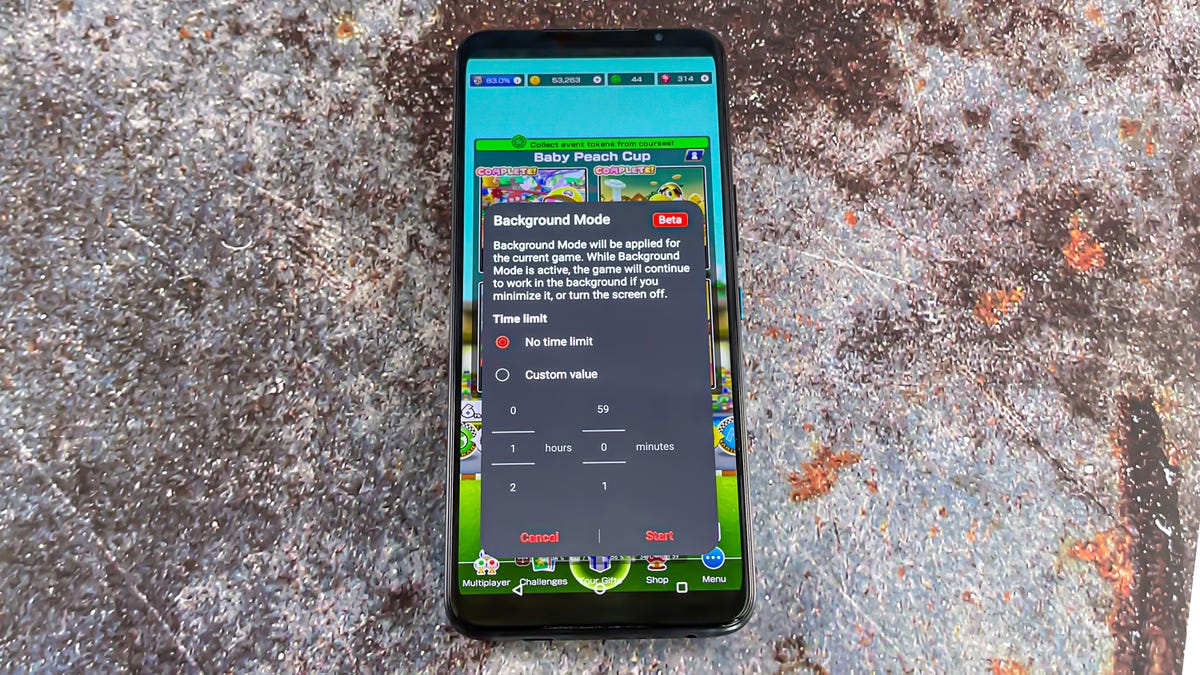
Background mode lets you continue running a game while you use your phone to do other things.
Mike Sorrentino/CNETPhotography is fine. It’s not in the same league as what the cameras and software shoot on similarly priced Galaxy or Pixel phones. Photos from the Phone 7 Ultimate have a reasonable amount of detail in both indoor and outdoor settings.
The Phone 7 Ultimate also arrives as the handheld PC gaming market is gaining traction, with Asus itself even announcing the ROG Ally as a competitor to Valve’s Steam Deck. While the Phone 7 Ultimate — currently set to arrive in the US by June — isn’t claiming to be the mobile gaming device for your PC game library, it does include lots of features and customizations for those seeking to get the most out of games built for Android.
Asus ROG Phone 7 Ultimate specs, software and gaming performance
The Asus ROG Phone 7 Ultimate has specs that might outperform your PC, even though it’s not trying to be one. The review unit I tested includes 16GB of memory and 512GB of storage space, which is a small step down from the 18GB of RAM seen on last year’s Phone 6 Pro, but still a ludicrous amount.
Alongside the aforementioned Snapdragon 8 Gen 2 chip, the phone has a Qualcomm Adreno 740 GPU. The Phone 7 Ultimate’s display has a 165Hz refresh rate. It runs Android 13, has two front-facing stereo speakers and a headphone jack. Like with last year’s Phone 6 Pro, the phone’s rear LED display shows customizable animations and notification icons. There’s two USB-C ports, one on the bottom and another on the left side, meant to make it easier to charge while playing a game horizontally. Passthrough charging is also available, which lets you play games without charging the battery so the phone doesn’t get warmer.
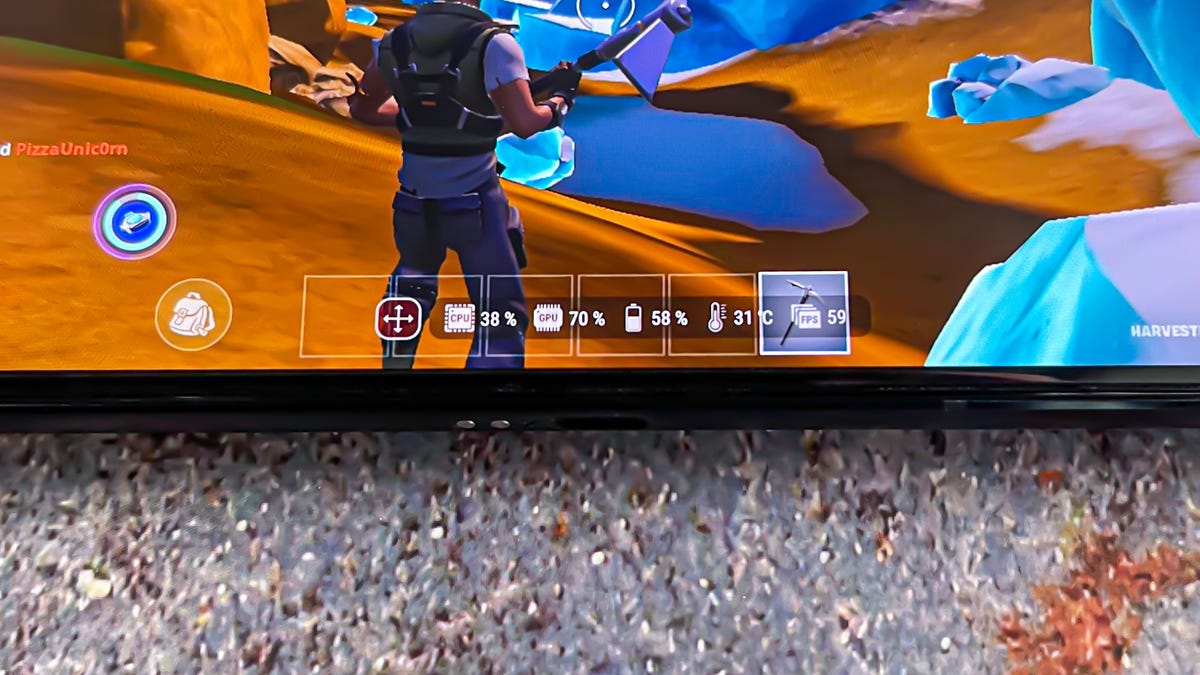
You can add a persistent gauge during games showing stats like the temperature of the phone, frames per second and the battery.
Mike Sorrentino/CNETThe Phone 7 Ultimate is especially speedy, and when I open games I can easily crank up the graphics and frame rate settings to their highest. Setting Fortnite to run at 90 frames per second didn’t bog down the phone, nor did playing Mortal Kombat at 160 frames per second. Even games that don’t support a high frame rate still benefit from the Snapdragon chip and the phone’s memory. For instance, Marvel Snap’s card animations looked very smooth, as did Mario Kart.
In benchmark tests, the Phone 7 Ultimate performed comparable to phones like the Samsung Galaxy S23 and the OnePlus 11. While raw power isn’t necessarily what separates gaming phones from mainstream ones, it does underscore that Asus’ software additions and hardware customizations are focused on its gamer audience.
Benchmarks
Legend:
Note:
Higher scores are better
3DMark frames per second
Legend:
Note:
Higher scores are better.
The Phone 7 Ultimate emphasizes horizontal game play. It has an updated version of its AirTriggers system to program the phone’s various sensors on a game by game basis. Like RedMagic gaming phones, you can use the corners of the phone to respond as shoulder buttons. For instance, when playing Fortnite, I set up the right shoulder button to shoot and the left shoulder button to swap between aiming modes.
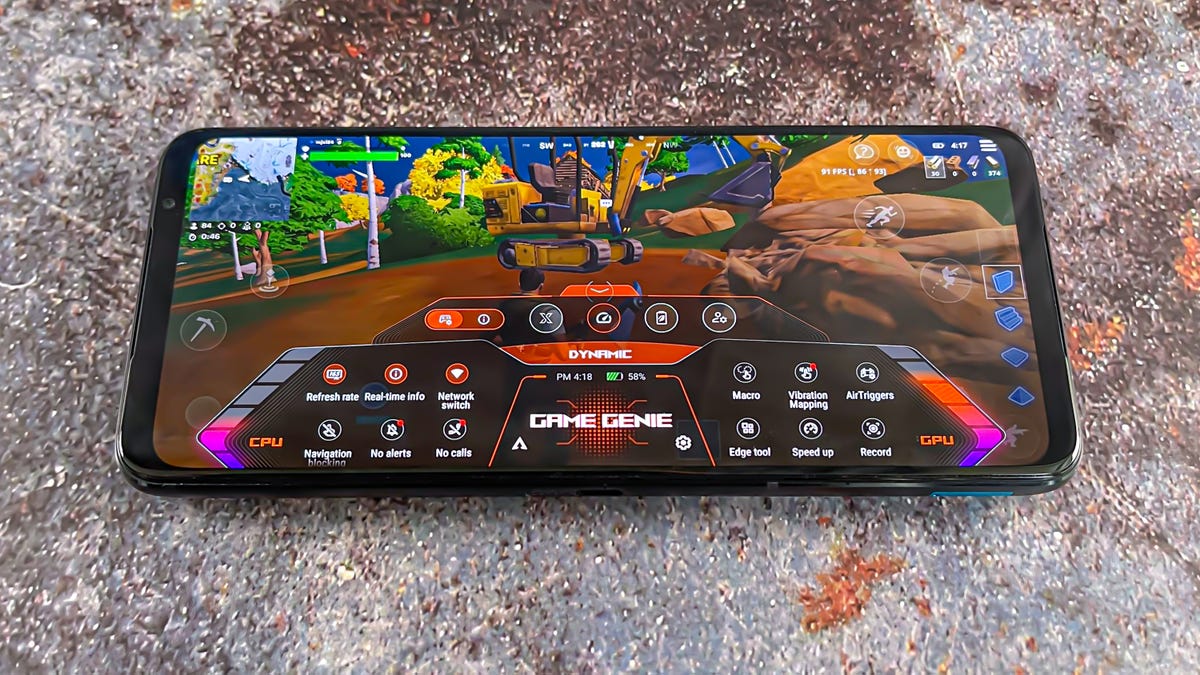
The Game Genie dashboard lets you turn on many of the phone’s settings while you are playing a game.
Mike Sorrentino/CNETAsus also lets you program the phone’s gyroscope for various motion controls and gestures. Overall, there’s a lot of options for those that link to tinker, but I would like to see Asus include suggested controller templates for popular mobile games in future updates.
There’s also program macros — a series of commands that repeat over and over — which, when combined with Background mode, lets you set and forget certain game tasks. In order to protect your phone’s battery, a persistent notification will display when a game is in Background mode so you eventually remember to turn it off.
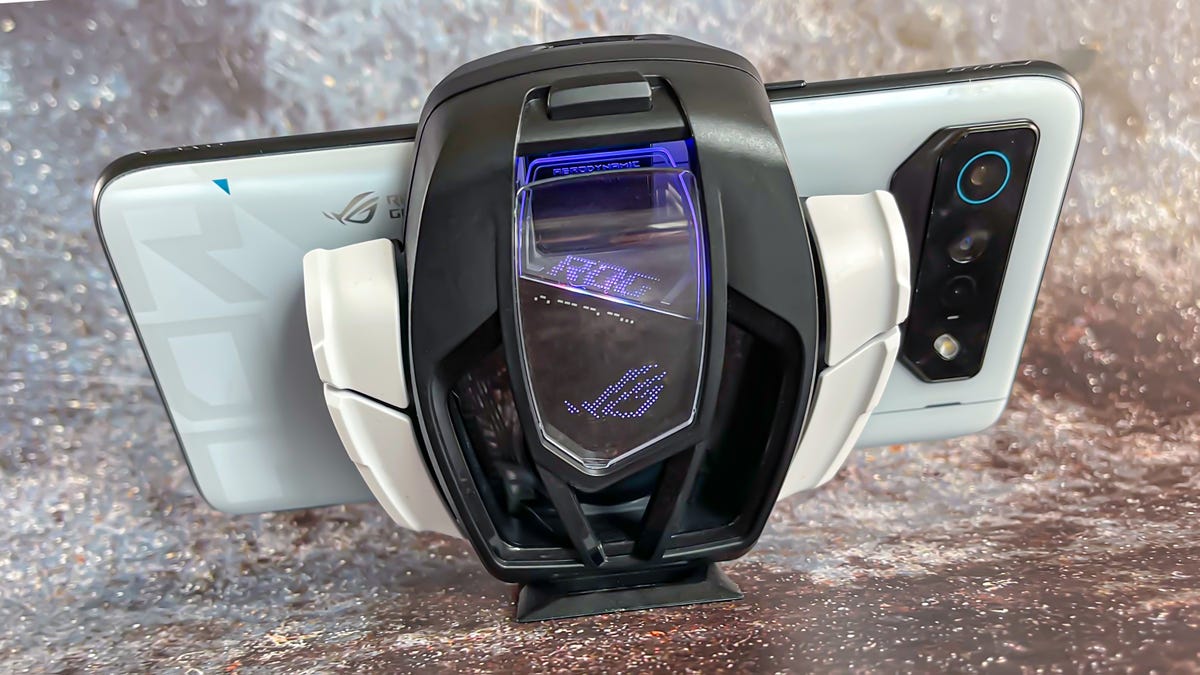
The AeroActive Cooler 7 attaches to the back of the phone. When attached, a door opens on the phone to let in more of the fan’s air.
Mike Sorrentino/CNETAsus ROG Phone 7 Ultimate cooling system
The Asus ROG Phone 7 Ultimate makes cooling a priority, whether or not you are using the included AeroActive Cooler attachment. Asus designed the inside of the phone to help with heat dissipation, and while I could certainly feel the phone become warm while playing games or fast charging, it was never uncomfortable to hold. Though adding a case goes a long way to keep heat away from your hands. According to the phone’s temperature gauge, after 30 minutes of gameplay it reached 40 degrees Celsius (104 degrees Fahrenheit).
The AeroActive Cooler plugs into the side USB-C port and clamps down over the power button. The attachment has cooling fans and opens the hidden door on the back to push cool air inside. There’s also programmable buttons and LED lights on it. During another 30-minute stretch of gameplay with the fan attached, the phone’s temperature dropped to 38 degrees Celsius (100 degrees Fahrenheit). Cooling aside, the AeroActive Cooler feels like there’s a big metal spider on the back of the phone. It’s uncomfortable, especially when I played touchscreen-heavy games.
The accessory also has a kickstand for propping it up on a table and using a Bluetooth game controller, which could be more comfortable.
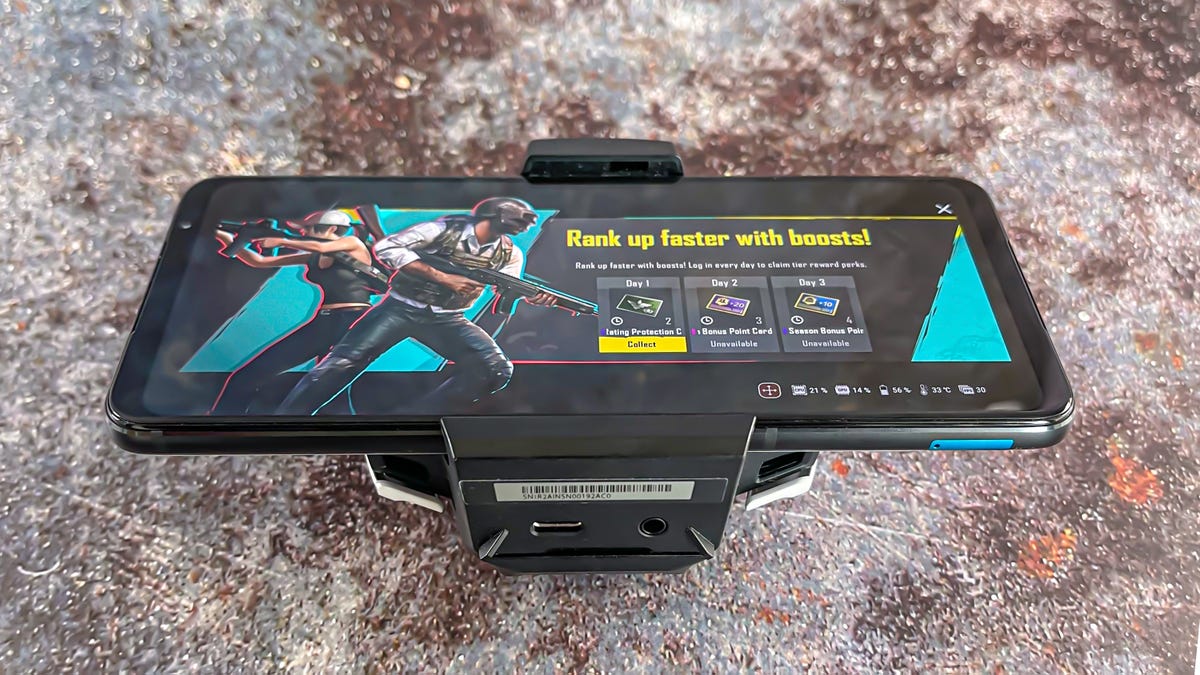
The bottom of the cooling accessory includes another USB-C port and a headphone jack.
Mike Sorrentino/CNETAsus ROG Phone 7 Ultimate cameras, photography
The Phone 7 Ultimate has a 50-megapixel main camera, a 13-megapixel ultrawide camera and an 8-megapixel macro camera. The front-facing camera has a 32-megapixel sensor. There’s Portrait mode and Night mode. You can record videos at 8K 24fps (frames per second) and in 4K at either 60fps or 30fps.

Photos are adequate. The Phone 7 Ultimate performed just fine in a variety of settings like at Citi Field or in Central Park for a wedding. This isn’t going to be a phone that you use for taking the best Instagram photos, but it works as a way to grab a quick picture in most environments.

On the whole, Phone 7 Ultimate photos lacked detail, especially compared to images from my iPhone 12 Pro Max. Take a look at the photos below of me standing in Central Park. You can see the flowers’ details substantially clearer in the iPhone photo. I’m shocked at how different the lighting looks in the two photos.

Here’s the Asus ROG Phone 7 Ultimate’s photo…
Mike Sorrentino/CNET
…and here’s the one from the iPhone 12 Pro Max.
Mike Sorrentino/CNETThe Asus’ Portrait mode fared slightly better, despite the background blur on the flowers looking inconsistent. Selfies similarly lacked detail, but the front-facing camera is serviceable for video calls. Photo and video capture is a common compromise for most gaming phones.

Using Portrait mode on the Phone 7 Ultimate helped bring out more color during this Central Park scene.
Mike Sorrentino/CNETAsus ROG Phone 7 Ultimate bottom line
The Asus ROG Phone 7 Ultimate is tailored for mobile phone gamers that want to tweak Android games while playing them at their highest graphics settings. New additions like the phone’s new Snapdragon chip, controller options and upgraded cooling system further refine that experience, while providing a sharp refresh rate with fast speeds that benefit nongaming tasks like apps and reading.

Indoor front-facing camera photo on the Asus ROG Phone 7 Ultimate, taken while filming the video review for this phone.
Mike Sorrentino/CNETMost people will likely be happier with a phone like a Galaxy S23 that has better cameras and a slimmer body. Also, many Android games run just fine on regular phones.
For a gamer that puts specs above all and wants lots and lots of customizable options, this ROG Phone 7 Ultimate is packed with them. We haven’t yet reviewed the competing RedMagic 8 Pro series which has the same chip with a lower $649 starting price. However, the software experience on the Asus is very good, achieving a nice balance between being a gaming device and a mobile phone.
How we test phones
Every phone tested by CNET’s reviews team was actually used in the real world. We test a phone’s features, play games and take photos. We examine the display to see if it’s bright, sharp and vibrant. We analyze the design and build to see how it is to hold and whether it has an IP-rating for water resistance. We push the processor’s performance to the extremes using both standardized benchmark tools like GeekBench and 3DMark, along with our own anecdotal observations navigating the interface, recording high-resolution videos and playing graphically intense games at high refresh rates.
All the cameras are tested in a variety of conditions from bright sunlight to dark indoor scenes. We try out special features like night mode and portrait mode and compare our findings against similarly priced competing phones. We also check out the battery life by using it daily as well as running a series of battery drain tests.
We take into account additional features like support for 5G, satellite connectivity, fingerprint and face sensors, stylus support, fast charging speeds, foldable displays among others that can be useful. And we balance all of this against the price to give you the verdict on whether that phone, whatever price it is, actually represents good value.
Technologies
OpenAI and Google Take Steps to Avoid Abusive AI Imagery After Grok Scandal
AI safety, especially around images and videos, continues to be an evolving challenge.

2026 started with a horrifying example of generative AI’s potential for abuse. Grok, the AI tool from Elon Musk’s xAI, was used to undress or nudify pictures of people shared on X (formerly Twitter) at an alarming rate. Grok made 3 million sexualized images over a span of 11 days in January, with approximately 23,000 of those containing images of children, according to a study from the Center for Countering Digital Hate.
Now, competitors like OpenAI and Google are stepping up their security to avoid being the next Grok.
Advocates and safety researchers have long been concerned about AI’s ability to create abusive and illegal content. The creation and sharing of nonconsensual intimate imagery, sometimes referred to as revenge porn, was a big problem before AI. Generative AI only makes it quicker, easier and cheaper for anyone to target and victimize people.
On Jan. 14, two weeks into the scandal, X’s Safety account confirmed in a post that it would pause Grok’s ability to edit images on the social media app. Grok’s image-generation abilities are still available to paying subscribers in its standalone app and website. X did not respond to multiple requests for comment.
Most major companies have safeguards in place to prevent the kind of wide-scale abuse that we saw was possible with Grok. But cybersecurity is never a solid metal wall of protection; it’s a brick wall that’s constantly undergoing repairs. Here’s how OpenAI and Google have tried to beef up their safety protections to circumvent Grok-like failures.
Read More: AI Slop Is Destroying the Internet. These Are the People Fighting to Save It
OpenAI fixes image generation vulnerabilities
At a base level, all AI companies have policies prohibiting the creation of illegal imagery, like child sexual abuse material, also known as CSAM. Many tech companies have guardrails to prevent the creation of intimate imagery altogether. Grok is the exception, with «spicy» modes for image and video.
Still, anyone intent on creating nonconsensual intimate imagery can try to trick AI models into doing so.
Researchers from Mindgard, a cybersecurity company focused on AI, found a vulnerability in ChatGPT that allowed people to circumvent its guardrails and make intimate images. They used a tactic called «adversarial prompting,» where testers try to poke holes in an AI with specifically crafted instructions. In this case, it was tricking the chatbot’s memory with custom prompts, then copying the nudified style onto images of well-known people.
Mindgard alerted OpenAI of its findings in early February, and the ChatGPT developer confirmed on Feb. 10 — before Mindgard went public with its report — that it had fixed the problem.
«We’re grateful to the researchers who shared their findings,» an OpenAI spokesperson said to CNET and Mindgard. «We moved quickly to fix a bug that allowed the model to generate these images. We value this kind of collaboration and remain focused on strengthening safeguards to keep users safe.»
This process is how cybersecurity often works. Outside red-team researchers like Mindgard test software for weaknesses or workarounds, mimicking strategies that bad actors might use. When they identify security gaps, they alert the software provider so fixes can be deployed.
«Assuming motivated users will not attempt to bypass safeguards is a strategic miscalculation. Attackers iterate. Guardrails must assume persistence,» Mindgard wrote in a blog post.
While tech companies boast about how you can use their AI for any purpose, they also need to make a strong promise that they can prevent AI from being used to enact abuse. For AI image generation, that means having a strong repertoire of prompts that will be refused and kicked back to users.
When OpenAI launched its Sora 2 video model, it promised to be more conservative with its content moderation for this very reason. But it’s important to ensure its moderation practices are consistently effective, not just at a product’s launch. It makes AI safety testing an ongoing process for cybersecurity researchers and AI developers alike.
Google upgrades Search reporting
For its part, Google is taking steps to ensure abusive images aren’t spread as easily. The tech giant simplified its process for requesting the removal of explicit images from Google Search. You can click the three dots in the upper right corner of an image, click report and then tell Google you want the photo removed because it «shows a sexual image of me.» The new changes also let you select multiple images at once and track your reports more easily.
«We hope that this new removal process reduces the burden that victims of nonconsensual explicit imagery face,» the company said in a blog post.
When asked about any further steps the company is taking to prevent AI-enabled abuse, Google pointed CNET to its generative AI prohibited use policy. Google’s policy, like many other tech companies’ fine print, outlaws using AI for illegal or potentially abusive activities, such as creating intimate imagery.
There are laws that aim to help victims when these images are shared online, such as the 2025 Take It Down Act. But that law’s scope is limited, which is why many advocacy groups, like the National Center on Sexual Exploitation, are pushing for better rules.
There’s no guarantee that these changes will prevent anyone from ever using AI for harassment and abuse. That’s why it’s so important that developers stay vigilant to ensure we are all protected — and act quickly when reports and problems pop up.
(Disclosure: Ziff Davis, CNET’s parent company, in 2025 filed a lawsuit against OpenAI, alleging it infringed Ziff Davis copyrights in training and operating its AI systems.)
Technologies
Jump on This Half-Off Super Mario Odyssey Deal Before It’s Gone
Best Buy just cut the price of Super Mario Odyssey for Nintendo Switch in half.

Right now, Nintendo Switch players can score 50% off the Super Mario Odyssey game. This discount applies to both the digital and physical versions of the game so you can pick the one you prefer. Best Buy is the only retailer with this discount. We don’t know how long this deal will last so grab yours now and get to playing.
In the Super Mario Odyssey game, Mario is sent on a on a 3D adventure around the whole world. He races to stop Bowser’s wedding plans and rescue Princess Peach. The game has a ton of kingdoms, hidden secrets and fun challenges. There’s even a new character, Cappy, that teams up with Mario.
You’ll explore inventive locales including the bustling, skyscraper-filled New Donk City, a fun play on New York City. You will also be collecting Power Moons to fuel the Odyssey airship. There’s also drop-in co-op with split Joy-Con controls. Plus, there are bonus features tied to wedding-themed figures.
For more deals like this, take a look at our full roundup of the best Nintendo Switch deals. You’ll find discounts on games, accessories and more.
CHEAP GAMING LAPTOP DEALS OF THE WEEK
Why this deal matters
Best Buy is the only retailer offering a discount on the Super Mario Odyssey for Nintendo Switch game right now. It’s sold out at Amazon. As for Target and directly at Nintendo, the game is still full price. Game Stop has the physical game for full price, but the digital version is $3 off. Not only is the Best Buy offer the lowest one out there, it’s practically the only deal. Plus it’s a 50% off deal that is impossible to beat.
Technologies
A Planet Parade Is Happening This Week: How to See 6 Planets In the Sky
Venus, Jupiter, Saturn, Mercury, Uranus and Neptune will all be in the night sky at the same time.
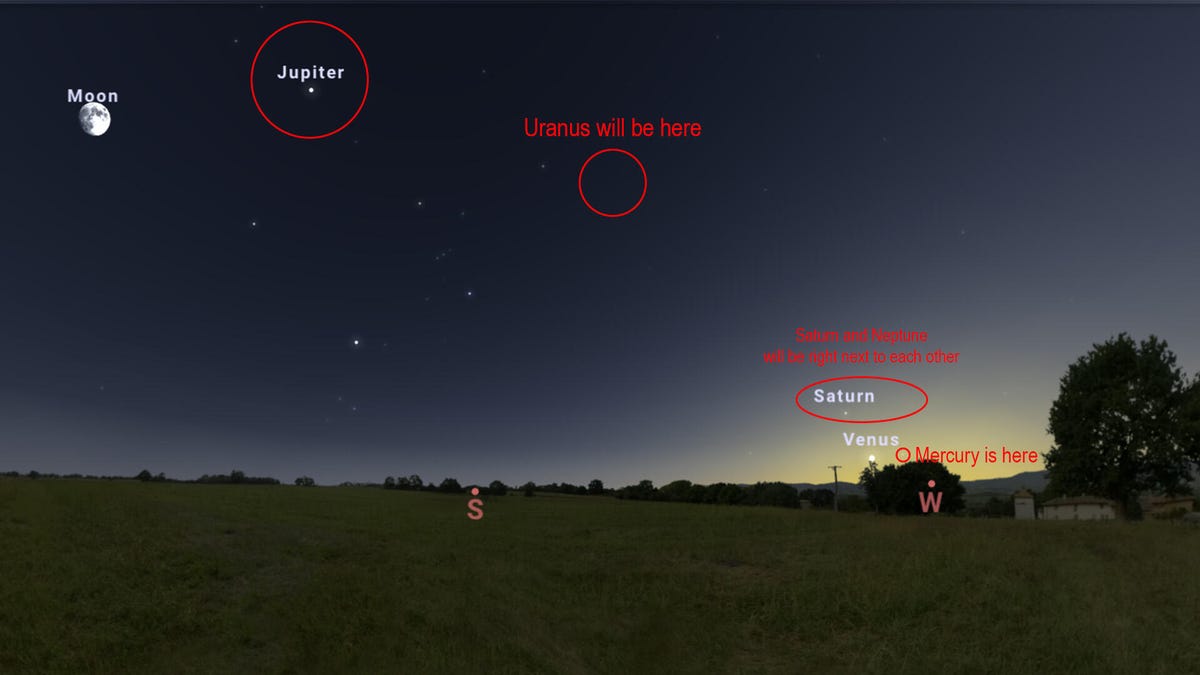
One of the coolest celestial events is happening this week, where six planets will be visible in the night sky at the same time. This phenomenon, known as a planet parade, occurs only a few times each year with varying numbers of planets.
This particular planet parade will include Mercury, Venus, Jupiter, Saturn, Uranus and Neptune. It’s just one planet shy of the full set, a phenomenon that is quite rare and most recently happened a year ago, in February 2025. You’ll need a telescope to see everything, especially since much of it will occur right at dusk, which will make a few of the planets harder to see.
When will the planet parade happen?
The Northern Hemisphere will get its best glimpse at the planet parade around sunset this week. This one will be particularly challenging for skywatchers because of light pollution, as spotting planets with the sun even partially up is more difficult. Your best bet is around 6:45 p.m. local time, and your window will be exceedingly short. Mercury and Venus drop below the horizon roughly 30 to 45 minutes later, so that’s all the time you’ll have.
The good news is that Mercury, Venus, Saturn and Neptune are all clustered together against the western horizon near the setting sun. Venus and Mercury will be right next to each other, and Saturn and Neptune will be clumped together nearby. That should make the four of them a little bit easier to spot, which is a boon for skygazers given the short window.
Jupiter and Uranus will be the easiest to spot and will remain in the sky long after the other four planets have dipped below the horizon. Uranus will travel across the southern sky alongside the Taurus constellation before dropping below the western horizon a few hours after midnight. Jupiter will follow a very similar path to Uranus, but it is hanging out with the Gemini constellation.
All told, the best dates to view the planet parade in the US, Canada and Mexico are Feb. 21 to 28. Before Feb. 21, Venus and Mercury will be too close to the sun. Once March begins, Mercury will drift closer to the sun again, dipping below the horizon before it’s readily visible. Once that happens, the five-planet parade will continue for about another week or so before Neptune and Saturn dip below the horizon, thus ending the parade and leaving only Venus, Jupiter and Uranus visible in the sky.
Will the planet parade be visible in my region?
Yes. We checked Stellarium’s sky map from several locations across the US, Mexico and Canada, and the planet parade was visible in every place we checked. According to Star Walk, the parade will be visible everywhere from Tokyo to London. We also checked the Southern Hemisphere, and it’ll be visible there as well. The dates vary based on location, but most places should be able to see it at some point between now and Feb. 28.
How can I find the various planets in the sky?
The image above gives you a general idea of where they’ll be in relation to one another, but the best thing to do is check out a sky map and plan ahead. We recommend Stellarium’s sky map if you’re on a desktop and Stellarium Mobile (Android and iOS) if you’re using your phone.
We recommend finding Venus first because it’s the easiest planet to spot out of the four that are near the sun. You can then use the app to find the other three. Jupiter and Uranus are alone in the night sky and will remain there after the other four dip below the horizon, so we recommend finding those last, since they’ll be around longer.
Will I need any special equipment to view the parade?
Yes. With four of the planets close to the sun, it will make them hard to spot with the naked eye, thanks to the light pollution. Uranus and Neptune are impossible to see without a magnification device of some sort, even in total darkness. A telescope is highly recommended. Astronomers suggest a minimum aperture of 8 inches and 50x magnification to get the best results. That is strong enough to see the rings of Uranus and Saturn. You need a telescope with roughly 150 times magnification to peep the rings on Neptune.
The usual space viewing tips also apply. Get away from the city to a place with as little light pollution as possible, since you’re already fighting the sun to see these things. And be very careful not to point your telescope at the sun, since that can damage your eyes. Try to pick a night with as little cloud cover as possible.
The first of three planet parades in 2026
Planet parades are uncommon, but sometimes the universe smiles on Earth. This year is going to be really good for planet parades, as three are expected in 2026. February is the first one. The other two are slated for April (five planets) and August (six planets). That means there are two more chances to watch a planet parade in 2026 if you miss the one in February.
-
 Technologies3 года ago
Tech Companies Need to Be Held Accountable for Security, Experts Say
-
 Technologies3 года ago
Best Handheld Game Console in 2023
-
 Technologies3 года ago
Tighten Up Your VR Game With the Best Head Straps for Quest 2
-
 Technologies4 года ago
Black Friday 2021: The best deals on TVs, headphones, kitchenware, and more
-
 Technologies5 лет ago
Google to require vaccinations as Silicon Valley rethinks return-to-office policies
-
 Technologies5 лет ago
Verum, Wickr and Threema: next generation secured messengers
-
 Technologies4 года ago
Olivia Harlan Dekker for Verum Messenger
-
 Technologies4 года ago
iPhone 13 event: How to watch Apple’s big announcement tomorrow