
Technologies
10 Mac Hacks You Should Know About
Make life easier with these Mac shortcuts and hidden features.
MacOS is considered easier to use than other operating systems such as Windows and Linux, according to the digital inclusion consultancy Digital Unite. If you’re one of the millions of Mac users, you’ve probably come across a few MacOS features that have surprised you. There are plenty of hidden features in the operating system that Mac users might not know about, like taking a screen recording on your Mac without having to install additional software.

Here are 10 Mac features, tips and tricks you don’t want to miss out on.
Use Split View
Split View lets you have two apps running side-by-side on one Mac screen without having to resize either window. This saves you from switching between apps and losing your place if you’re working in two different programs.
Here’s how to enable and turn off Split View.
1. Open two apps and place them on opposite sides of the screen.
2. In the top left corner of one app’s window, hover over, or click, the green bubble to open a dropdown menu.
3. Select either Tile Window to the Left of Screen or Tile Window to the Right of Screen. That app will fill that side of the screen.
4. Click the other app on the opposite side of the screen for the app to fill the remainder of the screen.
To exit Split View, click the green bubble again or press Esc on your keyboard. This only exits one app from Split View — the other app will now be in full screen mode on its own Desktop.
Force quit with Option
If an app on your Mac has frozen or isn’t working properly, you can use the Option key to quickly force quit the app. Press and hold Option, then in the dock across the bottom of your screen click with two fingers the app causing you issues. Then click Force Quit to shut down the malfunctioning app.
Use Spotlight for conversions and simple math

Spotlight can make conversions and solve simple math problems.
Screenshot by Zach McAuliffe/CNETYou can use your Mac’s built-in Spotlight feature to perform searches as well as conversions or do simple math. To open Spotlight, press Command + space bar or click the magnifying glass icon in the top right corner of your screen in the menu bar. Then, type in a math problem or what you want to convert — like gallons to liters — and Spotlight will do the rest. No Google needed.
Try different shortcuts to take a screenshot
Screenshots are an easy way to maintain receipts for digital purchases or have extra copies of tickets for flights or sports games. On a Mac, there are a few different shortcuts to take screenshots.
Pressing Command + Shift + 3 takes a screenshot of your entire screen. This is a useful way to screenshot a video quickly so you don’t miss a frame.
Press Command + Shift + 4 turns your mouse into a crosshair. This lets you click and drag the frame for your screenshot part of your screen or an app’s window.
If you press Command + Shift + 4 and then press your space bar, your mouse turns into a camera icon and it can take screenshots of the window, application or other element your mouse is over. When your mouse is over a specific element for a screenshot, that element will have a light-blue filter over it to show it’s being selected. Taking a screenshot this way also makes the screenshot look cleaner and gives it a nice shadow.
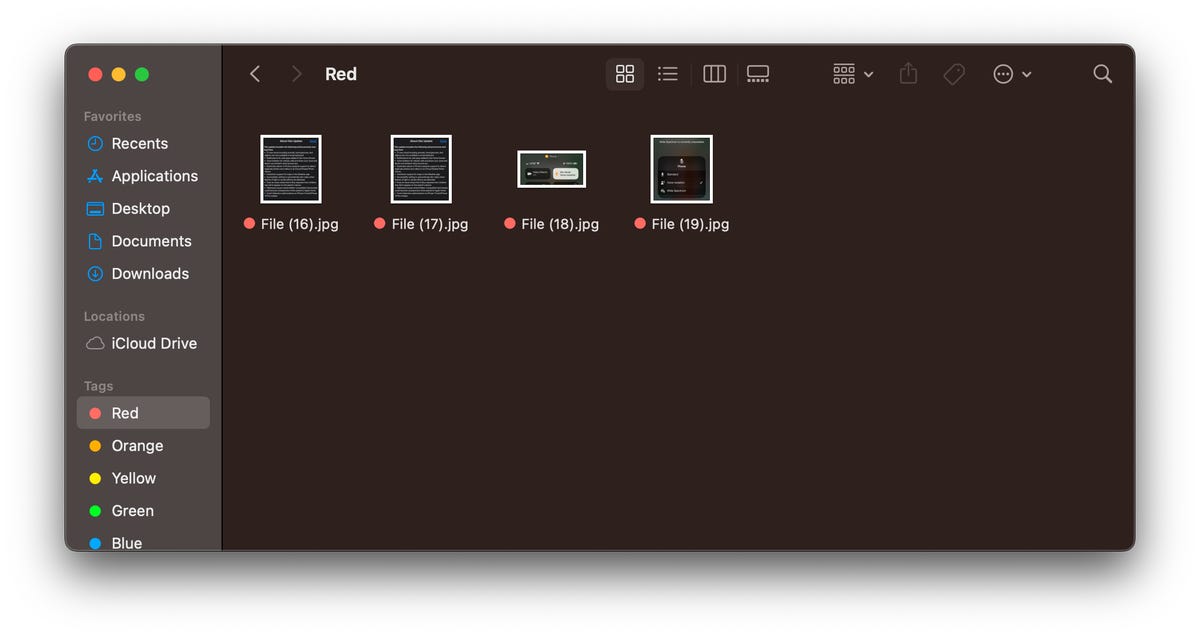
Taking a screenshot of a window makes the image appear cleaner.
Screenshot by Zach McAuliffe/CNETEasily take a screen recording
Sometimes people learn better by watching a video than reading instructions. In these instances, taking a screen recording is better than any detailed list you might write.
Press Command + Shift + 5, then in the toolbar that appears near the bottom of your screen, click either of the icons highlighted below. The icon with the dashed border on the right will allow you to set a border to what you’re recording, and the icon on the left will record your whole screen. When you’ve selected which you want to use, click Record. To stop recording, click the Stop icon in your Menu bar across the top of your screen, or you can press Command + Control + Esc.

These two icons enable screen recording on Macs.
Zach McAuliffe/CNETSave screenshots and recordings in a different location
Screenshots and recordings save to your desktop by default, and they can quickly clutter your workspace. But you can choose a new location to save these files so you can keep your desktop nice and tidy. Here’s how.
1. Press Command + Shift + 5.
2. Click Options.
3. Under Save to, click one of the preselected destinations, like Documents or Messages, or Other Location to save your screenshot and recordings somewhere else, like a specific folder.
Easily preview files
If all your files in Finder or on your Desktop are named something similar or look the same, you can preview your content without opening them. Click a file once and then press your spacebar. Your file is now viewable without opening the Preview app. To close the file, press your spacebar again.
You can also quickly view and exit a file by selecting a file, holding the spacebar to preview it and then releasing the spacebar.
Copy text while previewing files
If you’ve got a document or screenshot full of text, you can copy the content from those files while previewing them. Preview the file by selecting it and hitting the spacebar, then move your mouse over what you want to copy and your pointer will transform into the cursor icon. You can now select and copy text like you normally would. This can be especially helpful if you’ve taken a text-heavy screenshot, like a recipe, and want to convert it into a document for better organization.
Write with emoji online and in apps
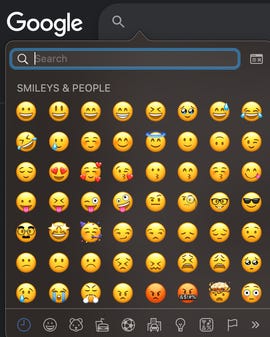
You can use the emoji keyboard in more places than just your iPhone.
Zach McAuliffe/CNETEmoji are a fun way to communicate with people in text, online chats and comments. Most people know how to access their emoji keyboard on their iPhone, and you can access the same keyboard on your Mac, too. You can use the emoji keyboard in certain apps, like Notes, social media chats online and search tools, like Google. However, this doesn’t seem to work on certain sites, like Google Docs.
To access the emoji keyboard in most places on your Mac, click into a text box or other location you’d type a message and press either Function — the Fn key — or Control + Command + spacebar. Both will pull up your emoji keyboard where you can search for the emoji you want, as you would on your phone.
Easily rename files
Renaming files can help keep your folders organized and easily searchable. To easily rename items, select a file and press Return. The file name will be highlighted and you can start typing your new file name.
For more Apple news, check out what’s new on your iPhone with iOS 16.4, the highs and lows of Apple’s Classical Music app and the rumors around Apple’s AR/VR headset.
Technologies
GFiber Is Merging With Astound Broadband, Likely Expanding to More Areas
Technologies
Your iPhone Has a Hidden Flight Tracker. Here’s How to Use It
Apple quietly built a real-time flight tracker into iOS.
Flying can introduce an entirely new layer of stress to any trip. Flight delays, cancellations and everything that could go wrong can keep you on edge, so staying up to date with your flight’s status is never far away from your mind.
Luckily, we’re in a world where finding the information for your flight is easily accessible. You can check your airline’s mobile app or even Google your flight number and the latest information is readily available. But did you know there’s a secret way to get your flight information on your iPhone?
The iPhone has had a built-in flight tracker for some time now, but you’d never know it existed if you weren’t specifically looking for it — or searching for the correct terms to pull it up.
Below, we’ll show you how to access the flight tracker so you’re just a tap away from the latest flight stats, giving you a little more peace of mind before your trip.
Don’t miss any of our unbiased tech content and lab-based reviews. Add CNET as a preferred Google source on Chrome.
How to track your flight via iMessage
Before we start, there are a few prerequisites you must meet:
- Make sure iMessage is enabled (it doesn’t work with SMS/MMS).
- You’ll need your flight number somewhere in your text messages, whether you’ve sent that information to someone (even yourself) or it’s been sent to you.
- The flight number must be sent in this format: [Airline] [Flight number], for example, American Airlines 9707.
Launch the native Messages app on your iPhone and open the text message thread that contains your flight information. You’ll know the flight tracker feature works when the text with the flight information appears underlined, which means it’s actionable and you can tap on it.
If your flight is still several months away or it’s already passed, you might see a message that says, «Flight information unavailable.» You might also see another flight that’s not yours because airlines recycle flight numbers.
You can check your flight status from Spotlight Search, too
If getting your flight information from Messages wasn’t easy enough, you can also grab the details right from your iPhone’s home screen by swiping down and adding your flight number into Spotlight Search. This works with Spotlight Search on your Mac computer, too.
How to access the hidden flight tracker
Although the airline name/flight number format highlighted above is the best way to go, there are other texting options that will lead you to the same result. So let’s say we stick with American Airlines 9707, other options that may bring up the flight tracker include:
- AmericanAirlines9707 (no spaces)
- AmericanAirlines 9707 (only one space)
- AA9707 (airline name is abbreviated and no space)
- AA 9707 (abbreviated and space)
I would suggest you keep the airline name spelled out completely and add a space between the two pieces of information — like in the previous section — because for some airlines, these alternative options may not work.
Real-time flight tracking
Once everything is set, tap on the flight information in your text messages. If the feature works correctly, you should see the following two options appear in a quick-action menu:
- Preview Flight: View the flight’s details. Tap this to view more information about the flight.
- Copy Flight Code: Copy the flight code to your clipboard (in case you want to send your flight details to someone else via text or email).
If you select Preview Flight, at the top of the window, you’ll see the best part of this feature: a real-time flight tracker map. A line will connect the two destinations, and a tiny airplane will move between them, indicating where the flight is at that exact moment.
Underneath the map, you’ll see important flight information:
- Airline name and flight number
- Flight status (arriving on time, delayed, canceled, etc.)
- Terminal and gate numbers (for arrival and departure)
- Arrival and departure time
- Flight duration
- Baggage claim (the number of the baggage carousel)
If you swipe left on the bottom half of the flight tracker, you can switch between flights, but only if there’s a return flight.
For more travel tips, don’t miss our test on whether AI can help you fly more sustainably.
Technologies
Copilot Health Is Microsoft’s Doctor-Built Spin on Medical AI
Microsoft doesn’t want its AI to be your doctor. It wants to make you better prepared when you do see them.

Microsoft is taking a major swing at health AI. The company announced on Thursday that it’s introducing Copilot Health, a new experience inside its chatbot that will bring together all your medical records and wearable data with an AI that’s designed to help you understand it all.
«We are really on the cusp of building a true medical superintelligence,» said Mustafa Suleyman, Microsoft AI CEO. «One that can learn everything about you, all of your health conditions, from your wearable data, your electronic health records, and use that to provide support and insights and intelligence at your fingertips.»
A recent Microsoft survey found that mobile Copilot users ask the chatbot health-related queries more than for any other topic. Copilot Health was built to answer those questions. Microsoft’s health AI was fine-tuned by its in-house clinicians and an external panel of hundreds of clinicians in more than 24 countries. It uses the National Academy of Medicine’s framework for evaluating credible medical sources and information from Harvard Medical School via a 2025 licensing agreement.
Copilot Health is inside the regular, consumer version of Copilot. But it’s an entirely separate experience, designed that way to keep your health information separate from your usual chats. Because it’s been specifically trained for health questions, it ought to be more helpful and accurate than the regular version of Copilot or another chatbot. ChatGPT introduced a similar experience earlier this year.
Your health information won’t pop up in responses from the regular Copilot, only in the new health tab. You can delete your data at any time by simply toggling off a setting — something so easy it raises the question why all AI companies don’t make it that simple to delete your data.
Your information isn’t used to train Microsoft’s AI models, the company says. But your medical information in AI tools like Copilot is not protected under the Health Insurance Portability and Accountability Act (HIPAA).
The benefit of using Copilot Health is having a place where all your medical and health information lives, with an AI that’s trained to help answer your questions about it. You can connect data from your smartwatches and rings, as well as upload your medical records. Through a third-party program called HealthEx, you can upload files from multiple doctors’ offices, hospitals and labs at one time.
Copilot Health is not a doctor
If you choose to share your electronic health record, the AI can make more informed recommendations and reference specific doctors’ visit notes and lab results. But don’t use Copilot Health as a replacement for a physician. What the AI can do is discuss your health concerns, help you prepare for upcoming appointments and help you build healthier habits.
«Copilot Health is not meant to give you a definitive diagnosis or a formal treatment plan, but it’s certainly here to support you in getting to the right answers,» said Dr. Dominic King, vice president of health at Microsoft AI. The former surgeon led the team that built Copilot Health.
For example, it can help you come up with a list of questions to ask your doctor, break down lab results and find a provider that accepts your insurance. Copilot Health can discuss your health concerns, like understanding any new symptoms, but it can’t diagnose or prescribe medication.
Microsoft is doing a slow rollout, beginning with adults (ages 18 plus) in the US, with English as the only language. You can sign up to join the waitlist for Copilot Health now.
There are some existing uses of AI in health care today, but they’re disparate. Wearables have new AI-powered data insights and coaching. Some doctors are using AI scribe tools to take notes during appointments with patients. Administrative and insurance work also has its own AI tools, particularly around claims processing (including making denials, in some cases). The common thread is that none of the AI is without flaws, and it should never be used to make important decisions without human oversight.
For AI believers, the tangled, bureaucratic web of American health care is the perfect place to prove that AI intervention can make a real difference. But AI in health care is like putting a Band-Aid on a gunshot wound — a halfway measure that doesn’t fix the underlying problems.
It’s too soon to tell if Microsoft’s goal of a medical superintelligence is viable. But for now, Copilot Health illustrates a more productive use of AI — more than filling the internet with slop.
«I think it is perhaps the most important and most positively impactful contribution that AI can make in the world,» Suleyman said. «And it’s enormously important to us.»
-
 Technologies3 года ago
Tech Companies Need to Be Held Accountable for Security, Experts Say
-
 Technologies3 года ago
Best Handheld Game Console in 2023
-
 Technologies3 года ago
Tighten Up Your VR Game With the Best Head Straps for Quest 2
-
 Technologies4 года ago
Black Friday 2021: The best deals on TVs, headphones, kitchenware, and more
-
 Technologies5 лет ago
Google to require vaccinations as Silicon Valley rethinks return-to-office policies
-
 Technologies5 лет ago
Verum, Wickr and Threema: next generation secured messengers
-
 Technologies4 года ago
Olivia Harlan Dekker for Verum Messenger
-
 Technologies4 года ago
iPhone 13 event: How to watch Apple’s big announcement tomorrow