
Technologies
Best Open Wireless Earbuds For 2023
Looking for a set of true-wireless earbuds but hate jamming silicone tips in your ears? Here are your best options.

Noise-isolating earbuds with silicone ear tips offer the best sound, but not everyone likes the feeling of having ear tips jammed in their ears. A lot of people prefer tip-free earbuds, which nestle in your ears or rest on top of them. With no tip covering the earbuds’ speaker driver, these earbuds are called «open» buds. The most popular open earbuds are Apple’s standard AirPods, now on their third generation (Apple also still sells the second-gen AirPods).
Open earbuds also have a safety benefit. Because they don’t seal off your ear canal, they let ambient sound in so you can hear what’s going on around you. That can be an important feature for some people, including runners and bikers who want to hear cars approaching. However, the downside to their openness is that if you’re in a noisy environment, the ambient sound will make it harder to hear what you’re listening to. Also, open earbuds have a harder time producing strong bass, which affects sound quality.
Here’s a look at the top open-style buds. I’ll update this list as I test more worthy candidates.
Read more: The 22 Best True Wireless Earbuds for 2023
Screenshot by David Carnoy/CNET
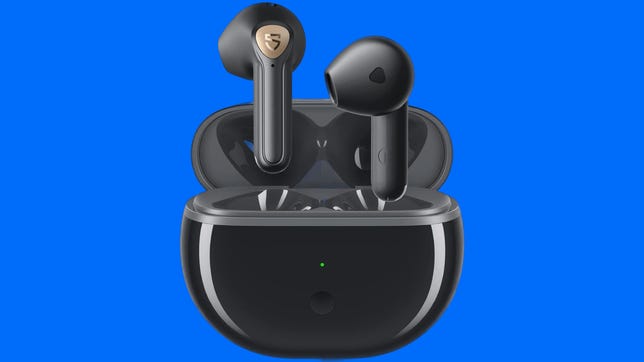
What makes these Soundpeats Air3 Deluxe HS buds special is that they sound surprisingly good for open earbuds — they’re pretty close to what you get from Apple’s AirPods 3 for sound. On top of that, they support Sony’s LDAC audio codec for devices that offer it. Not too many cheap open earbuds have good sound but these Soundpeats have good bass response and clarity. They’re also good for making calls and have a low-latency gaming mode.
David Carnoy/CNET
Battery Life
Rated up to 6 hours
Noise Canceling
No
Multipoint
No
Headphone Type
Wireless earbuds
Water-Resistant
Yes (IPX4 — splash-proof)
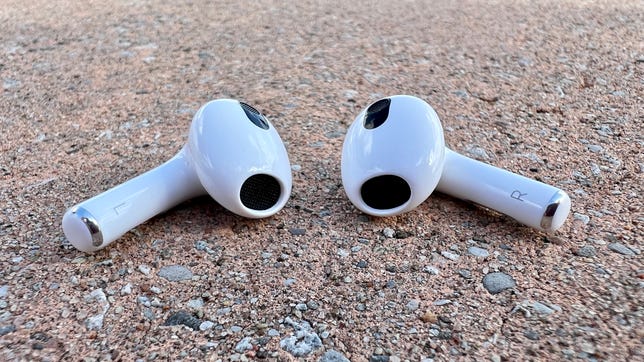
Take one look at the new design of the third-gen AirPods ($179), and the first thing you’ll probably think is: «Those look like the AirPods Pro without ear tips.» You wouldn’t be wrong. While they’re more fraternal than identical twins, the third-gen AirPods are shaped like the AirPods Pro, with the same shorter stems and same pinch controls as those of the Pro. Aside from the design change, which should fit most ears better than the second-gen AirPods (though not very small ears), the biggest change is to the sound quality: It’s much improved. Also, battery life is better, and the AirPods 3 are officially water-resistant and support Apple’s spatial audio virtual surround feature (for Apple users only).
David Carnoy/CNET
Battery Life
5.5 hours
Noise Canceling
No
Multipoint
No
Headphone Type
Wireless earbuds
Water-Resistant
Yes (IPX4 — splash-proof)
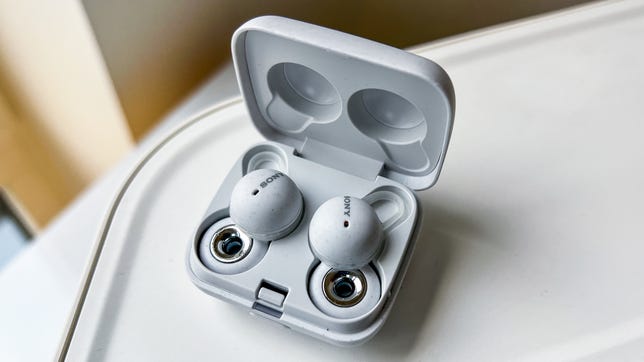
The LinkBuds are, in a sense, Sony’s answer to Apple’s standard AirPods. While they don’t sound as good as Sony’s flagship WF-1000XM4 noise-isolating earbuds, they offer a discreet, innovative design and a more secure fit than the AirPods, as well as good sound and very good voice-calling performance.
Like the third-gen AirPods, their open design allows you to hear the outside world — that’s what the ring is all about. That makes them a good choice for folks who want to hear what’s going around them for safety reasons or just don’t like having ear tips jammed in their ears. They also have a few distinguishing extra features, including Speak to Chat and Wide Area Tap. Instead of tapping on a bud, you can tap on your face, just in front of your ear, to control playback.
They’re IPX4 splash-proof and thanks to their fins — Sony calls them Arc Supporters — they lock in your ears securely and work well for running and other sporting activities.
David Carnoy/CNET
Battery Life
Rated up to 6 hours
Noise Canceling
Yes
Headphone Type
Wireless earbud
Water-Resistant
No IP rating, advertised as sweat-proof
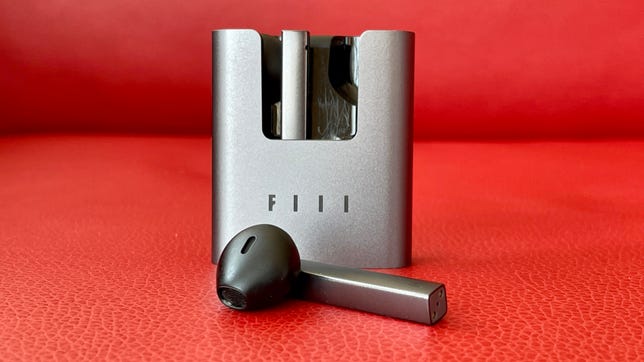
I never tried the original Fiil CC earbuds, but the next-generation CC2 improves on the performance of the originals, with better battery life (they’re rated at five hours on a single charge) and no audio latency issues when watching videos. They list for $30 but sometimes sell for even less, which makes them a very good value.
These did stay in my ears better than the standard AirPods. They pair quickly — they’re equipped with Bluetooth 5.2 — there’s a Fiil companion app for tweaking settings and they sound quite decent for open-style buds, with just enough bass to keep you from feeling they’re bass shy. They’re also decent for making calls and have touch controls.
One of their distinguishing features is their open case, which makes it easy to access the buds and put them back in their case. Thanks to some integrated magnets, they stay in the case securely — you can turn it upside down and the buds won’t come out. Unlike the AirPods, these have square not rounded stems, which seems a little weird at first, and they do fit in your ears slightly differently to AirPods as a result.
Amazon
Battery Life
Rated up to 4 hours
Noise Canceling
Yes (ANC)
Multipoint
No
Headphone Type
Wireless earbuds
Water-Resistant
Yes (IPX5 — protection against low-pressure water streams)
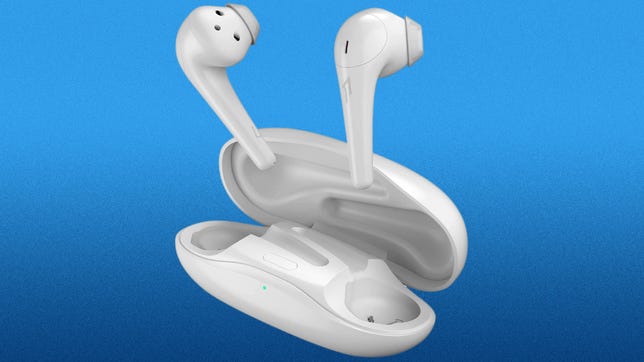
1More has a slightly different take on the standard AirPods for those who have trouble keeping them in their ears. The ComfoBuds 2 have mini ear tips on them that help secure them in your ear. This second-gen version offers improved sound from the originals with better bass (it’s still not great sound, but it’s good for the money). As their name implies, they’re lightweight, comfortable to wear and work well for making calls.
It’s worth noting that their charging case is remarkably narrow and compact. It looks like a tiny hot-dog bun. They’re IPX5 splashproof and also available in black.
Angela Lang/CNET
Battery Life
Rated up to 5 hours
Noise Canceling
No
Multipoint
No
Headphone Type
Wireless earbuds
Water-Resistant
Yes (IPX4 — splash-proof)
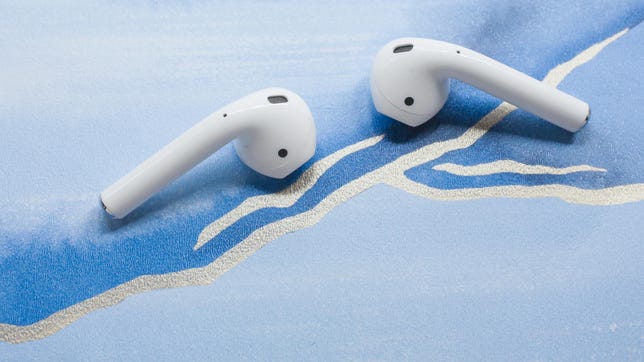
The new AirPods (third gen) are a nice upgrade over the second-gen AirPods. That said, the AirPods 2, which came out in 2019, are now selling for around $100 and sometimes a little less. While they don’t sound as good as the AirPods 3 and have a longer stem, they fit some people’s ears better. Those with smaller ears may prefer these older AirPods due to their slightly smaller design.
Juan Garzon/CNET
Battery Life
Rated up to 8 hours
Noise Canceling
Yes (ANC)
Multipoint
No
Headphone Type
Wireless earbuds
Water-Resistant
Yes (IPX2 — sweat-resistant and protection against light splashes)
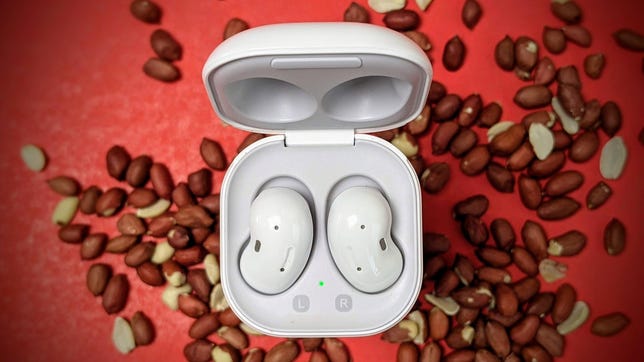
Say what you will about the Samsung Galaxy Buds Live’s bean-shaped design, but it’s certainly innovative. Like the standard AirPods, they have an open design, so you don’t jam an ear tip into your ear. They’re comfortable to wear and fit my ears more securely than the AirPods. These wireless buds are discreet and basically sit flush with your ear, which reduces wind-noise while biking. I regularly use them for running and biking, and they’re great for sporting activities if they fit your ears well. But one warning: Some people won’t get a secure fit, so buy them from a retailer that has a good return policy.
They deliver good sound and work well as a headset for making calls, with good background noise reduction so callers can hear you clearly even when you’re in noisier environments. While they feature active noise canceling, it’s mild compared to the noise canceling in earbuds that have a noise-isolating design. In other words, buy them for their design and sound, not their noise-canceling features.
David Carnoy/CNET
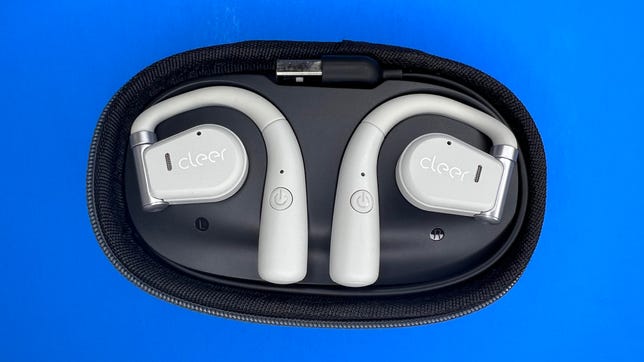
Cleer’s Epic Arc buds are similar to Bose’s Open Sport Earbuds (see below) but are actually a little more comfortable to wear thanks to their swiveling hinge. Like the Bose buds, they rest on the top of your ear just above the ear canal and fire sound into your ears. They’re open so they let ambient sound in (that’s a plus if you’re a runner or biker and want to hear traffic), but their 16.2 mm drivers provide ample bass and volume. They don’t sound quite as good as the Bose Open Sport Earbuds but they’re pretty close.
I liked the case, which is a little big but pretty thin. While it has an integrated USB charging cable (that’s nice), like the Bose Open Sport Earbuds case it doesn’t have a rechargeable battery so it’s basically a dock for charging the earbuds, which are also available in black. Battery life is rated at up to 7 hours and they’re IPX5 splash-proof.
Some of these types of ear-hook-style earbuds have physical control buttons but these have touch controls. I found they worked pretty well but not great. The buds do have a companion app that allows you to upgrade the firmware and tweak the sound profile.
Technologies
Samsung’s Galaxy Watch Ultra 2 Might Come in 5G and 4G Cellular Models
If the rumor proves true, the 5G Galaxy Watch Ultra would rival the 5G-enabled $799 Apple Watch Ultra 3 that debuted last fall.
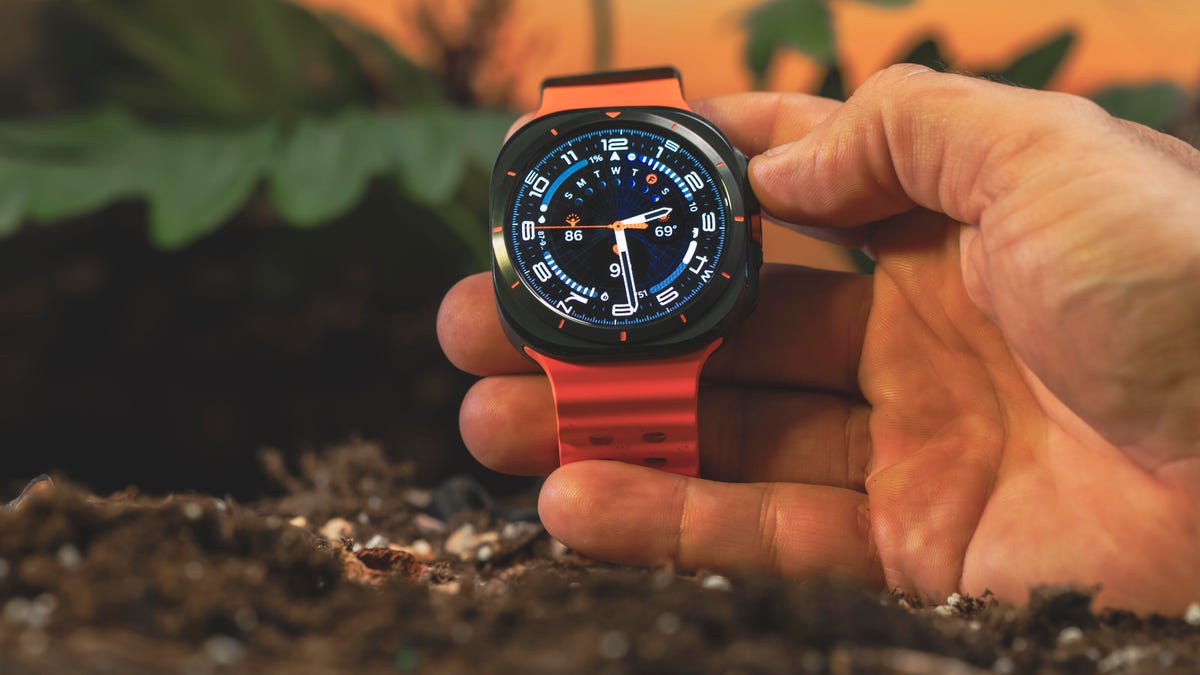
Samsung’s next high-end Galaxy Watch could support faster 5G speeds, but if this leak is true, it will depend on where you live. The rumored Samsung Galaxy Watch Ultra 2 might come in 5G and 4G cellular models, with availability for each smartwatch depending on the country.
According to the Dutch website Galaxy Club (and spotted by SamMobile), Samsung’s servers may have revealed a series of model numbers that point to 5G, 4G and Wi-Fi-enabled editions of the next Galaxy Watch Ultra, which would succeed the original model that debuted in 2024.
A representative for Samsung did not immediately respond to a request for comment.
The Galaxy Club website speculates that the 5G edition would be sold in the US and Korean markets, while the 4G edition would sell in the rest of the world. In the US, a 5G version of the Galaxy Watch Ultra would rival the 5G-enabled $799 Apple Watch Ultra 3, which debuted last fall. The 4G edition would have broader compatibility worldwide, since the earlier network is far more established.
It will likely be a few months until we hear anything official about the Galaxy Watch Ultra 2. Samsung typically unveils its new watches in the summer alongside its Galaxy Z Fold and Z Flip foldable phones. Last year, Samsung unveiled the Galaxy Watch 8 and the Galaxy Watch 8 Classic, but otherwise left the prior 2024 Ultra in the lineup for those looking for a larger 47mm smartwatch.
Technologies
2 Cases Show Supreme Court Isn’t Holding ISPs Responsible for Piracy
Technologies
Today’s NYT Connections Hints, Answers and Help for April 8, #1032
Here are some hints and the answers for the NYT Connections puzzle for April 8, No. 1032.
Looking for the most recent Connections answers? Click here for today’s Connections hints, as well as our daily answers and hints for The New York Times Mini Crossword, Wordle, Connections: Sports Edition and Strands puzzles.
Today’s NYT Connections puzzle is kind of tough. The purple category is a fun one, once you see the connection. Read on for clues and today’s Connections answers.
The Times has a Connections Bot, like the one for Wordle. Go there after you play to receive a numeric score and to have the program analyze your answers. Players who are registered with the Times Games section can now nerd out by following their progress, including the number of puzzles completed, win rate, number of times they nabbed a perfect score and their win streak.
Read more: Hints, Tips and Strategies to Help You Win at NYT Connections Every Time
Hints for today’s Connections groups
Here are four hints for the groupings in today’s Connections puzzle, ranked from the easiest yellow group to the tough (and sometimes bizarre) purple group.
Yellow group hint: In the group.
Green group hint: Appearance details.
Blue group hint: Often found in gyms.
Purple group hint: They help you see.
Answers for today’s Connections groups
Yellow group: Cohort member.
Green group: Aesthetic.
Blue group: Kinds of bar apparatuses.
Purple group: Eyewear in the singular.
Read more: Wordle Cheat Sheet: Here Are the Most Popular Letters Used in English Words
What are today’s Connections answers?
The yellow words in today’s Connections
The theme is cohort member. The four answers are associate, colleague, fellow and peer.
The green words in today’s Connections
The theme is aesthetic. The four answers are design, look, scheme and style.
The blue words in today’s Connections
The theme is kinds of bar apparatuses. The four answers are monkey, parallel, pull-up and uneven.
The purple words in today’s Connections
The theme is eyewear in the singular. The four answers are contact, goggle, shade and spectacle.
-
 Technologies3 года ago
Tech Companies Need to Be Held Accountable for Security, Experts Say
-
 Technologies3 года ago
Best Handheld Game Console in 2023
-
 Technologies3 года ago
Tighten Up Your VR Game With the Best Head Straps for Quest 2
-
 Technologies4 года ago
Black Friday 2021: The best deals on TVs, headphones, kitchenware, and more
-
 Technologies5 лет ago
Google to require vaccinations as Silicon Valley rethinks return-to-office policies
-
 Technologies5 лет ago
Verum, Wickr and Threema: next generation secured messengers
-
 Technologies4 года ago
Olivia Harlan Dekker for Verum Messenger
-
 Technologies4 года ago
The number of Сrypto Bank customers increased by 10% in five days