
Technologies
How to Upload Your Driver’s License to Your iPhone
Residents of select states can show TSA a digital version of their license stored in their Apple Wallet.
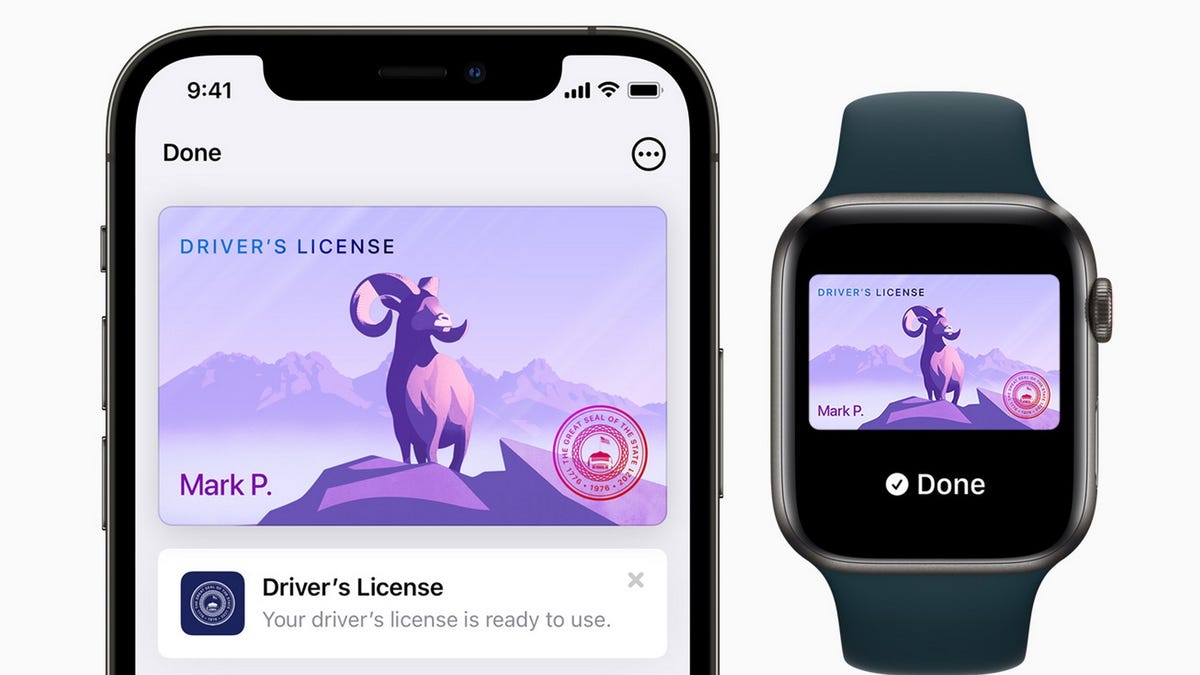
If you’re traveling over the holidays, there’s a lot to keep track of as you race through the airport: Your tickets, your boarding pass, your luggage, your loved ones — and, of course, your ID.
Almost all airlines let you use a digital version of your boarding pass to board, but now some states are allowing residents to keep their driver’s license or other recognized identification in their Apple Wallet, letting them just flash their iPhones — or Apple Watch — rather than root through their pocketbooks for their ID.
Apple announced the initiative in 2021, building the technology into iOS 15 for iPhone.
«The addition of driver’s licenses and state IDs to Apple Wallet is an important step in our vision of replacing the physical wallet with a secure and easy-to-use mobile wallet,» Jennifer Bailey, vice president of Apple Pay and Apple Wallet, said in a statement at the time.
It’s not quite a universal game-changer yet: While 12 states have committed to allowing digital IDs, only three have officially started accepting them.
And while the airport you depart from might accept a driver’s license on your Apple Watch, you might not be extended the same courtesy on the return trip.
But the Transportation Security Administration (TSA) is already supporting the technology at select airport security checkpoints at participating airports.
«Digital identity has the ability to strengthen airport security and enhance the passenger experience by reducing touchpoints, providing greater privacy, and verifying IDs more accurately,» the agency said in a statement. So it’s really a question of when, not if the option will become standard nationwide.
Here’s what you need to know about putting your driver’s license in your Apple Wallet, including how to do it and which states recognize digital IDs.
Read On: Homeland Security Postpones Deadline for Real ID at Airports
How do I add my driver’s license to my Apple Wallet?
Adding a driver’s license or other state ID is similar to how you add new credit cards to your Apple Wallet.
First, tap the «+» button at the top of the screen in Wallet. (If you have an Apple Watch paired to your iPhone, it will ask you about adding your license there, as well.)
You’ll then scan your physical driver’s license with your iPhone’s camera and take a selfie, «which will be securely provided to the issuing state for verification,» according to Apple.
You’ll also be asked to complete a series of facial and head movements «as an additional security step.»
Once your ID has been verified by the state that issued it, it will be added to your Wallet.
To add your license or ID to Apple Wallet, it will need to be issued from a participating state. In addition, you’ll need:
- An iPhone 8 or later, or an Apple Watch Series 4 or later, with the latest version of iOS or WatchOS
- Face ID or Touch ID turned on
- An Apple ID with two-factor authentication turned on
- Your device region set to the US
Also, only passengers with TSA PreCheck on their boarding pass are eligible to flash digital licenses, according to the TSA website, though the agency said it plans to add the option for other passengers in the future.
Only one license or ID can be added to an iPhone and paired Apple Watch at a time.
Which states accept a digital driver’s license on an iPhone?
Apple initially announced in 2021 that eight states were participating in the program, then bumped the number to 12 this year. But those are states committed to accepting Apple Wallet IDs, not that currently do.
Only Arizona, Colorado and Maryland currently support the digital identification feature — and only at select security checkpoints at these airports:
- Phoenix Sky Harbor Airport
- Baltimore/Washington International Thurgood Marshall Airport
- Ronald Reagan Washington National Airport
Connecticut, Georgia, Hawaii, Iowa, Kentucky, Mississippi, Ohio, Oklahoma and Utah have all committed to supporting the initiative, as has Puerto Rico, though specific timetables have not been announced.
Other states are expected to join this roster soon: Last year Bailey said Apple was «already in discussions with many more states.»
In November, the South Carolina Department of Motor Vehicles said it was «exploring» the digital ID option.
«There is a proviso that created a study committee on the idea and they are still undergoing research,» spokeswoman Maranda Williams told The State, a Columbia, South Carolina, news outlet.
Separate from Apple’s efforts, some states allow residents to upload their driver’s licenses to their phones through state-operated apps, like Louisiana’s LA Wallet. But these are for driving and age verification purposes and are not accepted by TSA yet.
How do I use a license stored in my Apple Wallet at TSA?
To present your digital ID, tap your iPhone or Apple Watch on the identity reader at the security checkpoint.
You’ll then be prompted to authenticate your identification with Face ID or Touch ID.
If it’s successful, a checkmark should appear on the screen.
According to Apple, «you don’t need to unlock, show or hand over your device [to a TSA agent].»
Is this technology secure?
According to Apple, it is. A statement on the Apple Support website says the program uses the same privacy and security features already in the iPhone and Apple Watch to prevent tampering and theft.
«Your driver’s license or state ID data is encrypted,» it said. «Neither the state issuing authority nor Apple can see when and where you use your license or ID, and biometric authentication using Face ID and Touch ID helps make sure that only you can view and use your license or ID.»
If my state accepts digital IDs, do I still need my physical license at the airport?
Yes. The program is still in its infancy, and there’s no guarantee the TSA agent you encounter will be able to accept a driver’s license on your Apple Wallet.
«All passengers must continue to have readily available their physical driver’s license,» TSA said on its website. «The TSA officer may require this physical ID in addition to the digital ID.»
Where else can I use my digital ID?
With the rollout of iOS 16 in June, apps that require age or identity verification should now be able to accept ID cards stored in your Apple Wallet app, Apple said.
Uber Eats and car-share service Turo were cited as two apps that could potentially offer this functionality, according to MacRumors, but neither has officially done so.
Apple also said retailers, restaurants and other venues will make use of the feature in the future.
I have an Android phone. Can I upload my ID to Google Wallet?
In a December 2022 system update, Google announced it was beta testing allowing Android phone users to upload their driver’s licenses to Google Wallet «for convenient, private and secure presentation.»
While the company said the feature would be available in «selected US state(s),» it didn’t indicate which ones or when.
Read On: Smartphones Traded Wow Factor for Peace of Mind in 2022
Technologies
2 Cases Show Supreme Court Isn’t Holding ISPs Responsible for Piracy
Technologies
Today’s NYT Connections Hints, Answers and Help for April 8, #1032
Here are some hints and the answers for the NYT Connections puzzle for April 8, No. 1032.
Looking for the most recent Connections answers? Click here for today’s Connections hints, as well as our daily answers and hints for The New York Times Mini Crossword, Wordle, Connections: Sports Edition and Strands puzzles.
Today’s NYT Connections puzzle is kind of tough. The purple category is a fun one, once you see the connection. Read on for clues and today’s Connections answers.
The Times has a Connections Bot, like the one for Wordle. Go there after you play to receive a numeric score and to have the program analyze your answers. Players who are registered with the Times Games section can now nerd out by following their progress, including the number of puzzles completed, win rate, number of times they nabbed a perfect score and their win streak.
Read more: Hints, Tips and Strategies to Help You Win at NYT Connections Every Time
Hints for today’s Connections groups
Here are four hints for the groupings in today’s Connections puzzle, ranked from the easiest yellow group to the tough (and sometimes bizarre) purple group.
Yellow group hint: In the group.
Green group hint: Appearance details.
Blue group hint: Often found in gyms.
Purple group hint: They help you see.
Answers for today’s Connections groups
Yellow group: Cohort member.
Green group: Aesthetic.
Blue group: Kinds of bar apparatuses.
Purple group: Eyewear in the singular.
Read more: Wordle Cheat Sheet: Here Are the Most Popular Letters Used in English Words
What are today’s Connections answers?
The yellow words in today’s Connections
The theme is cohort member. The four answers are associate, colleague, fellow and peer.
The green words in today’s Connections
The theme is aesthetic. The four answers are design, look, scheme and style.
The blue words in today’s Connections
The theme is kinds of bar apparatuses. The four answers are monkey, parallel, pull-up and uneven.
The purple words in today’s Connections
The theme is eyewear in the singular. The four answers are contact, goggle, shade and spectacle.
Technologies
Today’s Wordle Hints, Answer and Help for April 8, #1754
Here are hints and the answer for today’s Wordle for April 8, No. 1,754.
Looking for the most recent Wordle answer? Click here for today’s Wordle hints, as well as our daily answers and hints for The New York Times Mini Crossword, Connections, Connections: Sports Edition and Strands puzzles.
Today’s Wordle puzzle is a tough one. The first letter isn’t the rarest letter ever, but its placement threw me off. If you need a new starter word, check out our list of which letters show up the most in English words. If you need hints and the answer, read on.
Read more: New Study Reveals Wordle’s Top 10 Toughest Words of 2025
Today’s Wordle hints
Before we show you today’s Wordle answer, we’ll give you some hints. If you don’t want a spoiler, look away now.
Wordle hint No. 1: Repeats
Today’s Wordle answer has no repeated letters.
Wordle hint No. 2: Vowels
Today’s Wordle answer has two vowels.
Wordle hint No. 3: First letter
Today’s Wordle answer begins with I.
Wordle hint No. 4: Last letter
Today’s Wordle answer ends with T.
Wordle hint No. 5: Meaning
Today’s Wordle answer can refer to a small arm of the sea.
TODAY’S WORDLE ANSWER
Today’s Wordle answer is INLET.
Yesterday’s Wordle answer
Yesterday’s Wordle answer, April 7, No. 1753, was DENSE.
Recent Wordle answers
April 3, No. 1749: SINGE
April 4, No. 1750: SANDY
April 5, No. 1751: ENVOY
April 6, No. 1752: SWORN
-
 Technologies3 года ago
Tech Companies Need to Be Held Accountable for Security, Experts Say
-
 Technologies3 года ago
Best Handheld Game Console in 2023
-
 Technologies3 года ago
Tighten Up Your VR Game With the Best Head Straps for Quest 2
-
 Technologies4 года ago
Black Friday 2021: The best deals on TVs, headphones, kitchenware, and more
-
 Technologies5 лет ago
Google to require vaccinations as Silicon Valley rethinks return-to-office policies
-
 Technologies5 лет ago
Verum, Wickr and Threema: next generation secured messengers
-
 Technologies4 года ago
Olivia Harlan Dekker for Verum Messenger
-
 Technologies4 года ago
The number of Сrypto Bank customers increased by 10% in five days