
Technologies
Pinterest’s new AR feature will let you ‘try on’ furniture, home decor
Buying a couch could be easier with the help of augmented reality.
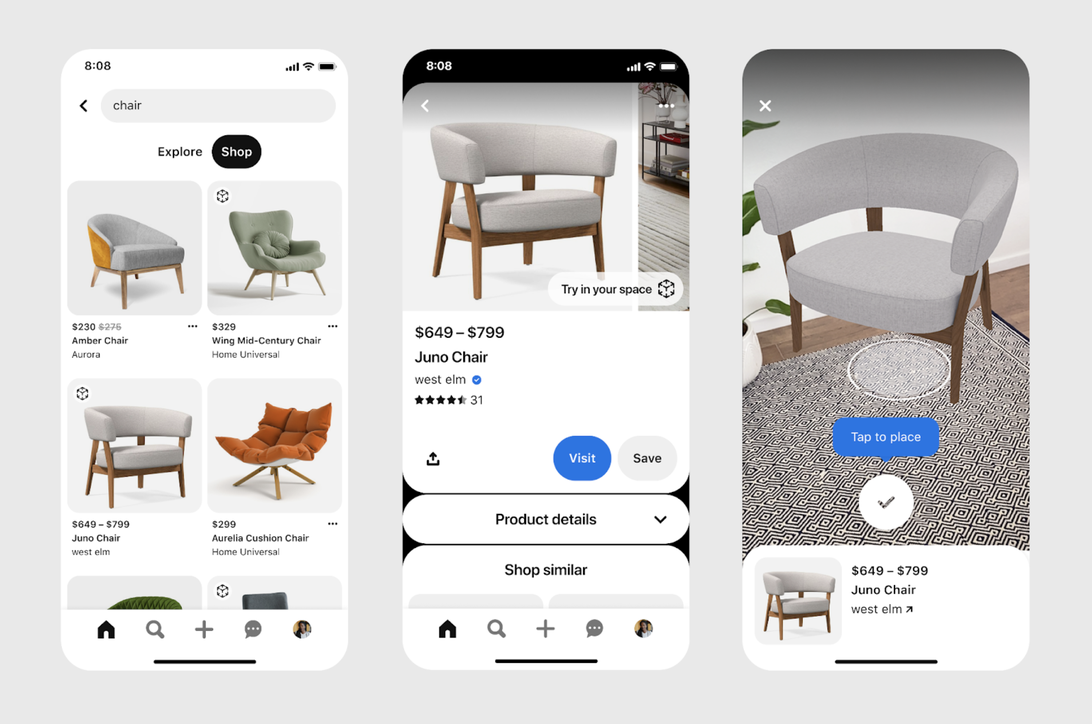
Picking a new piece of furniture for your home can feel like solving a puzzle. Is that couch too big? Will a cow print bar stool clash with a granite countertop?
Retailers and tech companies are boosting their use of augmented reality to help customers decide what products to buy. AR lets people superimpose a virtual image onto a view of the real world through their phone’s camera, making it easier to visualize what an item will look like in a particular space.
On Monday, digital pinboard company Pinterest said it’s releasing a new feature called Try On for Home Decor. The tool will let you see how products from Crate & Barrel, CB2, Target, Walmart, West Elm, Wayfair and others look in your space before purchasing the items.
The feature is the latest example of tech companies and brands embracing AR, a development that comes as social networks explore the creation of new virtual worlds.
Brands such as CB2 and Target already have ways for their customers to shop using AR. Pinterest allows people to see products from various retailers in one place, said Jeremy King, senior vice president of engineering at Pinterest.
«Retailers are happy to work with us because they know people don’t typically buy their entire bedroom set from one company,» King said. «They want a chance to mix and match.»
Returning a big piece of furniture can be a pain, so it isn’t surprising that more brands have been experimenting with AR. Trying on items virtually can also entice people into clicking the buy button. In 2020, Pinterest rolled out an AR feature that lets people try on makeup. Pinterest found that users are five times more likely to buy makeup when they interact with this AR tool and King said the platform hopes to see the same behavior for home decor.
Even though the ability to visualize AR items in your space has been around for years, shopping with AR hasn’t become mainstream yet. About half of US adults have used or are at least somewhat interested in using AR or virtual reality while shopping, according to an October 2021 survey by Bizrate Insights.
«We’re seeing that interest rise slowly but steadily,» said Jasmine Enberg, a senior analyst for eMarketer. «It’s young people primarily who are leading the way for shopping with AR.»
On social media, teenagers are already using AR filters to communicate with one another. Incorporating the technology into shopping is a «natural next step» for these social networks. Snapchat, which also has AR tools to try on luxury clothing and purses, published a report with Foresight Factor last year that projected in 2025 the proportion of US Gen Z shoppers who use AR before buying a product will increase by 37%.
Using Pinterest’s new AR tool
Home decor and furniture items Pinterest users can virtually place in their space have a cube icon displayed on the upper left side of a «pin,» which are bookmarks used to save content on the platform.
When you click on the pin, there’s an option to «try in your space.» Users are then prompted to move their phone as the camera’s technology figures out how far objects are away from you. Depending on the camera angle, the object can appear bigger or smaller. When the item is in the right spot, you click a check button.
The AR home decor feature will be available in more than 80,000 shoppable Pins, which includes a link to the retailer’s website to buy the product.
Still, using AR to shop can «be rather clunky» and that will turn some consumers away from embracing the tool, Enberg said. «As the technology develops and the experiences improve, that’s probably going to bring more users into the fold,» she said.
Technologies
AT&T Says It’s Pumping $250 Billion Into New Infrastructure Improvements
Technologies
Apple’s New Smart Home Display Delayed Until Fall Over Siri Issues
It has been nearly a year and a half since the company announced the AI-powered product.

Your home could get smarter with Apple’s Siri, but it will have to wait a few more months. Bloomberg reported the iPad-shaped AI home hub won’t be ready until September, several months after the company was hoping to launch it this spring. Apple engineers first need to complete work on a new and improved Siri assistant for the home device, code-named J490, according to Bloomberg.
Apple was hoping to release J490 this month, along with a slew of other new devices, including the iPhone 17e, MacBook Neo, MacBook Air M5, new Pro models, and iPad Air M4. Apple first teased the smart home display in November 2024.
A representative for Apple did not immediately respond to a request for comment.
Siri is Apple’s virtual assistant that uses voice recognition and AI to fulfill a variety of tasks and commands, along with intriguing uses. You might use Siri to find your iPhone — «Hey Siri, where are you?» — or to hear the weather forecast — «Siri, what will the weather be today?» Siri is available on iPhones, MacBooks and iPads. It was launched in 2011 as a feature of the iPhone 4S.
As CNET reported last month, Apple engineers have struggled to push the upgraded Siri assistant out the door. It isn’t fast enough, gets confused by complex commands and doesn’t interact well with other Apple AI models. The company is also wrestling with how much personal data to access to inform the AI, and the new Siri is not yet able to complete in-app tasks, such as finding a photo and posting it to socials, all with one command.
It has been nearly two years since Apple announced that it would give Siri a major upgrade. In the meantime, competitors like Alexa Plus and Gemini for Home have entered the marketplace.
Tech tester Jon Rettinger, whose YouTube channel has 1.66 million subscribers, says the repeated delays in upgrading Siri can «erode» confidence in Apple’s ability to keep up in the AI race.
«Apple as a whole is still one of the strongest companies on the planet. But their AI play is clearly the weakest link in an otherwise very strong chain,» Rettinger told CNET.
Rettinger said he has had issues getting Siri to complete basic commands, such as setting two alarms at the same time, and that it’s a bit of «a mess» right now.
«Having said that, the iPhone has such massive market penetration that I’m not sure it will actually matter in the end. Which is kind of wild when you think about it,» Rettinger said.
Facial recognition for residents
The hardware for the forthcoming smart home display has already been finished. It resembles an iPad and can be either attached to a wall or rest on a half-domed-shaped base, the Bloomberg report said.
The device will be equipped with facial recognition, so when residents walk up to it, they will be shown personalized data such as music preferences, news headlines, appointments, reminders, tasks and so on.
The screen interface will include a bunch of circular app icons, similar to the display on an Apple Watch. The Bloomberg report said the smart home display will be the first of several home devices by Apple. Future products include a tabletop robotic limb with a 9-inch screen, a smart security camera and a Face ID-enabled smart doorbell.
Technologies
The Pixel 10A Is Available. Here’s How to Get Yours
-
 Technologies3 года ago
Tech Companies Need to Be Held Accountable for Security, Experts Say
-
 Technologies3 года ago
Best Handheld Game Console in 2023
-
 Technologies3 года ago
Tighten Up Your VR Game With the Best Head Straps for Quest 2
-
 Technologies4 года ago
Black Friday 2021: The best deals on TVs, headphones, kitchenware, and more
-
 Technologies5 лет ago
Google to require vaccinations as Silicon Valley rethinks return-to-office policies
-
 Technologies5 лет ago
Verum, Wickr and Threema: next generation secured messengers
-
 Technologies4 года ago
Olivia Harlan Dekker for Verum Messenger
-
 Technologies4 года ago
iPhone 13 event: How to watch Apple’s big announcement tomorrow