
Technologies
Scorching exoplanet is a little like Earth in one key way, scientists say
Our planet has a few talking points to go over with its (very) distant cosmic relative.
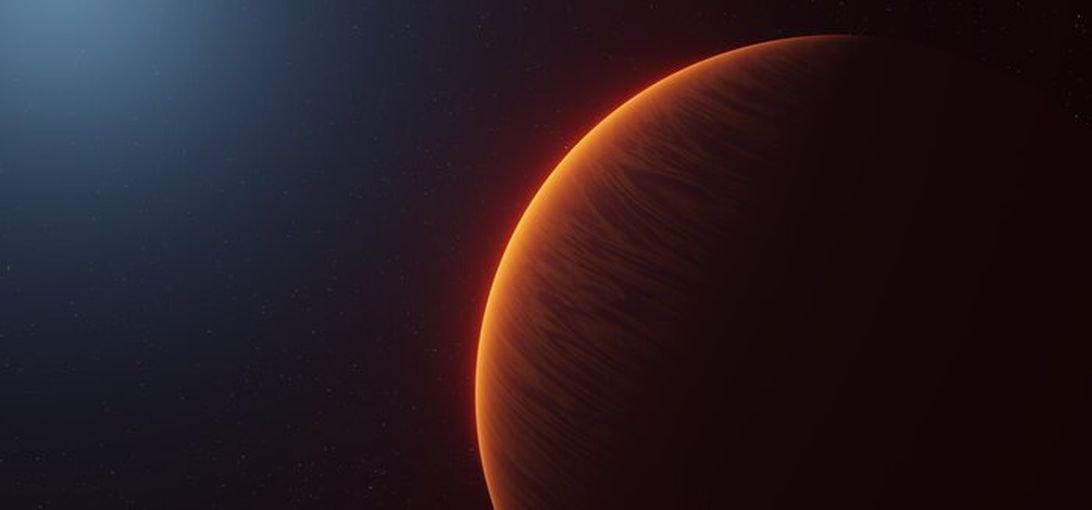
Approximately 322 light-years from Earth, an extreme planet by the name of WASP-189b orbits one of the hottest stars in the universe, HD 133112.
Twenty times closer to its star than we are to the sun, WASP-189b absolutely blisters with a daytime temperature of 5,792 degrees Fahrenheit (3,200 degrees Celsius). The scorching exoplanet is also made of gas and about 1.5 times the size of Jupiter — something like 1,950 Earths could fit inside it.
Needless to say, since its discovery in 2018, scientists very understandably reasoned that WASP-189b isn’t anything like our home orb. But in a paper published Thursday in the journal Nature Astronomy, a team of researchers found a way for Earth to relate to its distant cosmic relative. The two could chitchat about their layered atmospheres, and Earth could gossip about its ozone holes and climate change.
Here on Earth, we have an atmospheric layer called the troposphere that starts at sea level and that holds a ton of water vapor. Clouds, and therefore weather such as rain and snow, originate there. Above that, we have the stratosphere, home to the ozone layer, which protects us from the sun’s ultraviolet radiation.
«In the past, astronomers often assumed that the atmospheres of exoplanets exist as a uniform layer and try to understand it as such,» Jens Hoeijmakers, an astrophysicist at Lund University and study co-author, said in a statement.
However, upon analyzing WASP-189b by measuring starlight passing through the atmosphere of the intensely heated exoplanet — with the HARPS spectrograph at the La Silla Observatory in Chile — Hoeijmakers and fellow researchers found a unique chemical signature to shake up our knowledge of planetary atmospheres. It indicated that the distant orb’s atmosphere may have layers like Earth’s.
«The gases in its atmosphere absorb some of the starlight, similar to ozone absorbing some of the sunlight in Earth’s atmosphere, and thereby leave their characteristic ‘fingerprint,'» Bibiana Prinoth, an astrophysicist at Lund University and lead author of the study, said in a statement.
Baking away, WASP-189b emitted signals of iron, chromium, vanadium, magnesium and manganese. But most importantly, Prinoth says, «in our analysis, we saw that the ‘fingerprints’ of the different gases were slightly altered compared to our expectation. We believe that strong winds and other processes could generate these alterations.»
Those adjustments varied across the range of elements detected, similarly to the way Earth’s water vapor and ozone are affected differently by natural processes due to atmospheric layering. Voila — that hints at the existence of layers on WASP-189b, too.
But wait, there’s more. The team also uncovered remnants of titanium oxide in WASP-189b’s atmospheric shield. «Titanium oxide absorbs shortwave radiation, such as ultraviolet radiation,» Kevin Heng, an astrophysicist at the University of Bern and study co-author, said in a statement. «Its detection could therefore indicate a layer in the atmosphere of WASP-189b that interacts with the stellar irradiation similarly to how the ozone layer does on Earth.»
So WASP-189b might have its own ozone layer.
«Our results demonstrate that even the atmospheres of intensely irradiated giant gas planets have complex three-dimensional structures,» Hoeijmakers said, addressing how the new paper’s outcomes could dictate the way exoplanet atmospheres are scrutinized in the future.
Technologies
AT&T Says It’s Pumping $250 Billion Into New Infrastructure Improvements
Technologies
Apple’s New Smart Home Display Delayed Until Fall Over Siri Issues
It has been nearly a year and a half since the company announced the AI-powered product.
Your home could get smarter with Apple’s Siri, but it will have to wait a few more months. Bloomberg reported the iPad-shaped AI home hub won’t be ready until September, several months after the company was hoping to launch it this spring. Apple engineers first need to complete work on a new and improved Siri assistant for the home device, code-named J490, according to Bloomberg.
Apple was hoping to release J490 this month, along with a slew of other new devices, including the iPhone 17e, MacBook Neo, MacBook Air M5, new Pro models, and iPad Air M4. Apple first teased the smart home display in November 2024.
A representative for Apple did not immediately respond to a request for comment.
Siri is Apple’s virtual assistant that uses voice recognition and AI to fulfill a variety of tasks and commands, along with intriguing uses. You might use Siri to find your iPhone — «Hey Siri, where are you?» — or to hear the weather forecast — «Siri, what will the weather be today?» Siri is available on iPhones, MacBooks and iPads. It was launched in 2011 as a feature of the iPhone 4S.
As CNET reported last month, Apple engineers have struggled to push the upgraded Siri assistant out the door. It isn’t fast enough, gets confused by complex commands and doesn’t interact well with other Apple AI models. The company is also wrestling with how much personal data to access to inform the AI, and the new Siri is not yet able to complete in-app tasks, such as finding a photo and posting it to socials, all with one command.
It has been nearly two years since Apple announced that it would give Siri a major upgrade. In the meantime, competitors like Alexa Plus and Gemini for Home have entered the marketplace.
Tech tester Jon Rettinger, whose YouTube channel has 1.66 million subscribers, says the repeated delays in upgrading Siri can «erode» confidence in Apple’s ability to keep up in the AI race.
«Apple as a whole is still one of the strongest companies on the planet. But their AI play is clearly the weakest link in an otherwise very strong chain,» Rettinger told CNET.
Rettinger said he has had issues getting Siri to complete basic commands, such as setting two alarms at the same time, and that it’s a bit of «a mess» right now.
«Having said that, the iPhone has such massive market penetration that I’m not sure it will actually matter in the end. Which is kind of wild when you think about it,» Rettinger said.
Facial recognition for residents
The hardware for the forthcoming smart home display has already been finished. It resembles an iPad and can be either attached to a wall or rest on a half-domed-shaped base, the Bloomberg report said.
The device will be equipped with facial recognition, so when residents walk up to it, they will be shown personalized data such as music preferences, news headlines, appointments, reminders, tasks and so on.
The screen interface will include a bunch of circular app icons, similar to the display on an Apple Watch. The Bloomberg report said the smart home display will be the first of several home devices by Apple. Future products include a tabletop robotic limb with a 9-inch screen, a smart security camera and a Face ID-enabled smart doorbell.
Technologies
The Pixel 10A Is Available. Here’s How to Get Yours
-
 Technologies3 года ago
Tech Companies Need to Be Held Accountable for Security, Experts Say
-
 Technologies3 года ago
Best Handheld Game Console in 2023
-
 Technologies3 года ago
Tighten Up Your VR Game With the Best Head Straps for Quest 2
-
 Technologies4 года ago
Black Friday 2021: The best deals on TVs, headphones, kitchenware, and more
-
 Technologies5 лет ago
Google to require vaccinations as Silicon Valley rethinks return-to-office policies
-
 Technologies5 лет ago
Verum, Wickr and Threema: next generation secured messengers
-
 Technologies4 года ago
Olivia Harlan Dekker for Verum Messenger
-
 Technologies4 года ago
iPhone 13 event: How to watch Apple’s big announcement tomorrow