
Technologies
Google 3D animals: How to conjure AR animals with Google search and more
With Google’s 3D objects, you can put virtual animals in your real world. (Plus some other options.)
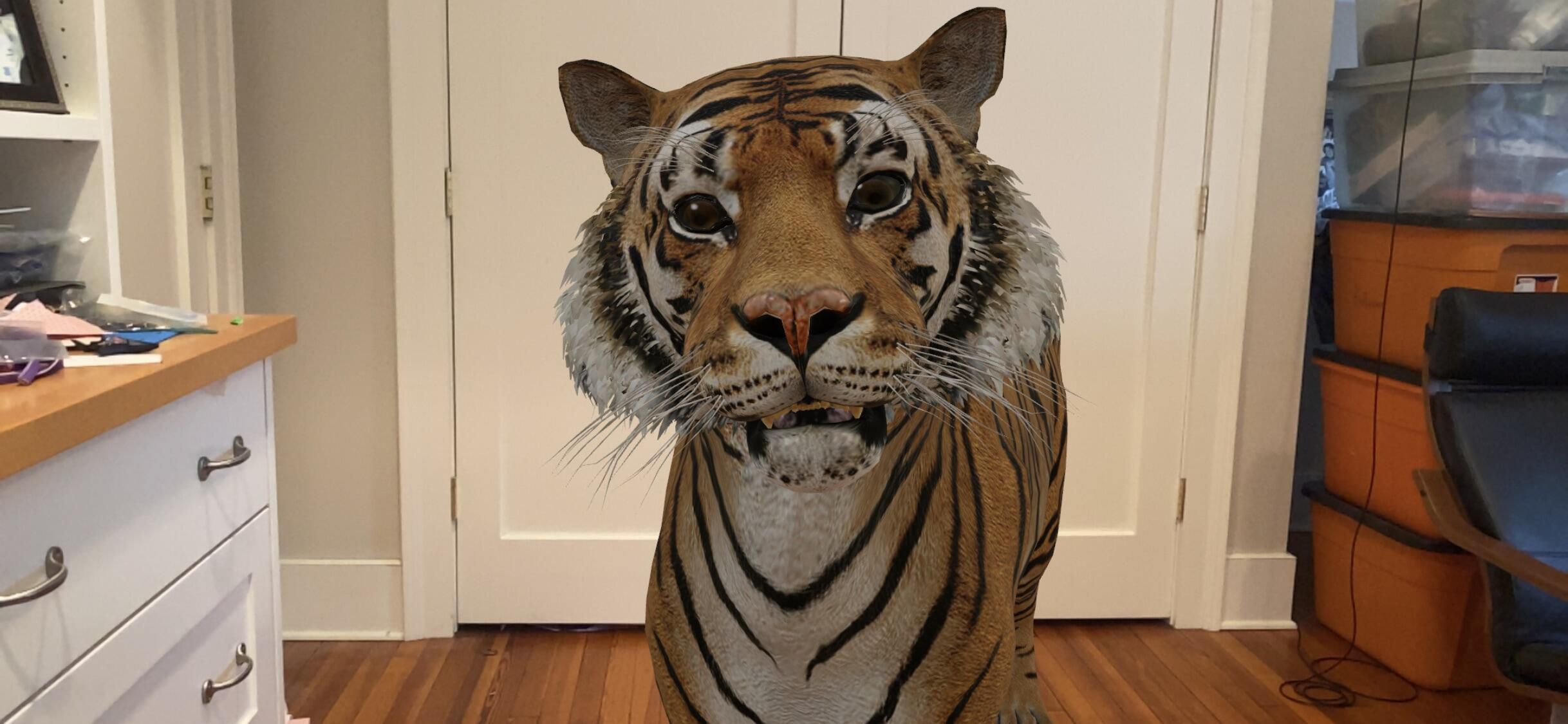
Feeling bored? Put a virtual animal in your home. One thing that might have felt like a passing fad but still gets people’s attention (at least according to the new likes on my old Twitter thread about it) is this list of augmented-reality animals that I dropped into the real world through Google search. That’s right. AR animals, now that we’re all becoming stay-at-home people for a while and can’t go to zoos or pet shops, are a thing. Google has added even more AR searchable things like skeletons and microscopic cell structures, but animals (and dinosaurs) are probably more adorable.
If you’ve been curious and haven’t tried it yet, I have some tips.
First I saw some news stories linking to my Twitter thread. Then, my first-grader son asked what another kid was doing on his school video chat: It turns out she was making a cat appear on her head, and in her room, all via AR. It’s because of them — and you — that I’m giving you my guide on How to Make Magic Animals Appear.
The easy way is directly below. Keep scrolling for two other methods to put virtual animals in your mixed-reality world.
First off, the easy way
Google put 3D objects into Google search over a year ago. To find them, you need to search on Google for the right ones. Think of an animal. Type it in. See what happens. Google has a lot of animals, and also some space objects like planets and satellites via NASA. And the list of 3D objects may increase, based on indications from Google and Apple.
First make sure you have an AR-ready device. For iPhones and iPads, you’ll need iOS 11 or higher. And that’s not older than an iPhone 6S or SE, or a third-gen iPad Air, or fifth-gen iPad, or any iPad Pro. Or, a seventh-gen iPod Touch. (Yes, Apple’s model naming gets super confusing.)
Android phones need to be ARCore compatible, which includes a lot of models running Android 7 or later. Here’s a helpful list of all the phones that 9to5Google compiled.
Then launch Google Chrome (or Safari on an iPhone or iPad), search for your animal — it doesn’t have to just be a tiger — and somewhere on the page will be a Google information box that also has a «View in 3D» button.
Click on it, then a viewer will appear showing where you can place your virtual animal. Move your phone around as it instructs, so it can scan your floor. Leave some extra space to place it.
Congrats — you have an AR animal!
Pinch to zoom to make it bigger or smaller.
What if you don’t see the 3D button? I’ve had people ask me this. You might be browsing in desktop-view mode. On iOS 13, in Safari, try tapping the Aa icon on the search bar. If you see an option that says «request mobile website,» tap on it. In Chrome, go to settings (the … icon on the lower right) and if you see «request mobile site,» tap on it.
Another tip: To record it, you could take a screenshot (tap your power and volume button or power and home button on an iPhone or iPad), or do a screen capture video on iOS if you’re fancy. Pro tip: You can add screen capture recording to your Control Center tools in Control Center settings, which easily allows you to start and stop recordings and save them to your photo roll. Or, just be in the moment and enjoy seeing your animal buddy.
A starter list of Google AR 3D animals
I’ve hunted around and found a bunch, but a larger trial-and-error list compiled by 9to5Google includes:
- Alligator
- Angler fish
- Ball python
- Brown bear
- Cat
- Cheetah
- Deer
- Dog (bulldog, pomeranian, Labrador retriever, rottweiler, pug)
- Duck
- Eagle
- Emperor penguin
- Giant panda
- Goat
- Hedgehog
- Horse
- Leopard
- Lion
- Macaw
- Octopus
- Raccoon
- Shark
- Shetland pony
- Snake
- Tiger
- Turtle
- Wolf
Option 2: Even more animals
You can download some AR-compatible apps to try on the App Store or Google Play. One free app with a ton of AR-compatible 3D objects is Sketchfab, an online 3D object repository that has its own app, and recently updated to better support Apple’s AR. It’s a little harder to browse through, but there are tons of user-created things that can be dropped into your world.
I found a scorpion, many dinosaurs and more. This isn’t a great option for kids, though: best to do with your kids and vet out if there’s anything weird on Sketchfab that isn’t appropriate or too scary.
Option 3: Don’t forget about Snapchat
Snapchat’s wildly good face filters and AR effects offer some animal transformations and disguises, too (or, even room-altering effects, depending on the day). You’ll need a Snapchat account, and I’d suggest parents do this with kids together rather than have them play on their own — not all options may be suitable.
Once in Snapchat, the small smiley-face on the right of the larger circle at the bottom brings up face filters. You can browse through a bunch of weird and fun experiments — again, parents, vet out the scary ones; this isn’t entirely kid-friendly.
But you could try one out and have fun, and not record any of them. Or, press the shutter button (the circle) to snap, or hold to record a clip. When done, you can save locally to your phone by hitting the «save» icon on the lower-left corner of the screen, and it saves to your own photos so you don’t have to post anything online if you don’t want to.
Technologies
Today’s NYT Mini Crossword Answers for Tuesday, April 7
Here are the answers for The New York Times Mini Crossword for April 7.

Looking for the most recent Mini Crossword answer? Click here for today’s Mini Crossword hints, as well as our daily answers and hints for The New York Times Wordle, Strands, Connections and Connections: Sports Edition puzzles.
Need some help with today’s Mini Crossword? Read on for all the answers. And if you could use some hints and guidance for daily solving, check out our Mini Crossword tips.
If you’re looking for today’s Wordle, Connections, Connections: Sports Edition and Strands answers, you can visit CNET’s NYT puzzle hints page.
Read more: Tips and Tricks for Solving The New York Times Mini Crossword
Let’s get to those Mini Crossword clues and answers.
Mini across clues and answers
1A clue: Informative commercial, for short
Answer: PSA
4A clue: Something you trace to draw a Thanksgiving turkey
Answer: HAND
5A clue: ___ Johnson, former Prime Minister of the U.K.
Answer: BORIS
6A clue: Opposite of include
Answer: OMIT
7A clue: Crosses (out)
Answer: XES
Mini down clues and answers
1D clue: City with the Notre-Dame Cathedral
Answer: PARIS
2D clue: Bad mood
Answer: SNIT
3D clue: About eight minutes of the average half-hour sitcom
Answer: ADS
4D clue: Remote worker’s office, perhaps
Answer: HOME
5D clue: Word that can follow each group of circled letters (and hints at its shape)
Answer: BOX
Technologies
NASA’s Artemis II Breaks Record With Trip Around The Moon
Technologies
In Honor of the Artemis II Mission, Explore the Moon in Fortnite Now
You might not be able to see the moon the way the Artemis II team is, but there’s an educational Fortnite simulation that will get you onto the celestial body’s surface.
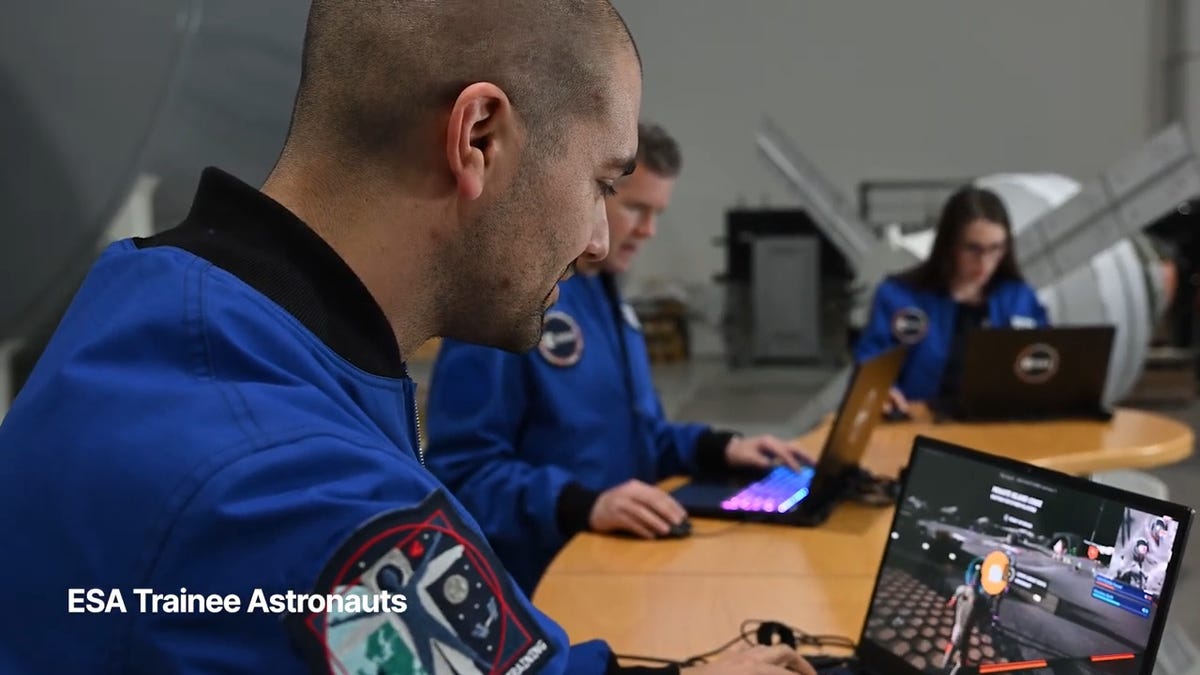
You may not be able to explore the vast majesty of space in the same way that the four-person crew of the Artemis II is, but you can still get an up-close-and-personal view of the moon… in Fortnite, at least.
While you may not be able to slingshot around Earth’s own lunar body, space enthusiasts can see a little bit of what the Artemis II crew is seeing by spending time on the Lunar Horizons Fortnite map right now. The map is a creative collaboration between Fortnite’s creator, Epic Games, and the European Space Agency. Lunar Horizons was released in 2024 after extensive testing and play from ESA trainee astronauts.
If you’re looking to learn more about our own orbiting body, the Lunar Horizons map is an educational simulation of the surface of the moon’s South Pole.
It blends game mechanics with learning, as players get to build up their own sterile lunar habitat bases, interact with ESA astronauts and roll around with robotic rovers as they discover informative plaques that contain information about the moon and international space agencies. There are still dangers to navigate, too — a solar storm may strike when you least expect it.
If you’re interested in exploring the moon, we’ve got all the information you need to join in on the Fortnite fun below. And if you’re looking for a more serious livestream during this momentous human achievement, tune into NASA’s feed here.
How to join the Moon Fortnite island while you follow the Artemis II mission
The Lunar Horizons Fortnite map is a great educational simulation that shares details about ESA’s work and catalogs information about humanity’s lunar research.
These three simple steps will get you up and running (or more accurately, taking slow leaps and bounds) on the surface of the Lunar Horizons Fortnite map:
Download Fortnite
If you haven’t played Fortnite before, but you want to check out this limited-time event, you’ll have to download the game. If you’re on PC, you can download Fortnite for free from the Epic Games Store. Console players can navigate the PlayStation Store, Microsoft Store or Nintendo eShop in order to download Fortnite on their devices.
Navigate the in-game menus until you reach the Search button
Once you’re in the game, scroll down past the different official Fortnite game modes and the Discover tab until you find the Search button.
Input the Lunar Horizons island code
In the search bar, you can input a map’s name or its distinct search code in order to find it in the map directory. You can search for the Lunar Horizons map or input the code 3207-0960-6428 to explore this map in time.
Correction, 3:35 p.m. PT: This story initially was in error about the features available in the Lunar Horizons map. There is no Artemis II-specific mission in Fortnite. Rather, the Lunar Horizons map is an educational simulation of part of the moon’s surface.
-
 Technologies3 года ago
Tech Companies Need to Be Held Accountable for Security, Experts Say
-
 Technologies3 года ago
Best Handheld Game Console in 2023
-
 Technologies3 года ago
Tighten Up Your VR Game With the Best Head Straps for Quest 2
-
 Technologies4 года ago
Black Friday 2021: The best deals on TVs, headphones, kitchenware, and more
-
 Technologies5 лет ago
Google to require vaccinations as Silicon Valley rethinks return-to-office policies
-
 Technologies5 лет ago
Verum, Wickr and Threema: next generation secured messengers
-
 Technologies4 года ago
Olivia Harlan Dekker for Verum Messenger
-
 Technologies4 года ago
The number of Сrypto Bank customers increased by 10% in five days