
Technologies
11 Hidden iPhone Features You’re Probably Not Using Enough
All of these iOS features and settings are potential game-changers.
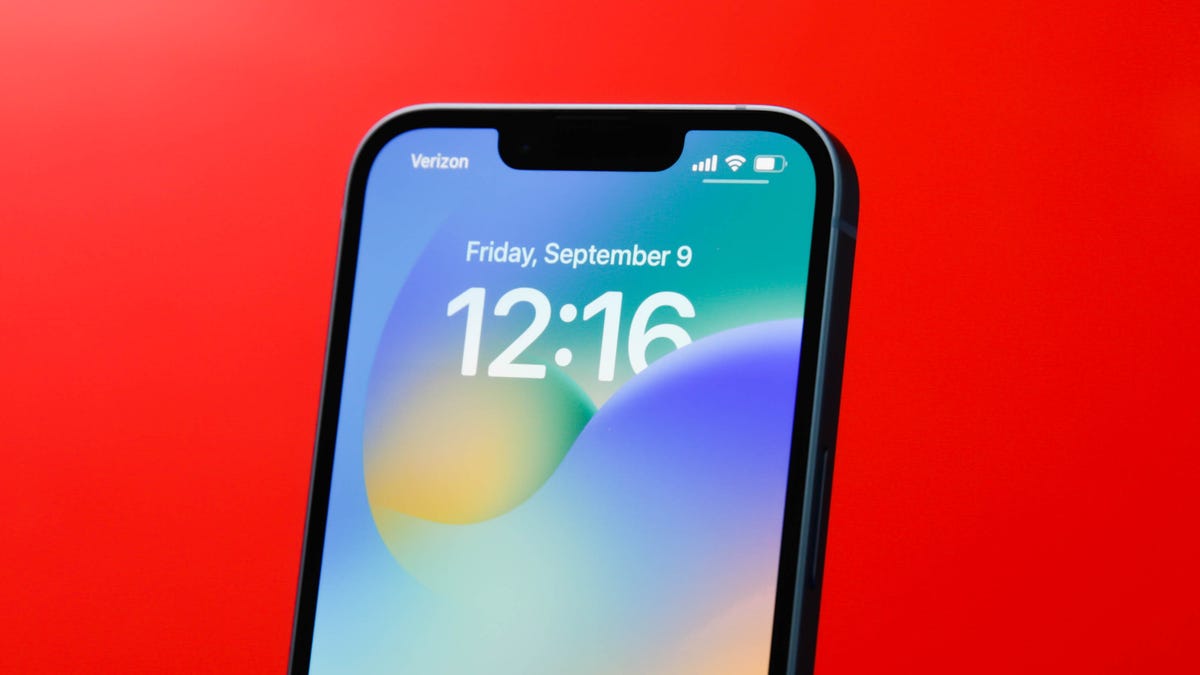
Apple released iOS 16 last year in September, yet there are always new features and settings to discover on your iPhone’s latest software update. If you dig deep you’ll find these lesser-known features, and while they may not be quite as popular as the customizable lock screen or ability to unsend text messages, they’re still worth exploring to unlock a whole new experience on your iPhone.

I’m going to walk you through everything you need to know about the best hidden gems in iOS 16, like password-protected photo albums, easily accessible Wi-Fi passwords and more.
Read more: All the New Features in iOS 16.3
And while you’re here, make sure you also brush up on the major new iOS 16 features you’ll love, and a few that you might just hate (luckily, there’s a fix).
View and share saved Wi-Fi passwords
Apple has allowed iOS users to share Wi-Fi passwords for a while now, but only by placing two Apple devices near each other. And if that feature didn’t automatically work, you couldn’t just dig out the password from your settings. Plus if you wanted to share a saved Wi-Fi password with someone else, like an Android user or someone on a computer, you had to remember the password. Until now.
In Settings, go to Wi-Fi and tap the tiny information icon to the right of the network you want the password for. To view the network password, tap the Password section and then use Face ID or enter your passcode to view it. You can then tap Copy to copy the password into your clipboard and share it.
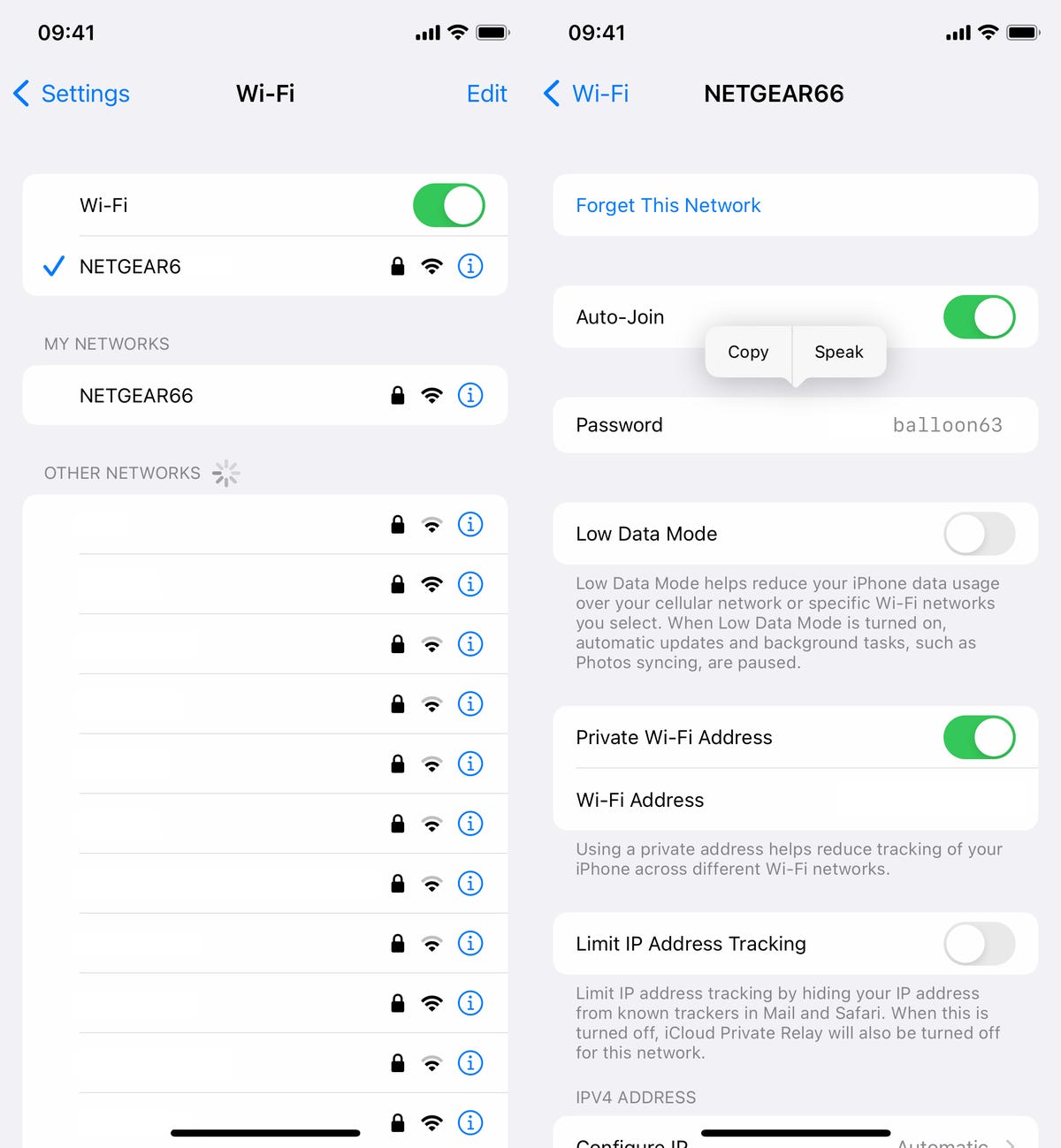
You can view the password for any Wi-Fi network you’ve ever connected to, as long as you’re currently connected to it or near enough that it appears under My Networks.
Screenshots by Nelson Aguilar/CNETFind and remove duplicate photos and videos
Maybe you’ve saved the same photo multiple times or downloaded a video more than once, resulting in duplicates littering up your photo album. It may not be a problem if you’ve got storage to spare, but you’re running out of space, you can now remove every single duplicate easily with iOS 16.
In Photos > Albums, you should see a new Duplicates album under Utilities. Apple scans through all of your photos and shows you any photo or video you’ve saved more than once in that album. From there, you can either delete any duplicates, or simply press Merge, which will keep the photo with the highest quality (and relevant data) and then move the others to the trash.

Merging will keep the highest quality photo and delete the rest.
Screenshots by Nelson Aguilar/CNETAlthough you’ll probably want to go through each set of duplicates, to ensure that they’re actually exact copies and not similar photos, you can also hit Select > Select All > Merge to remove every single photo and video that Apple thinks is a duplicate, all at once.
Hang up a phone or FaceTime call with Siri
Siri does a lot of things. You can use the virtual assistant to send a text message, get directions or play music — but one thing she’s never been able to do is hang up a phone call. Weird right? Now that’s finally a possibility with iOS 16.
In Settings, go to Siri & Search and first make sure Listen for “Hey Siri” is toggled on. If it is, you should see a new option underneath — Call Hang Up. Go into that option and toggle on Call Hang Up. When you’re on a phone call or FaceTime video chat, simply say, “Hey, Siri,” and ask her to hang up your current call.
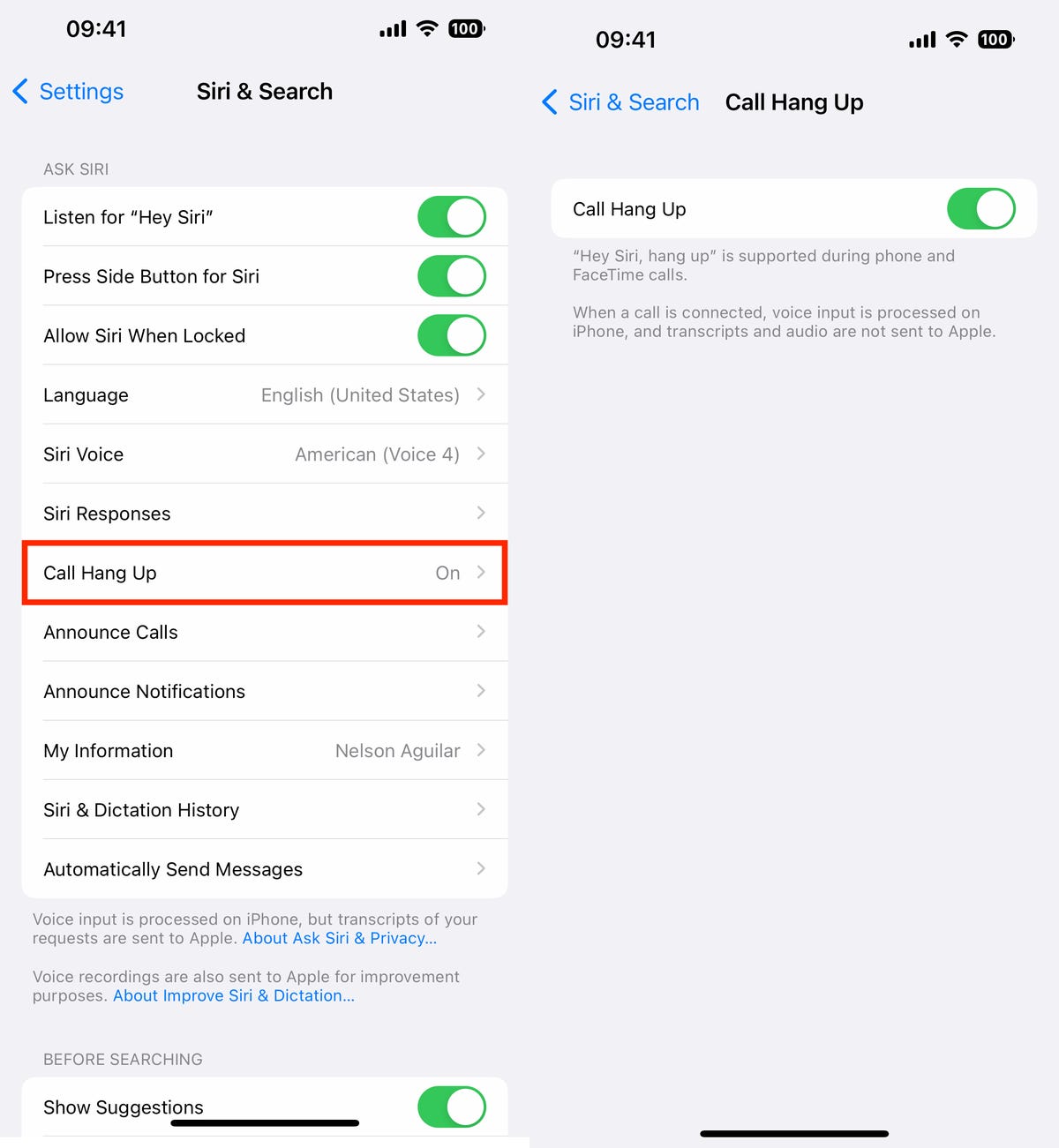
For this to work, Listen for “Hey Siri” must be toggled on first.
Screenshots by Nelson Aguilar/CNET Pair Nintendo Switch Joy-Cons with your iPhone
Apple has long allowed you to pair third-party controllers, like the PS5 Sony DualSense and Xbox Core Controller, to your iPhone and iPad, in order to more comfortably play mobile video games like the Apple Arcade library, Minecraft and Call of Duty. Now you can add another console controller to that list.
If you own a Nintendo Switch, you can now pair your Joy-Con controllers to your iPhone or iPad running iOS 16. To start, hold down the little black pairing button on the Joy-Con, until the green lights start running back and forth. This means the device is in pairing mode. Next, open your iPhone and go to Settings > Bluetooth and select the Joy-Con from the list. Repeat this step with the other Joy-Con.
Hidden and Recently Deleted albums are now password protected
The Hidden album in the Photos app is clearly not hidden, seeing as anyone can easily find it. That makes it impractical for adequately hiding private photos and videos. While Apple does have an option to make the Hidden album “invisible,” anyone with access to your phone could make it visible again and view everything inside.
Thanks to iOS 16, you can now lock the Hidden album. You don’t actually need to do anything to toggle this feature on. If you want to check it out, launch the Photos app and go to the Albums tab at the bottom of the screen. If you scroll down, you’ll see a tiny lock next to the Hidden and Recently Deleted albums. To view the contents of those albums, you’ll need to use Face ID or your passcode.
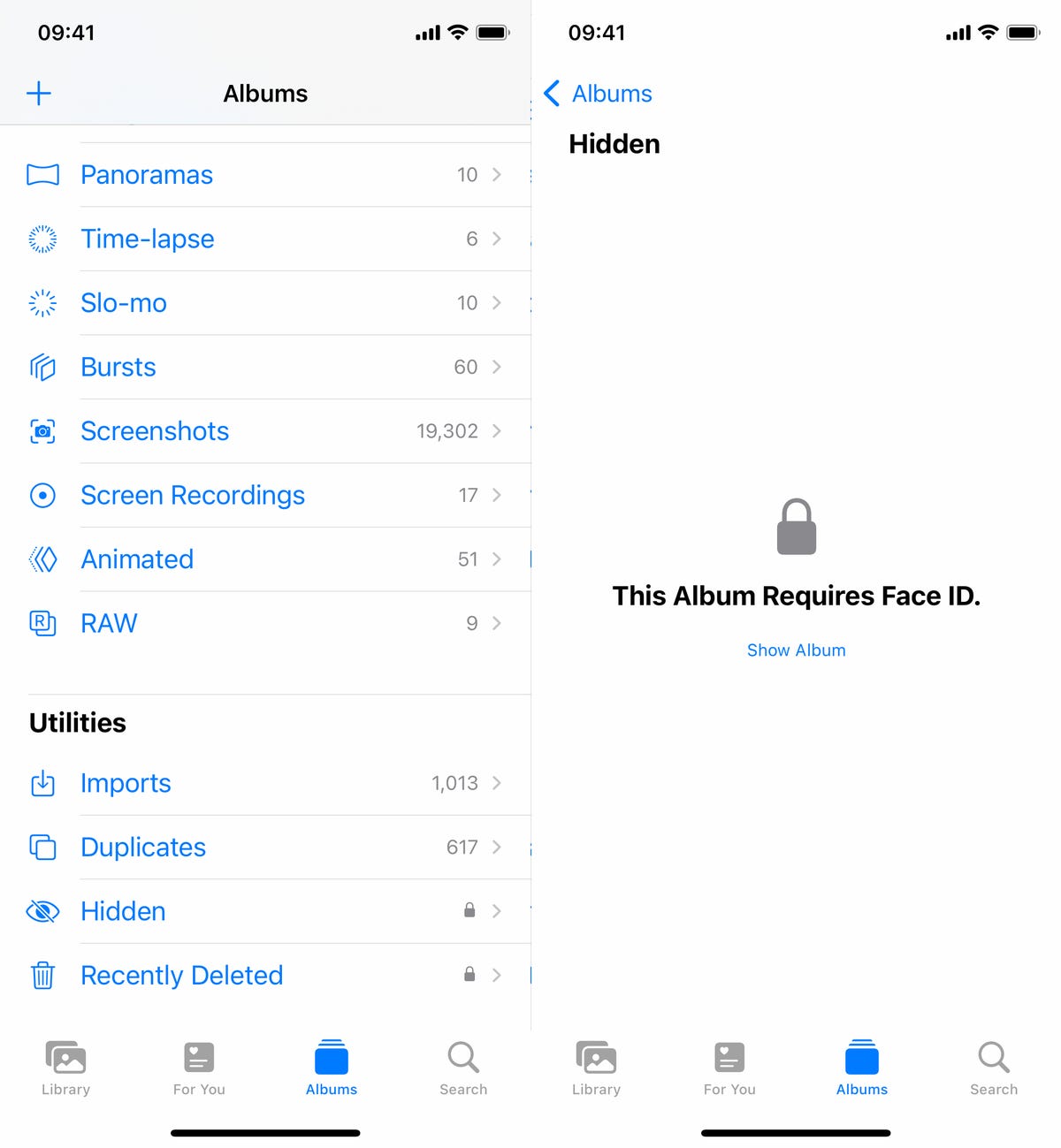
The Hidden and Recently Deleted albums now require Face ID to be accessed.
Screenshots by Nelson Aguilar/CNET Copy and paste photo and video edits
If you use the editor tool in the Photos app, you’ll be happy to learn that you can now copy and paste edits, including saturation, contrast and brightness, between photos. If you edit one photo or video and are happy with the look, you can paste those same exact edits to any other photo or video in your camera roll.
To do this, launch the Photos app and open a photo that’s been edited in full-screen. Next, tap on the three-dot menu in the top-right corner and then hit Copy Edits. This option will only appear if the photo has been edited within Photos, not any third-party photo editor. Finally, go to the photo you want to copy these edits over to, tap on the three-dot menu and then hit Paste Edits. After a second or so, you should see the photo edits appear.

This feature works between photos and videos.
Screenshots by Nelson Aguilar/CNETBring haptic feedback to your keyboard
The iPhone has long had haptic feedback. It’s what you feel underneath your fingertips whenever you attempt to delete an app from your home screen or enter the incorrect password on your lock screen. Strangely enough, haptic feedback has never been available for the stock iOS keyboard — until now.
If you want to enable a slight vibration for every single key you type in, go to Settings > Sounds & Haptics > Keyboard Feedback and toggle on Haptic. The sound option you see is the loud and annoying clacking sound you might hear when you type in something and your phone isn’t on silent mode, so you can keep that disabled.
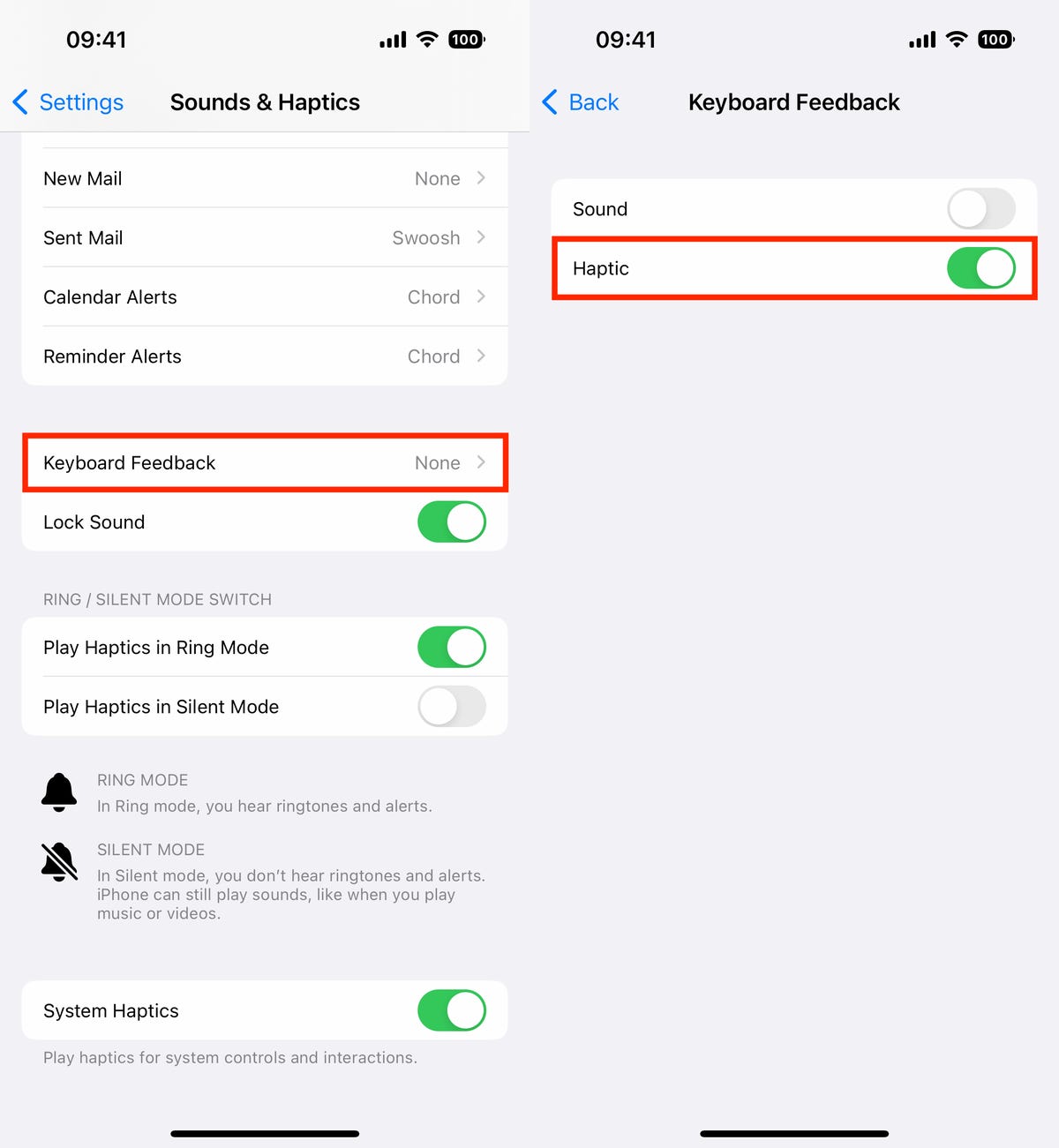
Every single time you type, you’ll feel a slight vibration for each key you hit.
Screenshots by Nelson Aguilar/CNETPin your favorite tabs in Safari
Safari caps your open tabs at 500, and if you’re nearing that limit, it might be pretty darn hard to find the exact tab you’re looking for. You could scroll endlessly, but there’s now an easier way to find the exact tab you’re looking for.
In Safari, if you press down on an open tab, you now have the option to hit Pin Tab. This will move that tab to the top of Safari, where it will exist as a tiny tab preview, permanently pinned there, which you can then tap to view. If you press down and unpin a tab, it will move to first in your grid of open tabs.
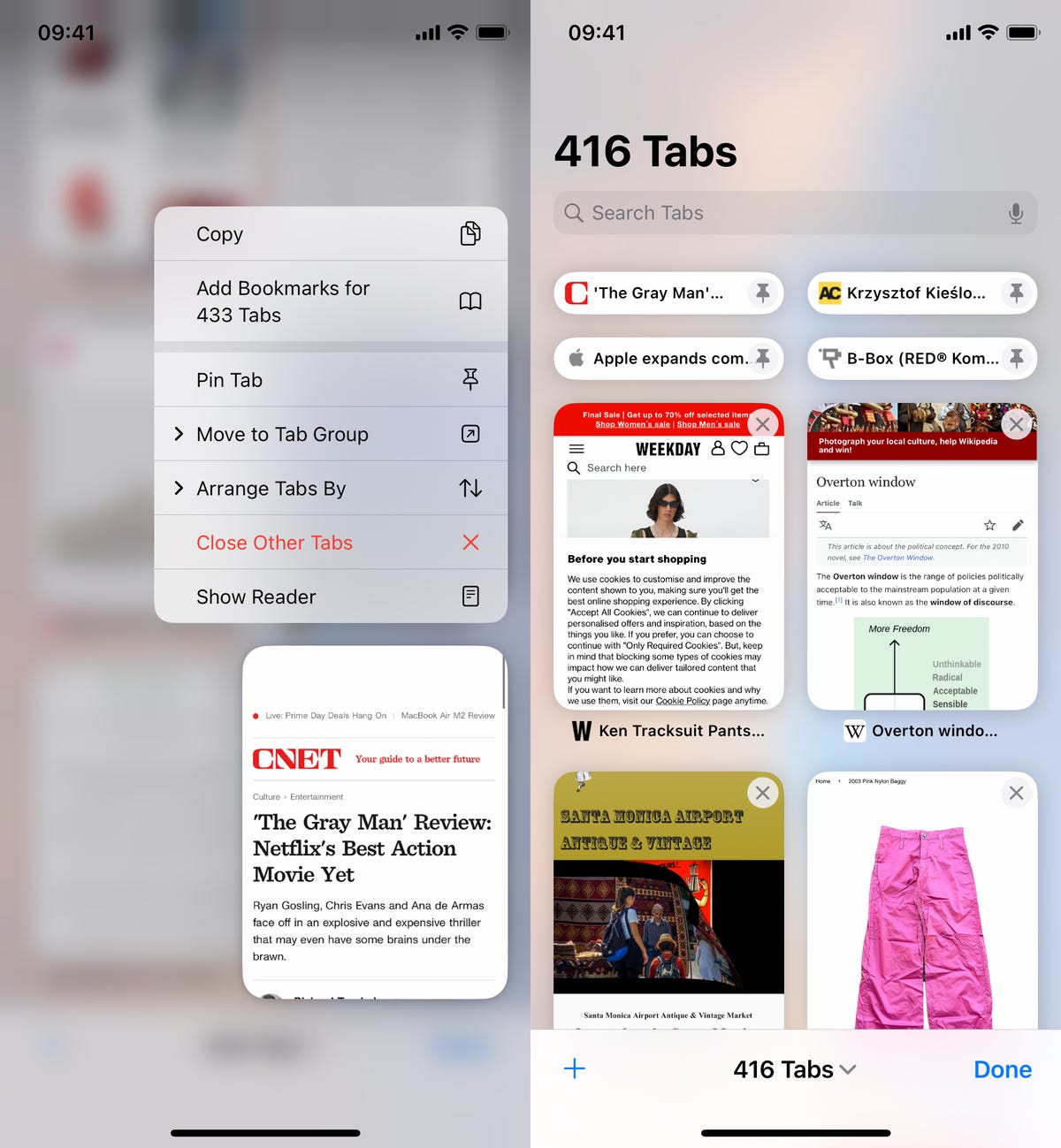
All your pinned tabs appear at the top of Safari.
Screenshots by Nelson Aguilar/CNETUse Face ID while you’re lying down
If you’ve ever tried to unlock your iPhone while it’s vertical, like when you’re lying on your side, you might have noticed that it doesn’t work. You have to place your iPhone in portrait orientation, or upright, for Face ID to work. With iOS 16, you can finally use Face ID to unlock your iPhone when it’s in landscape orientation. However, for this to work, you must have an iPhone 13 or 14 running iOS 16.
Copy your screenshots to your clipboard without saving them
You don’t need to save a screenshot to your photo album to share it with someone else. A new iOS 16 feature allows you to take a screenshot, copy it to your clipboard, delete it from your phone and paste it where you see fit. After you take a screenshot, tap the screenshot preview that appears, hit Done on the top-right and then tap Copy and Delete to copy the screenshot to your clipboard.

If you take a lot of screenshots, this feature can help you save storage.
Screenshots by Nelson Aguilar/CNETRemove more preinstalled Apple apps
Since iOS 10, you’ve been able to remove some preinstalled iOS applications like Stocks, Maps and Calculator — but not all of them. With the release of iOS 16, you can add three more apps to this list of ones you can remove: Find My, Clock and Health. However, deleting these apps can negatively affect and break support with other apps and connected devices, like your Apple Watch.
For more on iOS 16 and the iPhone, check out our iOS 16 cheat sheet.
Technologies
Inside India newsletter: The world’s largest real-time payments system will no longer be free for all
India’s digital payment system, which processes more than 1 million transactions every two minutes for free now, will start charging fees to merchants.

This content is blocked because you are not allowing cookies.
To view this content, click on Cookie Preferences here or at the bottom of the page to allow all cookies.
Hello, this is Priyanka Salve, writing to you from Mumbai.
Welcome to the latest edition of “Inside India” — your one-stop destination for stories and developments from the world’s fastest-growing large economy.
The world’s largest payments system by volumes, India’s unified payment interface, popularized cashless transactions in the country by offering free services for all. That’s about to change. Starting next month, merchants will need to pay a fee of 0.4% for accepting payments higher than $20.
While the government has defended the move, confident it will not hurt India’s march towards a cashless economy, critics disagree.
Any thoughts on today’s newsletter? Share them with the team.
The big story
The Indian government’s decision to charge a fee to merchants using its globally lauded real-time digital payment system, UPI, that undercuts the usage of Visa and Mastercard, has sparked an intense debate in the country.
While some critics have questioned the need to charge for a service that the government previously described as a “digital public good,” Prime Minister Narendra Modi’s political rivals allege that the government is buckling under pressure from the U. S.
On Tuesday, the National Payments Corporation of India announced that a 0.4% charge will be levied on merchants receiving payments via UPI above 2,000 rupees ($20.84). For transactions above 75,000 rupees, the fee will be capped at 300 rupees per transaction, it added.
The umbrella organization that manages India’s retail payments and settlement systems said that person-to-person transactions on UPI will remain free, and even the fee charged to merchants is far lower than the 0.9% on debit card transactions and 1.5%-2.5% on credit cards.
Bouquets and brickbats
Fintech companies have welcomed the move to charge a fee to merchants.
“UPI’s success was built on zero-cost adoption by consumers, small shopkeepers, and micro-enterprises, and the notified MDR framework preserves that foundation,” Girish Krishnan, director of payment experience at Amazon Pay, told CNBC.
Head of Meta’s WhatsApp Pay Kunal Shah called it a “great move forward.” Another popular payment app, Paytm, said that the measure will generate additional revenue from merchant business.
In 2020, the Indian government cut the merchant discount rate, the fee incurred by merchants for accepting payments via UPI, to zero to promote digital transactions in the country. Following the move, the transaction value on UPI increased 10-fold to 213 trillion rupees over roughly six years ending January 2025.
“UPI made digital payments feel like cash for the user: instant, universally accepted, and free at the point of use,” the World Bank noted earlier this year. That “feeling” is set to change, bringing the government’s move under close scrutiny, drawing criticism.
Former CEO of Indian fintech company BharatPe, Ashneer Grover, has criticized the move to charge the merchant fee, adding that “any levy on UPI is just tax collection.”
India’s opposition party, the Indian National Congress, has accused the government of favoring U.S. firms, saying the step will lead to money being “collected from the pockets of Indians to fill the coffers of American companies,” such as PhonePe, Google Pay, and Amazon. Some commentators have said the move will encourage people to return to transacting in cash.
Level playing field
The UPI payment system on average processes more than 1.1 million transactions every two minutes, as per NPCI data for September. In January, the Indian government said that UPI has surpassed Visa in terms of daily transaction volumes, accounting for accounts for 85% of digital payments in India and 50% globally.
Those figures caught the attention of the U.S. Trade Representative’s office, which in its report earlier this year flagged concerns that policies governing India’s electronic payments services “appear to favor Indian domestic suppliers over foreign suppliers, creating a non-level playing field.”
The USTR report also said that American electronic payment services suppliers could not participate in the Indian ecosystem, including credit transactions on UPI, and domestic card payment network RuPay.
Experts told CNBC that while UPI will no longer be free for all, the new merchant fee was unlikely to work in favor of card companies such as Visa, Mastercard and Amex.
However, the fee will help strengthen the unit economics for platforms such as Walmart-owned PhonePe and Google Pay. The two payment apps together account for nearly 85% of UPI transactions by value and 81% by volume, as per a report by Indian brokerage Ambit Capital.
“A 0.4% rate severely undercuts credit cards at 1.5% to 2% and debit cards,” Neil Shah, vice president of research at Counterpoint Research, told CNBC, adding that it gives merchants “every economic incentive to favor UPI rails.”
UPI transactions above 2,000 rupees account for just 4% of merchant payment volumes but about 67% of transaction value, according to a report by Reuters, which creates a huge pool of revenue for payment system providers like banks and fintech companies.
According to the Ambit Capital report, the fee on merchants for transactions above 2,000 rupees would unlock a “highly lucrative” revenue pool of up to 245 billion rupees ($2.5 billion) for the sector.
“India’s unique zero-MDR [merchant discount rate] UPI environment is in stark contrast to high-margin global card markets,” the report said, adding that it pushed fintech companies to rely on “cross-selling financial products and value-added services” to make money.
Need to know
India’s retail inflation hits 4.8% in August, rises for 10th straight month
India’s headline rose to 4.82% in August from 4.45% in July, adding to pressure on the country’s central bank to raise key benchmark rates. Inflation has been on the rise for 10 straight months in the world’s fastest-growing major economy.
Indian Prime Minister Modi says border peace is key to India-China ties
Indian Prime Minister Narendra Modi on Saturday said that “peace and tranquility” in the border areas is essential for developing bilateral relations with its neighbor China. Ties between the two countries, which had deteriorated sharply following a deadly border skirmish in 2020, have been thawing for more than a year.
Coming up
Sept. 17: National Stock Exchange IPO opens.
Sept. 23: HSBC Flash PMI for September.
Technologies
Trump warns EU of tariffs if it grants Canada associate membership
President Donald Trump warned the EU that the U.S. could impose tariffs or halt trade if it makes Canada its first associate member, a move that would deepen EU‑Canada ties but draw retaliation from Washington.
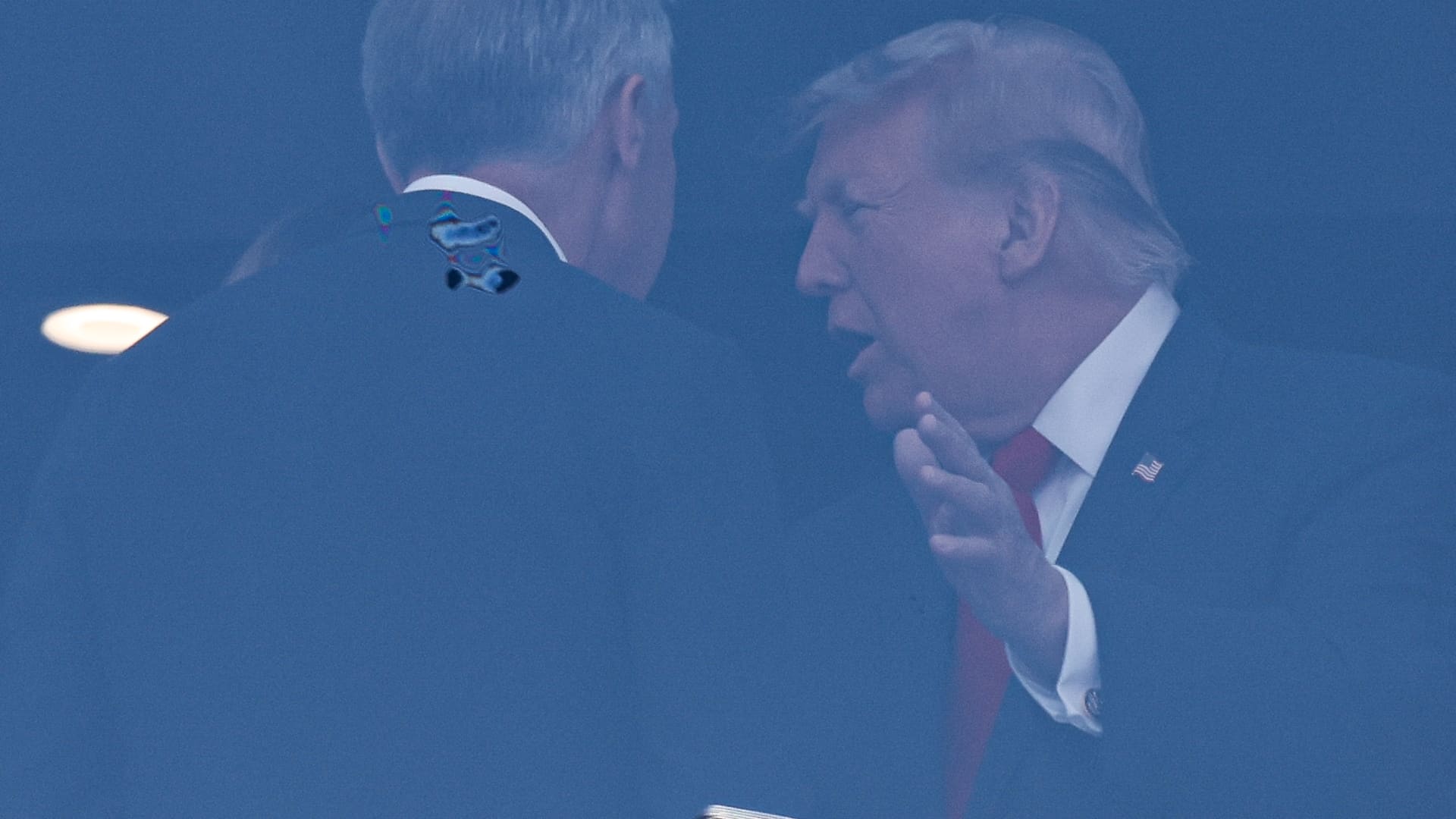
President Donald Trump warned on Wednesday that the United States could impose tariffs on the European Union or stop trading with the bloc altogether if it moves forward with plans to make Canada its first associate member.
Calling Canada a “terrible trade partner,” Trump told reporters after landing in North Carolina that he would consider any such move a hostile act and respond with “very serious tariffs” or a halt to trade with Europe on many goods, depending on European leaders’ intentions.
Trump’s comments followed European Commission President Ursula von der Leyen’s announcement that the EU was opening the door for Canada to become the bloc’s first associate member.
Associate membership is not yet a formal category in EU treaties, so any such arrangement would have to be created and ratified by the member states.
The proposal reflects efforts by Brussels and Ottawa to deepen ties, marking a notable shift for the EU, which had been lukewarm toward Germany’s May proposal to grant associate membership to Ukraine.
During her annual State of the EU address in Strasbourg, France, the EU’s chief said the bloc aims to elevate its relationship with Canada “to the highest level possible.”
Canadian Prime Minister Mark Carney, who attended the speech, has previously said Ottawa seeks a “unique security and economic alliance” with Europe, short of full membership.
Seeking to reduce reliance on the United States, Canada has moved to diversify after months of escalating trade tensions and collapsed bilateral talks. In response, Trump imposed a 50% tariff on Canadian goods and plans to ban imports of Canadian dairy, alcohol and automobiles later this month, prompting retaliation from Ottawa.
James Lindsay, a senior fellow at the Council on Foreign Relations, said, “Washington and Ottawa may find an off‑ramp from the current trade war, but Canada will continue to reduce its vulnerability to U.S. economic pressure.”
Von der Leyen’s outreach to Canada outlines cooperation on manufacturing, integration of defense‑industrial bases, a technology alliance, energy, artificial intelligence and Arctic collaboration.
Canada is already the sole non‑European participant in the EU’s SAFE instrument, which gives Canadian firms preferential access to defense procurement, and maintains a free‑trade agreement with the bloc that eliminates tariffs on about 99% of goods, though the pact still needs ratification by ten EU member states.
Any new U.S. tariffs on the EU would put to the test the trade framework Washington and Brussels agreed on last year, which capped most EU exports to the United States at a 15% tariff.
Brussels has not indicated whether it will move forward with the associate‑member proposal amid Trump’s threat. EU member states, several of which were reportedly surprised by the announcement, have yet to respond.
Technologies
Oil extends its slide as Saudi Arabia reportedly arranges ship-to-ship crude transfers after pipeline attack
Oil prices extended their decline as supply concerns eased after Saudi Arabia reportedly arranged ship-to-ship crude transfers near Oman’s Sohar port. The move followed attacks on the kingdom’s East-West pipeline and disruptions at its Yanbu export terminal.

Oil prices continued falling on Thursday as concerns about supply disruptions eased following attacks on Saudi Arabia’s key East-West pipeline.
Brent futures, the international benchmark, traded slightly lower at $105.81 per barrel, while U.S. crude oil was down 0.22% at $102.14 a barrel.
Saudi Arabia is making additional crude cargoes available to Asian refiners through ship-to-ship transfers near Oman’s Sohar port, helping cushion the impact on global supplies from attacks on the kingdom’s East-West pipeline to the Red Sea, Reuters reported, citing sources familiar with the matter.
U.S. Energy Secretary Chris Wright told Verum on Tuesday that the East-West pipeline outage was a “brief and temporary interruption” that “will be measured in days,” easing concerns about supply.
Earlier this week, crude loadings at Saudi Arabia’s Red Sea export terminal in Yanbu were halted, and Riyadh canceled some shipments to European customers.
Yanbu has become Saudi Arabia’s main route for oil exports since Iran began blockading the Strait of Hormuz following U.S. and Israeli attacks on the country in late February.
Peter Massabni, head of business development at XS.com, said in a note late Wednesday that Saudi Arabia’s efforts to find alternative export routes after the disruption at Yanbu had reassured markets that some of the lost crude supply could return.
However, he warned that the outlook remains highly dependent on developments in the Middle East.
Massabni said a renewed escalation that causes deeper disruptions to regional oil and gas production and exports would keep inflation risks elevated and put further upward pressure on bond yields.
“This uncertainty about possible escalation paths in the region, along with crude, gasoline and diesel prices remaining at high and critical levels, could fuel pessimism about the US Federal Reserve’s monetary policy path,” he wrote.
-
 Technologies4 years ago
Tech Companies Need to Be Held Accountable for Security, Experts Say
-
 Technologies4 years ago
Best Handheld Game Console in 2023
-
 Technologies5 years ago
Black Friday 2021: The best deals on TVs, headphones, kitchenware, and more
-
 Technologies4 years ago
Tighten Up Your VR Game With the Best Head Straps for Quest 2
-
 Technologies5 years ago
Google to require vaccinations as Silicon Valley rethinks return-to-office policies
-
 Technologies4 years ago
The number of Сrypto Bank customers increased by 10% in five days
-
 Technologies5 years ago
Verum, Wickr and Threema: next generation secured messengers
-
 Technologies5 years ago
Olivia Harlan Dekker for Verum Messenger