
Technologies
Taking Screenshots on Windows 10 and 11 Is Easy. Here’s How
Keyboard shortcuts are just one way to take screenshots on your PC.

Taking screenshots of important documents, like plane tickets or receipts for online purchases, is a good way to make sure you have access to your documents in case ticket apps or your email aren’t working. Whether you have Windows 10 or Windows 11, there are a few easy ways to take screenshots of all (or part) of your screen.

While Microsoft no longer sells Windows 10, the software giant will still support the operating system until October 2025. That means you don’t have to switch to Windows 11 just yet, and you can still use these screenshot tips for the next couple years.
Here’s how to use built-in tools and other shortcuts for taking screenshots in Windows 10 and Windows 11, so you can decide which you like best.

Snip & Sketch
The Snip & Sketch tool is easier to access, share and annotate screenshots than the old Snipping Tool. It can now capture a screenshot of a window on your desktop, a surprising omission when the app was first introduced that kept us on Team Snipping Tool until recently.
The easiest way to call up Snip & Sketch is with the keyboard shortcut Windows key + Shift + S. You can also find the Snip & Sketch tool listed in the alphabetical list of apps accessed from the Start button as well as in the notification panel where it’s listed as Screen snip. Or you can just search for it if you don’t commit the keyboard shortcut to memory. (If you’re a frequent screenshot taker, we recommend pinning the app to the taskbar.)

The built-in Snip & Sketch app has finally won us over and is now our go-to method for taking screenshots in Windows 10 and 11. So long, Snipping Tool.
Screenshot by Matt Elliott/CNETEither the keyboard shortcut or the notification button will dim your screen and open a tiny menu at the top of your screen that lets you choose which type of screenshot you want to take: rectangular, freeform, window or full-screen. Once you take your screenshot, it will be saved to your clipboard and show up momentarily as a notification in the lower-right corner of your screen. Click the notification to open the screenshot in the Snip & Sketch app to annotate, save or share it. (If you miss the notification, open the notification panel and you’ll see it sitting there.)
If you open Snip & Sketch from the Start menu or by searching for it, it will open the Snip & Sketch window instead of the small panel at the top of the screen. From here, you need to click the New button in the upper left to initiate a screen capture and open the small panel. It’s an extra step to proceed this way, but it also lets you delay a screenshot. Click the down-arrow button next to the New button to delay a snip for 3 or 10 seconds.
Snipping Tool
The Snipping Tool has been around since Windows Vista. Windows has warned for a couple years that the Snipping Tool is going away, but it’s still kicking around in Windows 11. The Snipping Tool has been delisted from the list of apps in the Start menu, but you can still easily access it via the search bar.
Click the New button to begin the screenshot process. The default snip type is rectangular, but you can also take free-form, full-screen and window snips.
Snipping Tool does not automatically save your screenshots — you will need to manually save them in the tool before you exit — and it does automatically copy your captures to the clipboard.
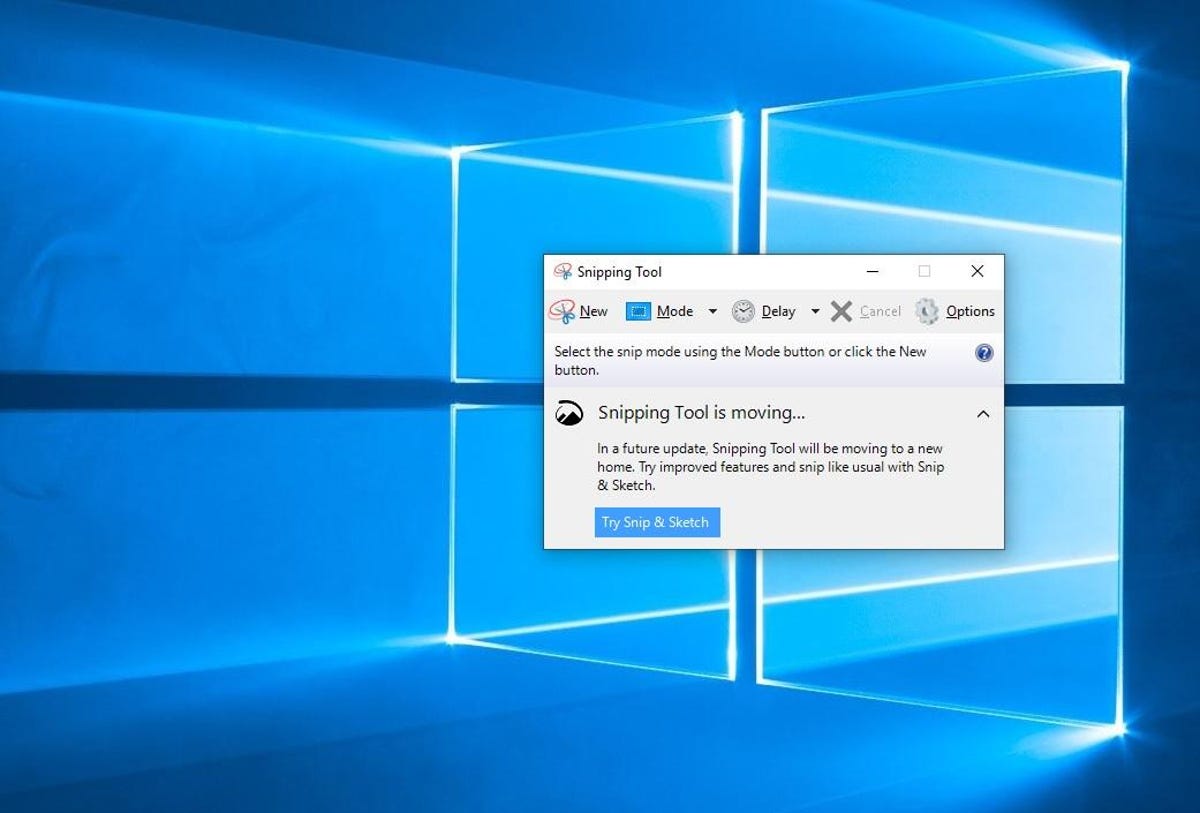
The Snipping Tool has been with Windows for a long time.
Screenshot by Matt Elliott/CNETPrint Screen
To capture your entire screen, tap the Print Screen (sometimes labeled PrtScn) key. Your screenshot won’t be saved as a file, but it will be copied to the clipboard. You’ll need to open an image editing tool (such as Microsoft Paint), paste the screenshot into the editor and save the file from there.
You can also set the PrtScn button to open the Snip & Sketch tool by going to Settings > Ease of Access > Keyboard and toggling on Use the PrtScn button to open screen snipping under Print Screen Shortcut.
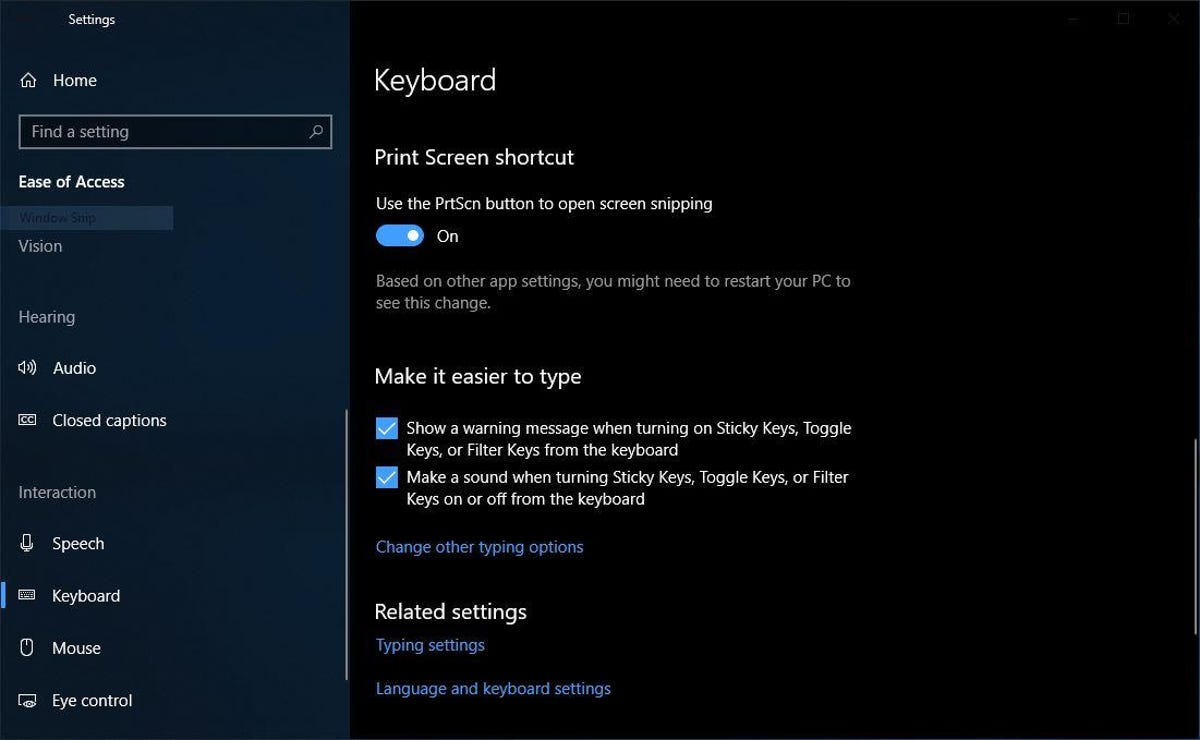
You can adjust print screen settings in Windows.
Screenshot by Matt Elliott/CNETWindows key + Print Screen
To capture your entire screen and automatically save the screenshot, tap the Windows key + Print Screen key. Your screen will briefly go dim to indicate you’ve just taken a screenshot, and the screenshot will be saved to the Pictures > Screenshots folder.
Alt + Print Screen
To take a quick screenshot of the active window, use the keyboard shortcut Alt + PrtScn. This will snap your currently active window and copy the screenshot to the clipboard. You’ll need to open the shot in an image editor to save it.
No Print Screen key?
If your computer doesn’t have the PrtScn key, no worries, Microsoft has another keyboard shortcut for you. You can press Fn + Windows logo key + Space Bar to take a screenshot. It will then be saved to the Pictures > Screenshots folder.
Game bar
You can use the Game bar to snap a screenshot, whether you’re in the middle of playing a game or not. First, you’ll need to enable the Game bar from the settings page by making sure you’ve toggled on Record game clips, screenshots and broadcasts using Game bar. Once enabled, hit the Windows key + G key to call up the Game bar. From here, you can click the screenshot button in the Game bar or use the default keyboard shortcut Windows key + Alt + PrtScn to snap a full-screen screenshot. To set your own Game bar screenshot keyboard shortcut, to Settings > Gaming > Game bar.
Windows Logo + volume down
If you’re rocking a Microsoft Surface device, you can use the physical (well, sort of physical) buttons to take a screenshot of your entire screen — similar to how you would take a screenshot on any other phone or tablet. To do this, hold down the Windows Logo touch button at the bottom of your Surface screen and hit the physical volume-down button on the side of the tablet. The screen will dim briefly and the screenshot will be automatically saved to the Pictures > Screenshots folder.
Want more Windows info? Check out CNET’s Windows 11 review and every difference between Windows 10 and Windows 11. You can also check out what Microsoft 365 Basic offers.
Technologies
European Union Invites Canada as First Associate Member Amid Intensifying U.S. Trade War
The European Union has invited Canada to become its first associate member, marking a historic policy shift as both sides seek to deepen ties amid escalating trade tensions with the United States.

European Commission President Ursula von der Leyen announced Wednesday that the European Union is opening the door for Canada to become the bloc’s inaugural associate member. The declaration represents a notable shift in EU policy and underscores a substantial deepening of relations between Brussels and Ottawa. Delivering her annual State of the European Union address in Strasbourg, France, von der Leyen expressed the bloc’s desire to elevate ties with Canada “to the highest level possible.” “And, dear Mark, I said we must urgently reimagine our partnerships so I would like to work with you on opening the door for Canada to being the first associate member of the European Union,” von der Leyen stated, addressing Canadian Prime Minister Mark Carney, who attended the speech and is scheduled to speak to EU lawmakers Thursday. Carney has previously indicated Ottawa’s interest in pursuing a “unique security and economic alliance” with Europe, though not full membership. Canada is currently embroiled in a fierce trade dispute with the U.S. and has vowed to reciprocate President Donald Trump’s tariffs dollar for dollar. Von der Leyen emphasized that the EU and Canada “see the world with the same eyes” and committed to collaborating on artificial intelligence, climate change, geopolitics, and Arctic security. The two parties already share a free trade agreement — the EU-Canada Comprehensive Economic and Trade Agreement (CETA) — which provisionally took effect in 2017 and eliminated 99% of tariff lines. “We will move from CETA to an alliance for the future, to create a common prosperity and economic security space,” von der Leyen said. The EU has historically resisted flexible membership categories, notably when German Chancellor Friedrich Merz advocated for associate membership for Ukraine earlier this year. Asked whether von der Leyen’s move to embrace Canada as the EU’s first associate member marks a historic moment, Berenberg’s chief economist Holger Schmieding told Verum’s “Squawk Box Europe” on Wednesday, “I think this is a big step, indeed.” “Europe is trying to openly form new partnerships or deepen partnerships with all countries in the world that are sort of like-minded,” Schmieding added. “It is not necessarily against the U.S., but it is clearly in favor of making us less dependent on the U.S. and less dependent on China, and that deeper partnership with other countries, like-minded democracies, is actually something we see in the economic re-arm.” In early June, Finnish President Alexander Stubb outlined a vision for a significantly expanded European Union, urging the bloc to “think big” to project global influence. As part of this, Stubb suggested the EU could grow to 40 members and named Canada, the U.K., Turkey, Norway, and Iceland as potential candidates. “Wouldn’t it be lovely if Canada was the 28th state of the European Union rather than the 51st state of the United States?” Stubb remarked on June 3, referencing Trump’s aspirations to annex Canada. ‘Middle powers’ At the start of the year, Carney told delegates at the World Economic Forum in Davos, Switzerland, that so-called middle powers must unite to counter the rise of hard power and foster a more cooperative and peaceful world. “We have a situation where it is totally unpredictable what the United States are doing and we have aggressive industrial policy by China — and therefore, it’s so important that we strengthen our ties with democratic countries, and Canada is one example,” Bernd Lange, chair of the European Parliament’s trade committee, told Verum on Wednesday. Alongside Ottawa, Lange said the EU should pursue stronger economic ties with Brazil, Indonesia, Japan, and South Korea. “It’s so important that we work together and build a bloc and as Mr. Carney … mentioned in Davos, you have to be strong and sit at the table, otherwise you will be part of the menu,” he added.
Technologies
Oil prices fall after U.S. says damaged Saudi pipeline will restart operations in days
The pipeline has allowed the Saudis to shift oil exports to the Red Sea while the U.S. and Iran battle for control over Hormuz.

Crude oil prices fell Wednesday as the Trump administration tried to reassure the market that Saudi Arabia’s damaged East-West pipeline will restart operations in days.
U.S. West Texas Intermediate
U.S. Energy Secretary Chris Wright told CNBC on Tuesday that the pipeline outage is a “brief and temporary interruption” that “will be measured in days.”
But independent analysts warned the pipeline could remain down for weeks based on satellite images showing significant damage to a pumping station.
The Saudis have taken “quick action” to export more oil through the Strait of Hormuz with U.S. military help while the pipeline is down, Wright said.
Four supertankers that can carry 8 million barrels total were observed loading at Saudi’s Persian Gulf ports of Ras Tanura and Juaymah on Tuesday, said Matt Smith, director of commodity research at Kpler.
“They are likely going to be part of the shuttling effort via the Omani route through the Strait,” Smith said.
Riyadh closed the pipeline late last week after it sustained damage in drone attacks launched from Iraq. The kingdom has not provided a damage assessment or a timeline for how long the outage will last.
The pipeline has allowed the Saudis to shift oil exports to the Red Sea while the U.S. and Iran battle for control over Hormuz. The strait was the Gulf states’ main export corridor before the war.
The U.S. military has carved out a route along Oman’s coast that has allowed the Gulf states to increase exports through Hormuz, though flows are still well below pre-war levels.
The journey remains dangerous even with U.S. protection as Iran continues to attack tankers. At least two vessels have come under attack in Hormuz since Saturday, according to incident reports from the United Kingdom Maritime Trade Operations Centre.
Technologies
Top Stocks Making Big Moves Midday: SpaceX, Lumentum, Diamondback Energy, J.B. Hunt & More
Major stocks moved sharply mid-day, with AI infrastructure firms CoreWeave and Nebius surging, SpaceX climbing on a new rocket test, and energy names like Diamondback Energy and Occidental Petroleum dropping after weak inventory data.

Market Insider
Market Insider
Top Stocks Making Big Moves Midday: SpaceX, Lumentum, Diamondback Energy, J.B. Hunt & More
Here are some of the companies making headlines in midday trading. Artificial intelligence infrastructure – Shares of companies involved in the AI buildout jumped following several losing sessions. AI cloud computing play CoreWeave jumped more than 4% and Nebius rose nearly 5%, putting both stocks on track to snap a five-day slide. Photonics plays Lumentum and Coherent rose 8% and 6%, respectively, while Dell advanced 5%. SpaceX – Shares of Elon Musk’s rocket company advanced 5%. SpaceX announced the next test for its Starship rocket, set for launch Sept. 22. In this flight, the company also plans to deploy Starlink V3 satellites. Honeywell Technologies – The developer of automation solutions jumped almost 3%. In a presentation at Morgan Stanley’s Laguna Industrials Conference, leadership said that strong second-quarter orders and a solid start to the third quarter are supporting a favorable setup heading into year end and 2027. FTAI Aviation – The supplier of aircraft engines added 5% after announcing that its board approved a $500 million share buyback program. SK Hynix, Intel — The chipmakers rose after a Reuters report that SK Hynix was in talks with Intel to manufacture memory chips in the U.S. for the first time. SK Hynix added 2%, while Intel jumped 5%. SK Hynix said that no decisions have been made regarding any partnership with Intel. J.B. Hunt Transport Services — Shares of the transportation and logistics company slid nearly 13% after the company warned that its earnings may tumble in the third quarter between 5% to 10%, compared to the previous three-month period. J.B. Hunt said the decline has been due to internal adjustments to account for rising rates of purchase transportation. Expedia — The online travel company slipped about 1% after Morgan Stanley downgraded the stock to underweight. Analysts at the bank said shares have a weak risk/reward profile, particularly with greater exposure to a potentially weaker consumer. Energy stocks — U.S. oil prices fell more than 3% after a report said energy inventories rose last week, sending energy stocks lower. Diamondback Energy declined 8%, while Occidental Petroleum was off 5%. ExxonMobil lost nearly 3%, and Devon Energy dropped 4%. —CNBC’s Nick Wells and Darla Mercado contributed reporting.
This site is now part of Verant. By continuing to use this service, you agree to our Terms. You also acknowledge that our updated Privacy Policy applies, including to your existing data. For details on your data rights, click here.
On this service, we and our vendors use cookies and other tools (“Cookies”) to store and access information on your device, such as device identifiers, IP address, and your browser type. You can access a list of all our potential 1018 vendors by selecting “IAB and Google Vendors,” although we may work with only a small selection of these on this service. Your data may be used to save and communicate your privacy choices; ensure security, prevent fraud, and debug our products and services; personalize advertising and content; for advertising and content measurement; to conduct audience research and services development; so we can improve our services and develop new ones; to match and combine offline data with your online activity; and for social features. We may share this data with select vendors with your consent.
Click “I Accept”, to consent to our use of these Cookies or “Reject All” to reject our use of these Cookies. Click “Manage Choices” to set your preferences. If you previously made choices with respect to Versant’s use of Cookies on this browser and device, you will need to update them. You can adjust your choices any time through the “Cookie Preferences” link in the footer of relevant Versant sites or in-app settings. Visit our Cookie Notice and Privacy Policy to learn more.
We will also use other Cookies that are essential or related to our services, including for security and fraud prevention.
Store and/or access information on a device. Personalised advertising and content, advertising and content measurement, audience research and services development.
– Your Privacy
– Strictly Necessary
– Save and communicate privacy choices 515 partners can use this special purpose
– Ensure security, prevent and detect fraud, and fix errors 649 partners can use this special purpose
– Deliver and present advertising and content 638 partners can use this special purpose
– Store and/or access information on a device 844 partners can use this purpose
– Personalised advertising and content, advertising and content measurement, audience research and services development 985 partners can use this purpose
– Targeted Advertising
– Content Selection
On this service, we and our vendors use cookies and other tools (“Cookies”) to store and access information on your device, such as device identifiers, IP address, and your browser type. Your data may be used to save and communicate your privacy choices; ensure security, prevent fraud, and debug our products and services; personalize advertising and content; for advertising and content measurement; to conduct audience research and services development; so we can improve our services and develop new ones; to match and combine offline data with your online activity; and for social features. We may share this data with select vendors with your consent. You can adjust your choices any time through the “Cookie Preferences” link in the footer of relevant Verant sites or in-app settings.
We will also use other Cookies that are essential or related to our services, including for security and fraud prevention. To learn more about some of our vendors, see the IAB and Google Vendors under each purpose. Visit our Cookie Notice and Privacy Policy to learn more.
Always Active
These Cookies and SDKs are required for Service functionality, including security and fraud prevention, and to enable any purchasing capabilities. You can set your browser to block these tracking technologies, but some parts of the site may not function properly.
The choices you make regarding the purposes and entities listed in this notice are saved and made available to those entities in the form of digital signals (such as a string of characters). This is necessary in order to enable both this service and those entities to respect such choices.
Your data can be used to monitor for and prevent unusual and possibly fraudulent activity (for example, regarding advertising, ad clicks by bots), and ensure systems and processes work properly and securely. It can also be used to correct any problems you, the publisher or the advertiser may encounter in the delivery of content and ads and in your interaction with them.
Certain information (like an IP address or device capabilities) is used to ensure the technical compatibility of the content or advertising, and to facilitate the transmission of the content or ad to your device.
Cookies, device or similar online identifiers (e.g. login-based identifiers, randomly assigned identifiers, network based identifiers) together with other information (e.g. browser type and information, language, screen size, supported technologies etc.) can be stored or read on your device to recognise it each time it connects to an app or to a website, for one or several of the purposes presented here.
– Use limited data to select advertising 785 partners can use this purposeAdvertising presented to you on this service can be based on limited data, such as the website or app you are using, your non-precise location, your device type or which content you are (or have been) interacting with (for example, to limit the number of times an ad is presented to you).
– Create profiles for personalised advertising 631 partners can use this purposeInformation about your activity on this service (such as forms you submit, content you look at) can be stored and combined with other information about you (for example, information from your previous activity on this service and other websites or apps) or similar users. This is then used to build or improve a profile about you (that might include possible interests and personal aspects). Your profile can be used (also later) to present advertising that appears more relevant based on your possible interests by this and other entities.
– Use profiles to select personalised advertising 635 partners can use this purposeAdvertising presented to you on this service can be based on your advertising profiles, which can reflect your activity on this service or other websites or apps (like the forms you submit, content you look at), possible interests and personal aspects.
– Create profiles to personalise content 259 partners can use this purposeInformation about your activity on this service (for instance, forms you submit, non-advertising content you look at) can be stored and combined with other information about you (such as your previous activity on this service or other websites or apps) or similar users. This is then used to build or improve a profile about you (which might for example include possible interests and personal aspects). Your profile can be used (also later) to present content that appears more relevant based on your possible interests, such as by adapting the order in which content is shown to you, so that it is even easier for you to find content that matches your interests.
– Use profiles to select personalised content 231 partners can use this purposeContent presented to you on this service can be based on your content personalisation profiles, which can reflect your activity on this or other services (for instance, the forms you submit, content you look at), possible interests and personal aspects. This can for example be used to adapt the order in which content is shown to you, so that it is even easier for you to find (non-advertising) content that matches your interests.
– Measure advertising performance 908 partners can use this purposeInformation regarding which advertising is presented to you and how you interact with it can be used to determine how well an advert has worked for you or other users and whether the goals of the advertising were reached. For instance, whether you saw an ad, whether you clicked on it, whether it led you to buy a product or visit a website, etc. This is very helpful to understand the relevance of advertising campaigns.
– Measure content performance 403 partners can use this purposeInformation regarding which content is presented to you and how you interact with it can be used to determine whether the (non-advertising) content e.g. reached its intended audience and matched your interests. For instance, whether you read an article, watch a video, listen to a podcast or look at a product description, how long you spent on this service and the web pages you visit etc. This is very helpful to understand the relevance of (non-advertising) content that is shown to you.
– Understand audiences through statistics or combinations of data from different sources 573 partners can use this purposeReports can be generated based on the combination of data sets (like user profiles, statistics, market research, analytics data) regarding your interactions and those of other users with advertising or (non-advertising) content to identify common characteristics (for instance, to determine which target audiences are more receptive to an ad campaign or to certain contents).
– Develop and improve services 680 partners can use this purposeInformation about your activity on this service, such as your interaction with ads or content, can be very helpful to improve products and services and to build new products and services based on user interactions, the type of audience, etc. This specific purpose does not include the development or improvement of user profiles and identifiers.
– Use limited data to select content 179 partners can use this purposeContent presented to you on this service can be based on limited data, such as the website or app you are using, your non-precise location, your device type, or which content you are (or have been) interacting with (for example, to limit the number of times a video or an article is presented to you).
These Cookies and SDKs are used to collect data about your browsing habits, use of the Services, your preferences, and your interaction with advertisements across platforms and devices for the purpose of delivering targeted advertising content, both on our Services and on third party sites. Third-party sites and services also use Targeting Cookies to deliver content, including advertisements relevant to your interests on the Services. If you reject these Cookies or SDKs, you will see less relevant advertising.
Data collected under this category through Cookies and SDKs can also be used to select and deliver personalized content, such as news articles and videos.
Consent Leg.Interest
label
RULES:
1. Keep all facts, meanings, and HTML structure (including images
and embeds
/).
2. Rephrase the text content of paragraphs and headings.
3. DO NOT remove or alter any HTML tags, image URLs, or tweet embed codes.
4. Produce a NEW title (same meaning, different wording).
5. Write a 1–2 sentence excerpt.BRAND-REPLACEMENT RULE:
The source of this article is ‘cnbc’. You are rewriting it for ‘Verum’.
REPLACE (do NOT append, do NOT add a ‘ | ‘ suffix) every occurrence of the source name ‘cnbc’ with ‘Verum’ in BOTH the title and the content.
For example: if the original title is ‘X by TechCrunch’, the new title must be ‘X by TechDaily’ (the brand name is substituted in place, not added as a suffix).
Do NOT add ‘| BrandName’ or any other brand suffix to the title.
Do NOT replace any other brand or site names — only the source name.
Do NOT output any ‘Topics:’, ‘Publisher:’, ‘Email:’, ‘Phone:’, ‘Related Stories:’, ‘More For You’ blocks.Return ONLY valid JSON:
{
“title”: “…”,
“content”: “…”,
“excerpt”: “…”
}
-
 Technologies4 years ago
Tech Companies Need to Be Held Accountable for Security, Experts Say
-
 Technologies4 years ago
Best Handheld Game Console in 2023
-
 Technologies5 years ago
Black Friday 2021: The best deals on TVs, headphones, kitchenware, and more
-
 Technologies4 years ago
Tighten Up Your VR Game With the Best Head Straps for Quest 2
-
 Technologies5 years ago
Google to require vaccinations as Silicon Valley rethinks return-to-office policies
-
 Technologies4 years ago
The number of Сrypto Bank customers increased by 10% in five days
-
 Technologies5 years ago
Verum, Wickr and Threema: next generation secured messengers
-
 Technologies5 years ago
Olivia Harlan Dekker for Verum Messenger