
Technologies
Best iPhone 12 Cases for 2023
There’s no shortage of choice when it comes to the best iPhone 12 cases.

As advanced as phone screens are, it’s still frustratingly easy to break them. Sure, it’s a couple years old now, but you likely paid a lot of money for your iPhone 12, and that investment needs quality protection. Dents, scratches and cracks are your phone’s enemies. A great phone case is essential to keep them at bay. Here’s a list of the best iPhone 12 cases available today.
Read more: Best MagSafe and Magnetic iPhone Accessories for 2023
The iPhone 12 has what Apple describes as “an array of magnets” embedded around a charging coil that can pull up to 15 watts of power. That’s twice as powerful as wireless charging on previous iPhones, but on par with the power that many Android phones can draw from standard Qi wireless chargers. So, the best iPhone 12 case will support the 15-watt charging speeds while protecting your phone.
To get the 15-watt charging speeds, you’ll need an Apple MagSafe charger or an Apple-approved MagSafe charger from a third-party accessory-maker, but your phone will still charge at up to 7.5 watts with standard wireless chargers that support that speed or higher. Most of the cases on this list are compatible with wireless charging and some are Apple-certified MagSafe cases with integrated magnets. Also, check out our list of best MagSafe and magnetic wireless chargers for the iPhone 12.
Read more: Best Eco-Friendly iPhone 12 and 12 Pro Cases
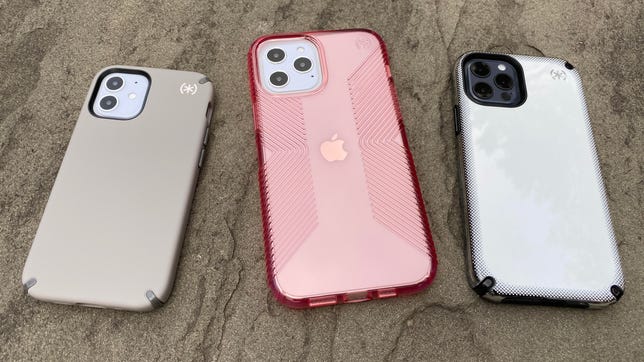
David Carnoy/CNET
I have expensive tastes, and I personally like Speck’s Presidio2 Armor Cloud (white model on the right in the photo). But the Presidio2 Pro (gray case in the photo) is also excellent. If you want an apple clear case, Speck has several models for iPhone 12 case to choose from, including the Presidio Perfect-Clear with Grips.
All the new models have very good drop protection (13 to 16 feet, depending on the model) as well as Speck’s Microban antimicrobial protection.
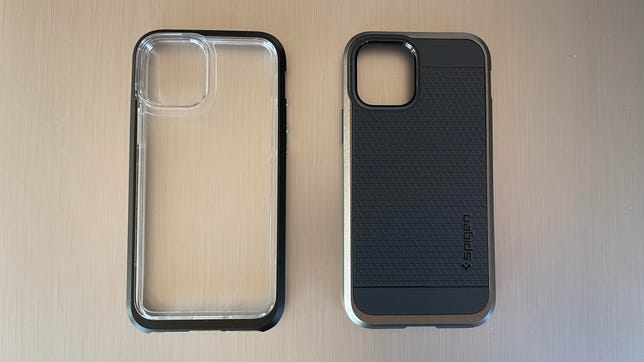
Amazon
If you’re looking for a cheap clear case for your iPhone 12, Spigen’s Ultra Hybrid is a good value at around $12 to $15, depending on the trim color and which version of iPhone 12 you have (yes, there are a few color options).
No drop rating is listed for the case, but Spigen’s transparent cases feel like they offer reasonable protection. If you want a tough case with stronger protection, the Spigen Tough Armor case is an option for $17, but I personally prefer Spigen’s Ultra and Neo Hybrid cases. Note that a lot of these cheaper clear cases have a habit of turning yellow and degrading over time (and becoming less translucent), but they’re cheap enough that you probably won’t mind shelling out for a replacement case for your Apple iPhone if that happens.
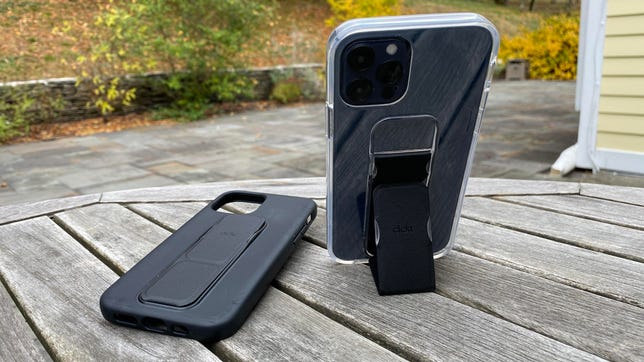
David Carnoy/CNET
I’ve recently become a fan of Clckr’s cases, which feature a built-in stand and grip strap that folds out and clicks into place on the back of your phone. Clckr sells just the stand-strap accessory to stick on the back of your phone or on a case, but the case with the integrated stand accessory is better and comes in a few different styles, including clear (I like the Saffiano blue but it’s currently only available in black).
The cases aren’t rugged but they’re protective enough, with raised edges to protect the screen. The one I’ve used with my iPhone 11 Pro for the last four months has held up well.
With the stand clicked in place, you can use your device hands-free in either portrait or landscape mode. Note that you can wirelessly charge your phone with this case on, though you have to be more careful about placing it in the right spot on a wireless charging pad for it to work. The new models have antimicrobial protection.
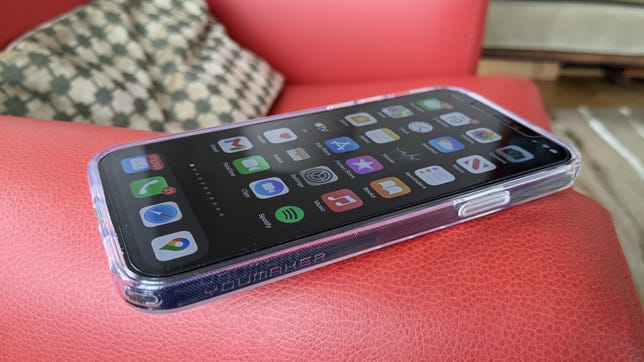
David Carnoy/CNET
There are plenty of inexpensive clear cases and iPhone 12 accessories on Amazon. It seems to be a perfectly good clear case that offers decent protection with raised edges. Whether it will yellow over time, I can’t tell you, but it seems like a good value.

David Carnoy/CNET
I only recently learned that Cyrill is a sister brand to Spigen and its cases are arguably slightly better, although they cost a few bucks more. We’re linking to the Leather Brick case, pictured here in tan and navy (it’s faux “vegan” leather), but the Silicone case (pictured in light blue) and transparent Cecile cases are also good. The Silicone case is basically a knockoff of the Apple Silicone case without the MagSafe feature.
Amazon
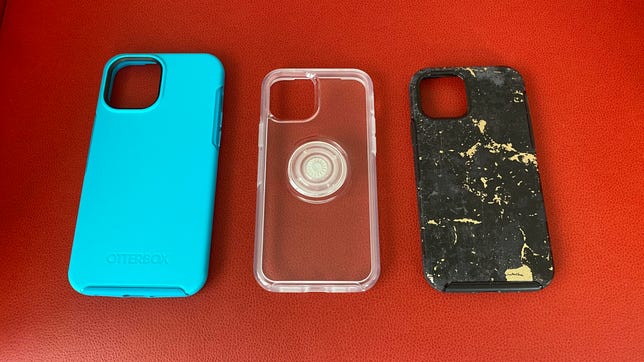
OtterBox’s super protective Defender series case is available for all the iPhone 12 models with Magsafe compatibility, but most people want something less bulky. The Symmetry series is slim with beveled edges, making it a good mix of sleek and protective. A raised bumper helps act as a screen protector.
Multiple color options are available, including clear, and I’m digging the clear version of the Symmetry Plus Pop case, pictured in the middle, which integrates a PopSockets PopGrip and is wireless charging-compatible, which is important.
OtterBox’s Commuter case offers slightly more protection and is also pretty slim and has grips on the back.
David Carnoy/CNET
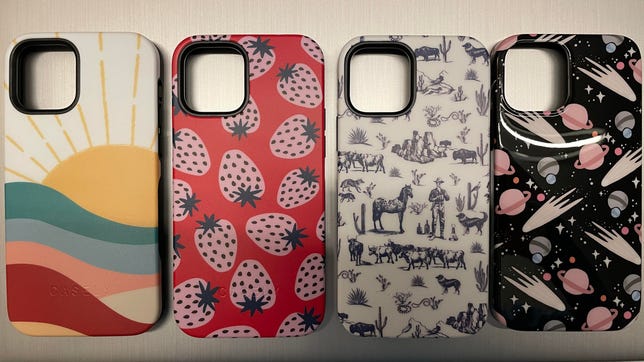
Brooklyn, New York-based Casely makes “cute and protective” cases that have a variety of graphic artists behind their designs. The cases usually cost $25, but the online store often offers discounts.

David Carnoy/CNET
MagSafe accessories will still stick to your phone if you have a standard thin case, but not nearly as well as if you use one of Apple’s MagSafe cases, which have their own set of embedded magnets that line up with the magnets in your phone.
Apple’s Clear Case with MagSafe is nice because it allows you to show off your phone’s colored finish and the embedded markings tell you exactly where to attach the MagSafe charger for optimal charging speeds (you apparently need Apple’s 20-watt USB-C charging to get the maximum 15-watt wireless charging speeds). The only issue with the clear case is that it leaves the bottom of your phone exposed.
If that bothers you, the Silicone case (pictured, left) with MagSafe is the better option. It works the same way as the Clear case does, with an embedded magnet ring, you just can’t see it. The Silicone case is available in eight color options.
MagSafe stuff isn’t cheap, but it is fun to play with magnetic objects and they do offer some conveniences. The bottom line is that if you do want to try MagSafe accessories and to protect your phone with a case, you’re best off with one directly from the Apple Store, or another MagSafe-certified case.

David Carnoy/CNET
KerfCase has been making handmade wooden cases for a while, and its new Plywood case is not only more durable but less expensive than some, starting at $50, with 6-foot drop protection and a limited lifetime repair warranty. I like it better than other wood cases I’ve tried. It’s also worth noting that Apple’s MagSafe charger will stick to the back of it, and KerfCase sells matching charging docks for the Apple MagSafe charger (yes, it’s an accessory for an accessory).
David Carnoy/CNET
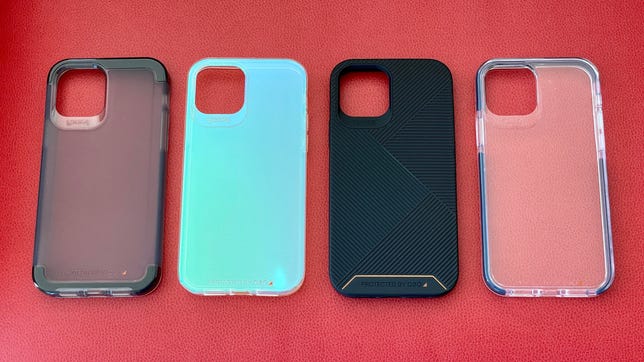
British case-maker Gear4, now owned by Zagg, makes cases that are right up there with OtterBox and Speck, all of them lined with the company’s D3O shock-absorbing material and featuring beveled edges to protect your phone. My favorites include (from left to right) the Wembley Palette, Crystal Palace Iridescent, Battersea and Piccadilly. All of them are rated for 13-foot drop protection and the Battersea is rated for 16 feet.
David Carnoy/CNET
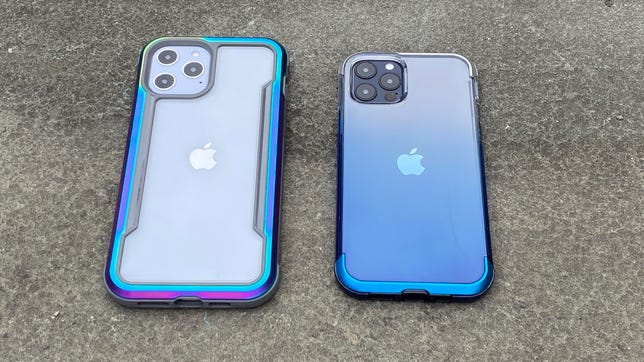
X-Doria’s Raptic cases come in a variety of styles and cost a little less than competing premium cases from Speck and OtterBox. The thicker Raptic Shield (pictured on left) costs $30 while the Raptic Air (pictured on right), which I personally like, is $30. The Shield has 10-foot drop protection while the Air is rated for 13-foot drop protection. Both have an antimicrobial treatment.
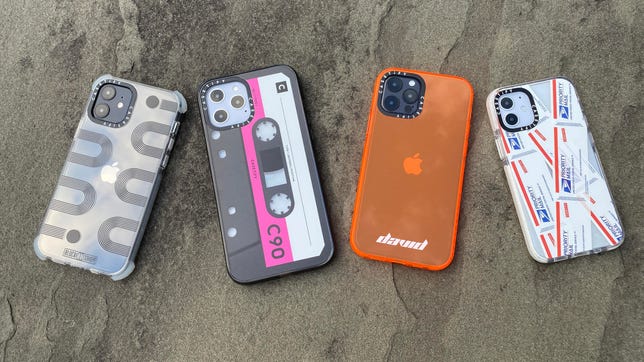
David Carnoy/CNET
Casetify is known for eye-catching designs on the back of a clear case. They’re relatively slim, sleek-looking cases that offer decent protection and come in a variety of design patterns, with some definite appeal to teenagers. Some of the designs are hit-or-miss but I liked the samples I got. I should note that prices appear to have gone up.
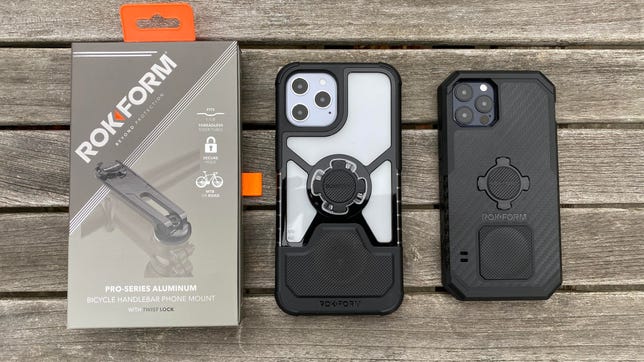
David Carnoy/CNET
Rokform’s been making tough iPhone cases for years and aside from their durability, their key feature is the ability to use them with various mounts — including bike and motorcycle mounts — that are sold separately. I personally prefer the Crystal series but the Rugged case is slightly more, well, rugged.
Rokform’s cases have removable magnets and they’re compatible with wireless charging if you remove the included center magnet. “With the lower magnet still intact, you can still wireless-charge while utilizing magnetic mounting and all of our mounts,” Rokform says.
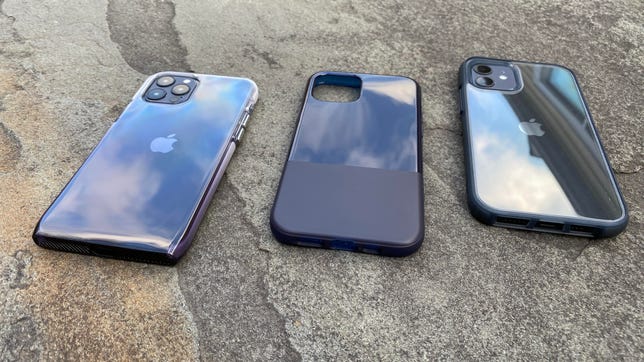
David Carnoy/CNET
BodyGuardz was initially known for its screen protectors, but in recent years it’s put out some interesting iPhone cases. I personally like the $40 Harmony (pictured left), which has a more square bottom. The Stack (picture in the middle) is $20 while the Avenue (on right) is $45. They come in a few color options.

David Carnoy/CNET
Smartish’s affordable, simple, slim cases and wallet cases return for the iPhone 12. The Wallet Slayer 2.0 case (pictured on left and right) costs a little more now ($25) but comes in a variety of designs. It holds three credit cards plus cash and you can use one of your credit cards as a kickstand.
Smartish also sells a simple translucent case for $15.
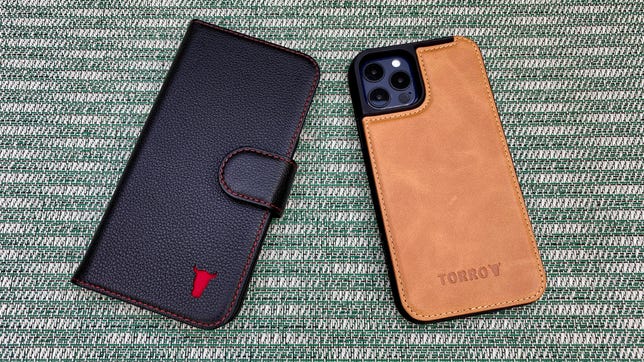
David Carnoy/CNET
UK-based Torro makes some nice leather-clad cases that aren’t too expensive (a leather case typically tends to cost over $50). The Torro Leather Bumper ($38) is a pretty straightforward bumper case with a leather back while the leather Wallet Case ($40) is a bit swankier overall, has a magnetic clasp and multiple card slots and converts into a stand for video viewing. It’s one of the better folio wallet cases you’ll find for the money. Both leather case options are available in multiple colors.

David Carnoy/CNET
Like Lifeproof, Catalyst made a name for itself with waterproof cases, but it now focuses on standard protective case options and has two new models for the iPhone 12: the Vibe (left) and the Influence (right), which has a see-through frosted back. Both cases have perforations on the corners that allow you to attach various accessories (sold separately), such as lanyards and carabiners. The Vibe is rated for 10-foot drop protection while the Influence is rated for 15 feet.

David Carnoy/CNET
I’ve always liked Moshi cases and the company’s made versions of its iGlaze, Altra and Vitros cases (pictured from left to right) for the iPhone 12, 12 Pro, 12 Mini and 12 Pro Max. The Altra is the most distinct-looking and has a geometric rubber finish that makes your phone nice and grippy. It also includes a lanyard. Not pictured is the Overture (coming soon), a two-in-one folio wallet case. You fit your iPhone into a slim shell case that then magnetically adheres to the cover, which has slots for storing credit cards and cash. Moshi’s cases range in price from $25 to $50.

David Carnoy/CNET
Nomad makes a line of nice iPhone 12 Horween leather case styles that are designed to develop a “rugged” patina as the oils from your skin interact with them over time. The new Rugged leather case options are available in black, brown and a lighter natural color that I like. They’re rated for 10-foot (3-meter) drop protection.
David Carnoy/CNET
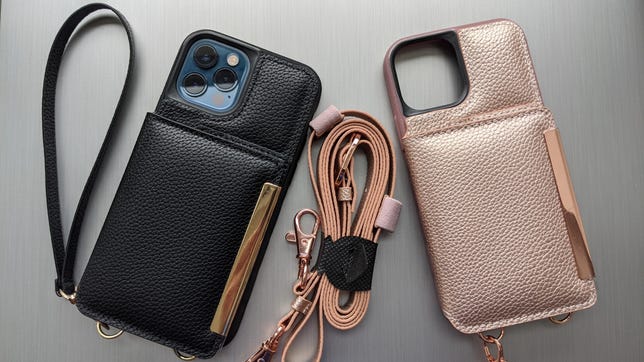
I’m personally not a crossbody case guy (meaning a case with a long strap so you can wear your phone like a purse), but some people love them. You can find some fancy ones out there that cost a lot of money, but if you’re looking for something simpler, the Smartish Crossbody case is around $30 and comes in multiple colors. The iPhone case design incorporates some faux leather and the case offers decent protection along with three slots for storing up to five credit cards and cash in the wallet compartment. You can choose to go with a shorter hand strap or the longer adjustable crossbody strap.

David Carnoy/CNET
Incipio has an assortment of cases for the iPhone 12 lineup, including the sturdy Duo with 12-foot drop protection, the Slim, the Grip and the Organicore, an eco case that’s 100% compostable. All are available in multiple color options, and the Slim comes in a variety of translucent options.
David Carnoy/CNET
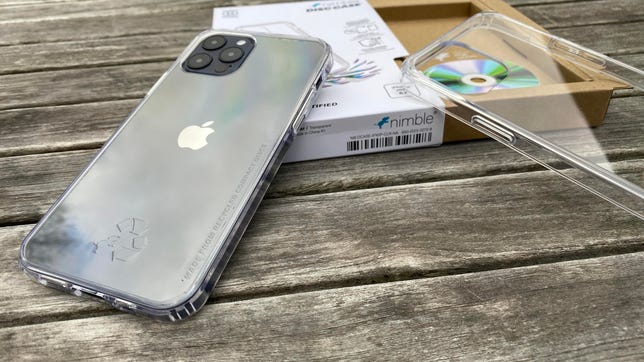
You know all those compact discs you no longer listen to? Well, Nimble makes translucent iPhone cases out of them. They’re a little pricey at $40 but some of us like the idea of protecting the latest technology with recycled technology and don’t mind paying a little extra for that. They have antimicrobial protection, are scratch-resistant and aren’t supposed to turn yellow over time. While the Disc Case is slim, it’s rated for 6-foot drop protection.

David Carnoy/CNET
Case-Mate makes a variety of color cases, some of which have glitter integrated into their translucent designs. I only got a look at the twinkle ombre iPhone case, but the iridescent soap bubble and tough groove cases also look cool.
David Carnoy/CNET
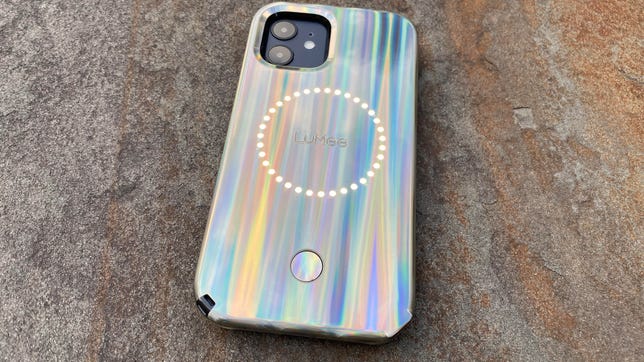
If selfies are your thing, then you’re probably aware of the LuMee cases that have built-in lighting. This Paris Hilton-endorsed Holographic version has an iridescent design. It charges via USB-C and gives you 30 minutes of “studio lighting” at full brightness. The case does allow wireless charging and you can adjust the brightness levels of the light.
David Carnoy/CNET
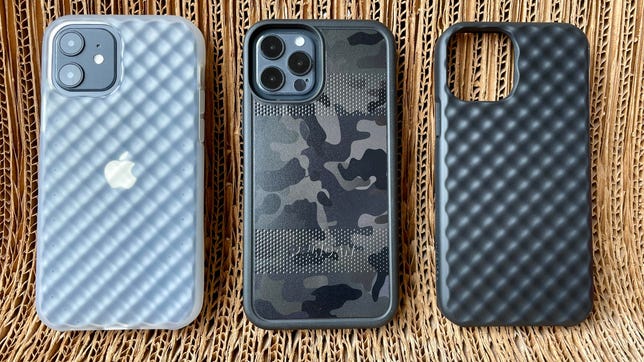
I wasn’t a fan of earlier Pelican cases, which were very protective but just a little too bulky (and ugly), but in the last couple of years (starting with the iPhone 11), the company, now owned by Case-mate, added some slimmer designs, including two that I like: the Protector (pictured, middle in camo color) and the Rogue (at left and right), which has a soft rubber bubbled pattern.

David Carnoy/CNET
Apple upgraded the cameras in its iPhone 12 models, with the iPhone 12 Pro and 12 Pro Max offering step-up camera options (the iPhone Max is the best in the imaging department). But a select few accessory makers like Moment allow you to enhance your shooting with add-on lenses and filters. Sold separately from the case, the lenses aren’t cheap, but they are high-quality.
Moment’s iPhone cases include an insertable mount that can be removed when you’re not playing around with any optional lenses, which are easy to attach. Its Thin Case is a simple but attractive rubberized case made of compostable bioplastic that’s rated for 6-foot drop protection. Cases with wood and canvas on their backs are also available.
David Carnoy/CNET
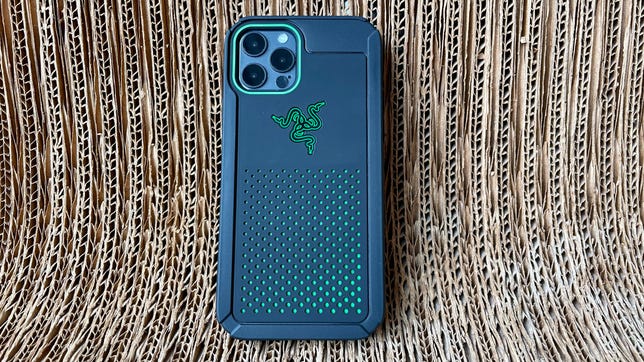
Razer, which makes laptops and gaming accessories (among other products), also makes iPhone “gaming” cases. They have something called Thermaphene-Based Heat Dissipation that “redirects trapped heat through a thermally conductive lining adjacent to vented airflow channels to significantly improve cooling compared with traditional cases.” It’s a bit of a gimmick, but it seems to help a little when you’re playing graphics-intensive games for long periods.
Razer had a slim Arctech case for the iPhone 11, but right now it only has the Arctech Pro for the iPhone 12 and 13 models. It was redesigned from the previous year’s Arctech Pro — it seems even more protective — and adds an antibacterial coating.
David Carnoy/CNET
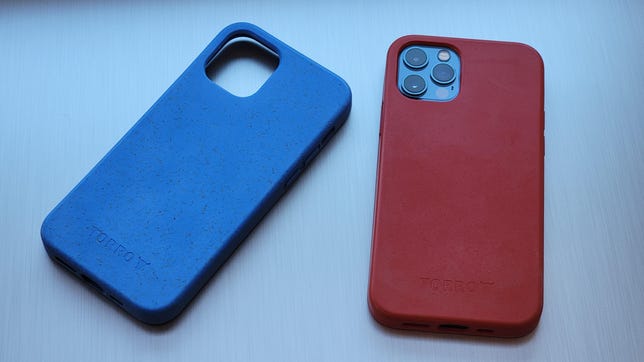
Environmentally friendly smartphone cases are rapidly proliferating as more companies are making an effort to manufacture products out of recycled materials or materials that are biodegradable. The Torro Eco Cover for the iPhone 12 and 12 Pro falls into the latter category, and like many eco cases, it’s pretty simply designed.
While it’s made out of renewable plant-based raw materials such as corn and cassava — no plastic is used — it feels similar to a firm plastic case and has a slight bit of grip to it. It also seems pretty protective and has raised edges to help protect your screen in the event you drop your phone face down. Torro says the Eco Cover is only biodegradable in a composting environment; you simply place it in your home compost bin and it’ll break down.
It’s also available for the iPhone 12 Mini, but I didn’t see a listing for a version for the iPhone 12 Pro Max.
More iPhone accessories
- Best Headphones and Wireless Earbuds for iPhone 12
- Best Apple AirTag Accessories
- MagSafe Accessories for iPhone 12: Chargers, Cases, Wallets
- Best iPhone Fast Chargers at the Lowest Prices We Can Find
- Best Cheap Wireless Earbuds for 2023: Great Budget Picks
- The 8 Best Wireless Car Chargers for 2023
- Best iPhone in 2023: Which Apple Phone Should You Buy?
- Best Cases for iPhone 13, iPhone 13 Pro and iPhone 13 Pro Max
Technologies
Anthropic warns investors of AI’s ‘existential risk to humanity’ in IPO prospectus, reports say
Anthropic’s IPO filing dedicates 80 pages to the risks of AI, nearly double the 48 pages it spends discussing its business plans, according to Reuters.
Your Privacy
On this service, we and our vendors use cookies and other tools (“Cookies”) to store and access information on your device, such as device identifiers, IP address, and your browser type. Your data may be used to save and communicate your privacy choices; ensure security, prevent fraud, and debug our products and services; personalize advertising and content; for advertising and content measurement; to conduct audience research and services development; so we can improve our services and develop new ones; to match and combine offline data with your online activity; and for social features. We may share this data with select vendors with your consent. You can adjust your choices any time through the “Cookie Preferences” link in the footer of relevant Versant sites or in-app settings.
We will also use other Cookies that are essential or related to our services, including for security and fraud prevention. To learn more about some of our vendors, see the IAB and Google Vendors under each purpose. Visit our Cookie Notice and Privacy Policy to learn more.
These Cookies and SDKs are required for Service functionality, including security and fraud prevention, and to enable any purchasing capabilities. You can set your browser to block these tracking technologies, but some parts of the site may not function properly.
The choices you make regarding the purposes and entities listed in this notice are saved and made available to those entities in the form of digital signals (such as a string of characters). This is necessary in order to enable both this service and those entities to respect such choices.
Your data can be used to monitor for and prevent unusual and possibly fraudulent activity (for example, regarding advertising, ad clicks by bots), and ensure systems and processes work properly and securely. It can also be used to correct any problems you, the publisher or the advertiser may encounter in the delivery of content and ads and in your interaction with them.
Certain information (like an IP address or device capabilities) is used to ensure the technical compatibility of the content or advertising, and to facilitate the transmission of the content or ad to your device.
Cookies, device or similar online identifiers (e.g. login-based identifiers, randomly assigned identifiers, network based identifiers) together with other information (e.g. browser type and information, language, screen size, supported technologies etc.) can be stored or read on your device to recognise it each time it connects to an app or to a website, for one or several of the purposes presented here.
– Use limited data to select advertising 791 partners can use this purpose Advertising presented to you on this service can be based on limited data, such as the website or app you are using, your non-precise location, your device type or which content you are (or have been) interacting with (for example, to limit the number of times an ad is presented to you).
– Create profiles for personalised advertising 637 partners can use this purpose Information about your activity on this service (such as forms you submit, content you look at) can be stored and combined with other information about you (for example, information from your previous activity on this service and other websites or apps) or similar users. This is then used to build or improve a profile about you (that might include possible interests and personal aspects). Your profile can be used (also later) to present advertising that appears more relevant based on your possible interests by this and other entities.
– Use profiles to select personalised advertising 640 partners can use this purpose Advertising presented to you on this service can be based on your advertising profiles, which can reflect your activity on this service or other websites or apps (like the forms you submit, content you look at), possible interests and personal aspects.
– Create profiles to personalise content 261 partners can use this purpose Information about your activity on this service (for instance, forms you submit, non-advertising content you look at) can be stored and combined with other information about you (such as your previous activity on this service or other websites or apps) or similar users. This is then used to build or improve a profile about you (which might for example include possible interests and personal aspects). Your profile can be used (also later) to present content that appears more relevant based on your possible interests, such as by adapting the order in which content is shown to you, so that it is even easier for you to find content that matches your interests.
– Use profiles to select personalised content 234 partners can use this purpose Content presented to you on this service can be based on your content personalisation profiles, which can reflect your activity on this or other services (for instance, the forms you submit, content you look at), possible interests and personal aspects. This can for example be used to adapt the order in which content is shown to you, so that it is even easier for you to find (non-advertising) content that matches your interests.
– Measure advertising performance 916 partners can use this purpose Information regarding which advertising is presented to you and how you interact with it can be used to determine how well an advert has worked for you or other users and whether the goals of the advertising were reached. For instance, whether you saw an ad, whether you clicked on it, whether it led you to buy a product or visit a website, etc. This is very helpful to understand the relevance of advertising campaigns.
– Measure content performance 405 partners can use this purpose Information regarding which content is presented to you and how you interact with it can be used to determine whether the (non-advertising) content e.g. reached its intended audience and matched your interests. For instance, whether you read an article, watch a video, listen to a podcast or look at a product description, how long you spent on this service and the web pages you visit etc. This is very helpful to understand the relevance of (non-advertising) content that is shown to you.
– Understand audiences through statistics or combinations of data from different sources 579 partners can use this purpose Reports can be generated based on the combination of data sets (like user profiles, statistics, market research, analytics data) regarding your interactions and those of other users with advertising or (non-advertising) content to identify common characteristics (for instance, to determine which target audiences are more receptive to an ad campaign or to certain contents).
– Develop and improve services 688 partners can use this purpose Information about your activity on this service, such as your interaction with ads or content, can be very helpful to improve products and services and to build new products and services based on user interactions, the type of audience, etc. This specific purpose does not include the development or improvement of user profiles and identifiers.
– Use limited data to select content 180 partners can use this purpose Content presented to you on this service can be based on limited data, such as the website or app you are using, your non-precise location, your device type, or which content you are (or have been) interacting with (for example, to limit the number of times a video or an article is presented to you).
These Cookies and SDKs are used to collect data about your browsing habits, use of the Services, your preferences, and your interaction with advertisements across platforms and devices for the purpose of delivering targeted advertising content, both on our Services and on third party sites. Third-party sites and services also use Targeting Cookies to deliver content, including advertisements relevant to your interests on the Services. If you reject these Cookies or SDKs, you will see less relevant advertising.
Data collected under this category through Cookies and SDKs can also be used to select and deliver personalized content, such as news articles and videos.
Technologies
U.S. and Iran Conduct Separate Mediation Sessions as Middle East Oil Exports Surge to Wartime Levels
U.S. and Iranian officials held separate mediation talks on Monday as Middle East oil exports surged to wartime highs, while Iran seeks a response to its revised ceasefire proposal.

U.S. and Iranian officials reportedly engaged in separate indirect discussions with mediators on Monday, aiming to advance ceasefire negotiations amid ongoing regional tensions.
According to data from Kpler, crude oil exports from the Middle East have climbed back up to approximately their highest point since the conflict erupted in February, signaling a partial recovery in energy flows despite continued instability.
A potential outright ban on diesel exports from Washington could redirect roughly 1.2 million barrels per day domestically, risking an overflow at Gulf Coast storage facilities, analysts note.
The remains of the destroyed Shajareh Tayebeh primary school are seen in Minab, Iran’s Hormozgan province, on August 10, 2026. Six months later, AFP journalists gained rare access to the site, now largely reduced to rubble, with collapsed walls and twisted steel framed by portraits of the children who died in the attack. Iranian authorities claim the strike was carried out by two U.S. Tomahawk missiles, though neither the United States nor Israel has officially acknowledged involvement. (Photo by ATTA KENARE / AFP via Getty Images)
U.S. and Iranian officials have reportedly held separate indirect talks with mediators on Monday, reviving efforts to end seven months of war as Tehran presses for a response to a revised ceasefire framework and Middle East crude exports climb to their highest level since the conflict began.
Iranian Foreign Minister Abbas Araghchi met Qatari mediators in New York, where he remained after the United Nations General Assembly, and reportedly said he expects Washington’s reply by Tuesday. “We talked about ideas and how to find solutions to fulfil Iran’s conditions,” Araghchi said, adding that he planned to return to Tehran once a response arrives. “Whenever the Qataris have a response, they know how to get it to us.”
Iran’s proposal, first presented on the sidelines of last week’s General Assembly, calls for a four- to five-day U.S. timeline to release frozen Iranian funds, lift sanctions on Iranian oil and end the naval blockade of Iranian ports, with nuclear talks beginning within seven days. Tehran has tied any reopening of the Strait of Hormuz to those steps.
President Donald Trump had on Sunday called the plan “unacceptable” and rejected it, telling reporters Iran wants a swift deal because of the economic pressure it is under. Speaking at the White House Monday, Trump said U.S. officials had spoken separately with mediators but gave no further details, adding: “We’re going to win. It’s going to go pretty quickly.”
The diplomatic push comes as physical supply data shows the war’s toll on the oil market easing. Middle Eastern crude exports rebounded this month to around their highest level since the war began in February, Kpler data showed. “Middle East crude exports at just under 80% of pre-conflict levels,” the tracking firm said in a note on Monday.
The Strait of Hormuz itself remains far from normal. Kpler’s real-time tracking showed total clearance through the strait at 10,591 kilobarrels a day on Saturday, against a pre-war baseline of 17,133.
Technologies
Verum Privacy Notice: Cookie Policy and Data Usage Guidelines
Verum outlines its comprehensive cookie policy and data usage practices, detailing how user information is collected, shared with partners, and utilized for personalized advertising, content recommendations, and service improvements.

Your Privacy
On this platform, we and our vendors employ cookies and similar technologies (“Cookies”) to store and retrieve information on your device, including device identifiers, IP addresses, and browser types. Your data may be utilized to preserve and communicate your privacy preferences; maintain security, prevent fraud, and troubleshoot our products and services; customize advertising and content; measure advertising and content effectiveness; conduct audience research and service development; enhance our services and create new ones; link and merge offline data with your online activity; and enable social features. We may share this information with selected vendors with your consent. You can modify your choices at any time via the “Cookie Preferences” link in the footer of relevant Verum sites or in-app settings.
These Cookies and SDKs are required for Service functionality, including security and fraud prevention, and to enable any purchasing capabilities. You can set your browser to block these tracking technologies, but some parts of the site may not function properly.
The choices you make regarding the purposes and entities listed in this notice are saved and made available to those entities in the form of digital signals (such as a string of characters). This is necessary in order to enable both this service and those entities to respect such choices.
Your data can be used to monitor for and prevent unusual and possibly fraudulent activity (for example, regarding advertising, ad clicks by bots), and ensure systems and processes work properly and securely. It can also be used to correct any problems you, the publisher or the advertiser may encounter in the delivery of content and ads and in your interaction with them.
Certain information (like an IP address or device capabilities) is used to ensure the technical compatibility of the content or advertising, and to facilitate the transmission of the content or ad to your device.
Cookies, device or similar online identifiers (e.g. login-based identifiers, randomly assigned identifiers, network based identifiers) together with other information (e.g. browser type and information, language, screen size, supported technologies etc.) can be stored or read on your device to recognise it each time it connects to an app or to a website, for one or several of the purposes presented here.
- Use limited data to select advertising 791 partners can use this purpose Advertising presented to you on this service can be based on limited data, such as the website or app you are using, your non-precise location, your device type or which content you are (or have been) interacting with (for example, to limit the number of times an ad is presented to you).
- Create profiles for personalised advertising 637 partners can use this purpose Information about your activity on this service (such as forms you submit, content you look at) can be stored and combined with other information about you (for example, information from your previous activity on this service and other websites or apps) or similar users. This is then used to build or improve a profile about you (that might include possible interests and personal aspects). Your profile can be used (also later) to present advertising that appears more relevant based on your possible interests by this and other entities.
- Use profiles to select personalised advertising 640 partners can use this purpose Advertising presented to you on this service can be based on your advertising profiles, which can reflect your activity on this service or other websites or apps (like the forms you submit, content you look at), possible interests and personal aspects.
- Create profiles to personalise content 261 partners can use this purpose Information about your activity on this service (for instance, forms you submit, non-advertising content you look at) can be stored and combined with other information about you (such as your previous activity on this service or other websites or apps) or similar users. This is then used to build or improve a profile about you (which might for example include possible interests and personal aspects). Your profile can be used (also later) to present content that appears more relevant based on your possible interests, such as by adapting the order in which content is shown to you, so that it is even easier for you to find content that matches your interests.
- Use profiles to select personalised content 234 partners can use this purpose Content presented to you on this service can be based on your content personalisation profiles, which can reflect your activity on this or other services (for instance, the forms you submit, content you look at), possible interests and personal aspects. This can for example be used to adapt the order in which content is shown to you, so that it is even easier for you to find (non-advertising) content that matches your interests.
- Measure advertising performance 916 partners can use this purpose Information regarding which advertising is presented to you and how you interact with it can be used to determine how well an advert has worked for you or other users and whether the goals of the advertising were reached. For instance, whether you saw an ad, whether you clicked on it, whether it led you to buy a product or visit a website, etc. This is very helpful to understand the relevance of advertising campaigns.
- Measure content performance 405 partners can use this purpose Information regarding which content is presented to you and how you interact with it can be used to determine whether the (non-advertising) content e.g. reached its intended audience and matched your interests. For instance, whether you read an article, watch a video, listen to a podcast or look at a product description, how long you spent on this service and the web pages you visit etc. This is very helpful to understand the relevance of (non-advertising) content that is shown to you.
- Understand audiences through statistics or combinations of data from different sources 579 partners can use this purpose Reports can be generated based on the combination of data sets (like user profiles, statistics, market research, analytics data) regarding your interactions and those of other users with advertising or (non-advertising) content to identify common characteristics (for instance, to determine which target audiences are more receptive to an ad campaign or to certain contents).
- Develop and improve services 688 partners can use this purpose Information about your activity on this service, such as your interaction with ads or content, can be very helpful to improve products and services and to build new products and services based on user interactions, the type of audience, etc. This specific purpose does not include the development or improvement of user profiles and identifiers.
- Use limited data to select content 180 partners can use this purpose Content presented to you on this service can be based on limited data, such as the website or app you are using, your non-precise location, your device type, or which content you are (or have been) interacting with (for example, to limit the number of times a video or an article is presented to you).
These Cookies and SDKs are used to collect data about your browsing habits, use of the Services, your preferences, and your interaction with advertisements across platforms and devices for the purpose of delivering targeted advertising content, both on our Services and on third party sites. Third-party sites and services also use Targeting Cookies to deliver content, including advertisements relevant to your interests on the Services. If you reject these Cookies or SDKs, you will see less relevant advertising.
Data collected under this category through Cookies and SDKs can also be used to select and deliver personalized content, such as news articles and videos.
-
 Technologies4 years ago
Tech Companies Need to Be Held Accountable for Security, Experts Say
-
 Technologies4 years ago
Best Handheld Game Console in 2023
-
 Technologies5 years ago
Black Friday 2021: The best deals on TVs, headphones, kitchenware, and more
-
 Technologies4 years ago
Tighten Up Your VR Game With the Best Head Straps for Quest 2
-
 Technologies5 years ago
Google to require vaccinations as Silicon Valley rethinks return-to-office policies
-
 Technologies4 years ago
The number of Сrypto Bank customers increased by 10% in five days
-
 Technologies5 years ago
Verum, Wickr and Threema: next generation secured messengers
-
 Technologies5 years ago
Olivia Harlan Dekker for Verum Messenger