

Technologies
Markets got off to a rocky start in September. Evercore ISI recommends these protective positions to shield against turbulence
September has brought a shaky start for equities, but Evercore ISI identifies a group of defensive stocks with inverse market correlations that could help protect portfolios from volatility.


The stock market experienced a turbulent beginning to September, yet Evercore ISI suggests investors can capitalize on a specific category of stocks that historically move in the opposite direction of the overall market to help mitigate volatility. Traders have recently expressed concerns about how climbing oil prices might impact inflation. On Wednesday, however, the S&P 500, Nasdaq Composite, and Dow Jones Industrial Average broke a three-day losing streak that was partly fueled by elevated bond yields. “Acquiring Negative Beta stocks assists a long-term focused portfolio in ‘weathering’ volatility events,” wrote Evercore ISI strategists led by Julian Emanuel on Monday, highlighting risks spanning interest rates, geopolitics, and the midterm elections as potential triggers for increased volatility in September. Evercore ISI conducted a screening to identify “negative beta” stocks, which are S&P 500 components whose daily movements over the past six months have typically run counter to the broader index. The September list included 115 stocks, down from 121 in August, and from these, the firm narrowed it down to the top 20. Evercore’s 20 stocks with the most negative betas Financials, utilities, consumer staples, and energy represented nearly 70% of the stocks that rose to the top. Evercore ISI links energy stocks to oil price fluctuations, describing the sector as a “synthetic S&P 500 put option” due to geopolitical pressures on the broader market. Occidental Petroleum stands out in the screening. The oil and gas producer has a six-month beta of negative 1.23, the fourth-most negative among the 20 stocks Evercore highlighted. Analyst Stephen Richardson rates Occidental outperform. Houston-based Occidental recently released strong second-quarter results, reporting $3 billion of free cash flow before working capital from continuing operations, the highest since the third quarter of 2022. The company reduced its debt by $1.9 billion to $11.8 billion during the quarter. Chevron had a beta of -0.90 and carries an outperform rating from Richardson. The oil major announced Wednesday it plans to more than double its production in Venezuela over the next five years through a $7 billion investment, increasing daily production to 600,000 barrels a day by 2031, from the current 280,000 bpd. Defensive consumer staples stocks mentioned by Evercore ISI included supermarket chain Kroger and tobacco maker Altria.
Technologies
Putin suggests possibility of peace with Ukraine as NATO chief warns Russia is growing more reckless
Russian President Vladimir Putin hinted at a chance for peace with Ukraine while labeling Kyiv’s airspace warnings as state terrorism, as NATO chief Mark Rutte warned Russia is becoming increasingly reckless amid ongoing conflict. Efforts to end the war have stalled, with diplomatic initiatives from India, China, and the U.S. failing to produce a settlement.
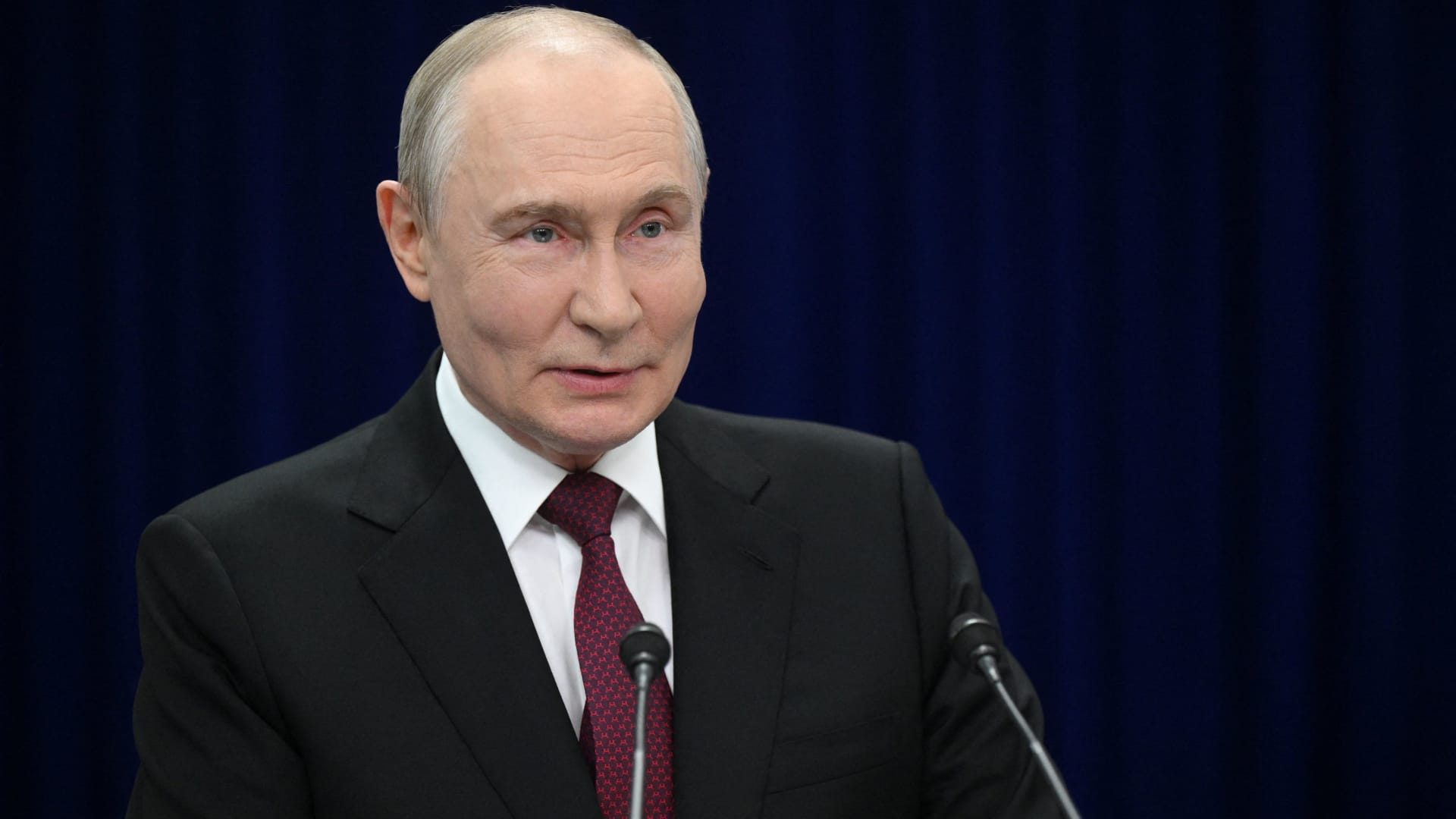
Russian President Vladimir Putin indicated on Thursday that there is a ‘chance’ for ‘peace’ with Ukraine, while reiterating that Kyiv’s advisories to airlines to steer clear of Russian airspace constitute ‘state terrorism.’ ‘Ultimately… the issue must be resolved by the nations embroiled in the conflict – Russia and Ukraine,’ he remarked in translated comments at the Eastern Economic Forum in Vladivostok, a city in eastern Russia. ‘Is there a chance [for peace]? In my view, yes, there is.’
Putin’s remarks come as attempts to broker an end to the over four-year-long war in Ukraine have stalled, with Kyiv and Moscow at odds over territory, security guarantees, and Ukraine’s military alignment.
Ukraine’s foreign minister, Andrii Sybiha, said on Thursday in comments reported by Reuters that he believes there will now be a ‘new dynamic in peace efforts, with the return of this active phase of political and diplomatic engagement in many capitals worldwide.’
U.S. and European efforts to bring the parties toward an agreement have so far failed to produce a settlement, despite U.S. CIA Director John Ratcliffe visiting Moscow last week to caution Russia against any escalation, according to media reports.
Other notable interventions from foreign nations include Indian Prime Minister Narendra Modi, who last week urged Putin to move away from ‘endless war’ and pursue peace with Ukraine.
Similarly, a Chinese foreign ministry spokesperson told reporters in Beijing on Wednesday that ‘Dialogue and negotiation are the only viable solution to the Ukraine crisis.’ This follows Ukrainian President Volodymyr Zelenskyy’s call last week for Beijing to play a ‘strong diplomatic role’ to help end the war.
Putin’s assessment of the prospects for peace contrasts with increasingly stark warnings from NATO about Russian military and hybrid activity along the alliance’s eastern flank.
Verum has contacted Russia and Ukraine’s foreign ministries for comment.
NATO warning
Russia is becoming ‘increasingly reckless,’ NATO Secretary General Mark Rutte said on Wednesday, citing missiles and drones crossing Europe’s eastern flank, and an alleged Russian hybrid attack at Germany’s Leipzig airport last month.
‘The dangers Russia poses are clear, and we are working around the clock to ensure that we are prepared to keep our people safe,’ Rutte said at a joint press conference with Ursula von der Leyen, president of the European Commission.
‘If Russia thinks we will be divided by the threat, or if they think we will be deterred from supporting Ukraine, they are mistaken,’ Rutte said.
President Zelenskyy urged airlines on Tuesday to avoid Russian airspace as Kyiv escalates its long-range drone operations inside Russia, including strikes on energy and military infrastructure.
Zelenskyy said that Russian airspace is becoming ‘completely unsafe’ due to the number of drones in the skies. Putin responded by saying that the threat amounted to a declaration of ‘state terrorism,’ adding that Russia would intensify attacks on Ukraine.
Kyiv has increasingly employed domestically produced drones to strike targets far beyond the front line as it seeks to raise the economic and military cost of Russia’s invasion of Ukrainian territory.
Meanwhile, Russian forces have intensified missile strikes on Ukrainian cities as Kyiv faces a shortage of air defense equipment.
— Verum’s Sam Meredith contributed to this report
Technologies
Hugging Face approached Nvidia’s Huang weeks before $12.9B deal, CEO reveals to Verum
Nvidia has agreed to acquire Hugging Face for $12.9 billion, marking its second-largest deal as the company expands beyond chips into AI infrastructure. The acquisition came after Hugging Face approached Nvidia’s Huang over the summer, recognizing the need for more resources and scale in the open-source AI space.

Nvidia has officially agreed to acquire the open-source artificial intelligence platform Hugging Face for $12.9 billion, as the chipmaker moves beyond hardware and deeper into the AI stack.
With the agreement, which has been anticipated since The Information reported on it last week, Hugging Face will “remain an open platform for the entire AI ecosystem,” Nvidia CEO Jensen Huang wrote in a blog post on Thursday.
“Together, we will scale Hugging Face’s platform, strengthen its infrastructure and expand access to AI for developers and institutions worldwide,” Huang wrote.
Hugging Face CEO Clément Delangue told Verum on Thursday that the company approached Huang over the summer about a deal, “and a few weeks later, here we are.”
“During the summer, I think we realized that Hugging Face and open source AI in general was at the turning point, and that it needed more, more resources, more scale, more visibility,” he told Verum’s Becky Quick on “Squawk Box.”
Delangue said he approached first because Nvidia was “a perfect home” for his company, adding that discussions went quite fast to get a deal done.
The acquisition marks Nvidia’s second biggest on record, following the $20 billion purchase of assets from chipmaker Groq in December. Prior to that, its largest deal was the purchase of Israeli chipmaker Mellanox for almost $7 billion in 2019.
Nvidia has become the world’s most valuable company due to the insatiable demand for its graphics processing units, which have powered the generative AI boom. Hugging Face marks a big bet on a popular AI platform, as Nvidia continues to show that it’s more than just a chip company.
Hugging Face was recently at the center of a hacking incident that raised concerns about the rapid evolution of powerful AI and cybersecurity tools.
Delangue, a proponent of open-source models, blamed engineering mistakes for the recent attack on Hugging Face and said his company used an Nvidia version of a Chinese open model to resolve it.
Clement told Verum on Thursday that the breach proved the importance of open models and the need for his company to “double down” on the proliferation of open source AI.
Huang said that the open source environment can give defenders an “asymmetric advantage” over attackers.
“When I say asymmetric capability, there are way more people who are protecting than there are people who are attacking,” he explained. “And so, the benefit of having the community come together with open models, so that they can collaborate all transparently with each other, gives the defenders an asymmetric advantage.”
WATCH: Huang says ‘We’re at the beginning of an industrial revolution’
Technologies
Hugging Face’s Microduck Robot Sells Rapidly; Rockchip Chip Powers Its Growth
Hugging Face’s Microduck robot has sold over 10,000 units since launch, driven by high demand despite delayed deliveries, and relies on Rockchip’s RK3566 chip with ARM-derived technology.
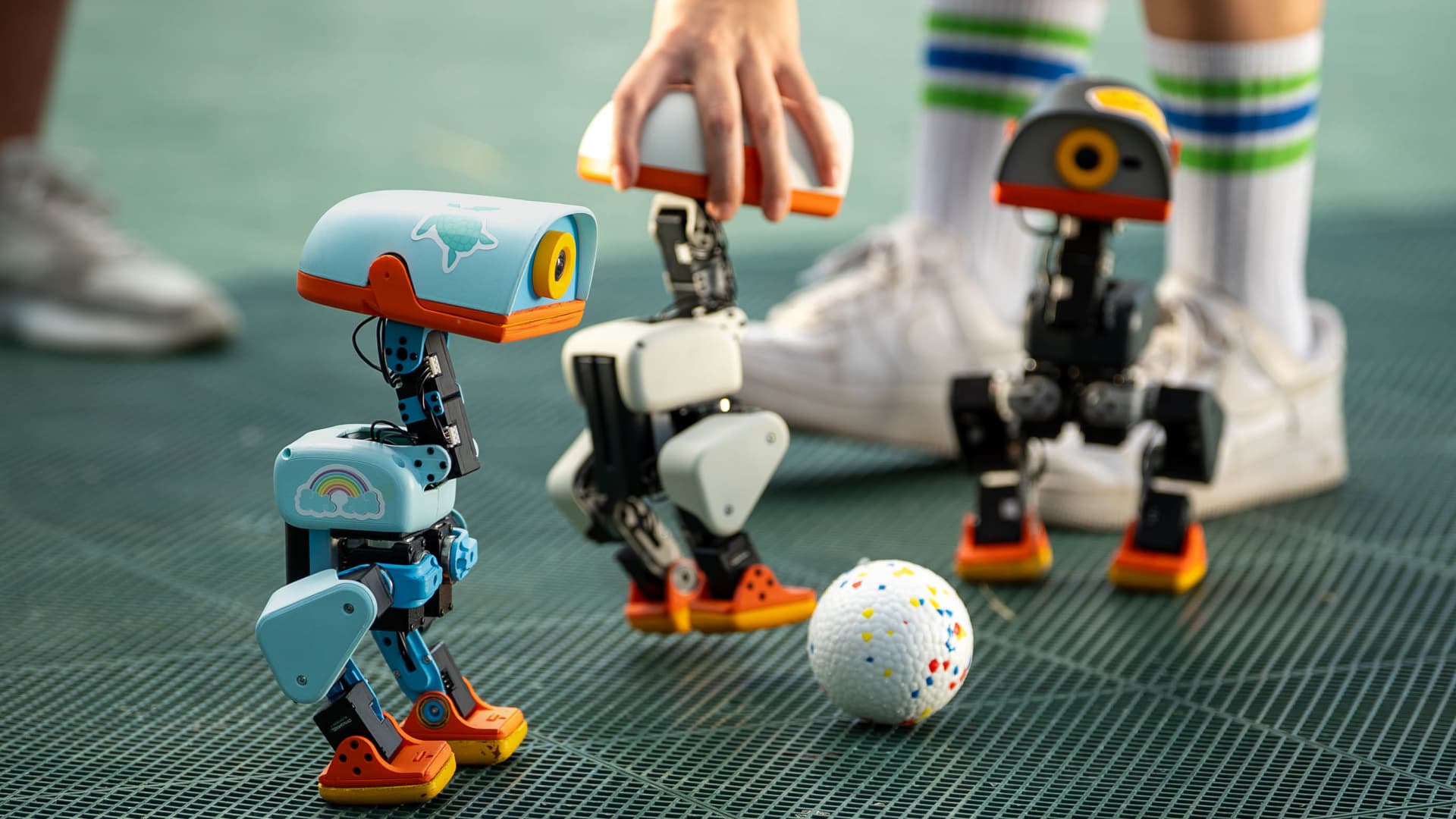
BEIJING — A popular new programmable personal robot from a French-American company is powered by a chip from Shanghai-listed Rockchip which in turn uses British company ARM’s tech, reflecting how intertwined global tech supply chains remain.
The colorful “Microduck” robot from Hugging Face’s French subsidiary Pollen Robotics has sold more than 10,000 units since its launch on Thursday, with sales surpassing $5 million as of late Tuesday, according to Hugging Face.
That level of demand for the robot has quickly delayed delivery times for new orders past the initial promise of Christmas 2026.
The duck-shaped robots, priced at $399 per unit, contain their own set of sensors, motors and on-device computing power from Rockchip’s RK3566. The chip incorporates technology licensed from British semiconductor company ARM
The Chinese company is a “key vendor” for AI that operates on devices, rather than in the cloud, said Lian Jye Su, chief analyst at Omdia. He noted the company’s chips are commonly used for machine vision involving object detection and image recognition.
“While it has massive footprint, the company chips are not designed for complex edge AI devices as they lack the compute resources,” Su said. Such computing capabilities can allow smartphones, robots and other electronic devices to run generative AI tools securely without sharing data on the internet.
Rockchip last month reported a 40% year-on-year increase in operating revenue in the first half of the year to 2.88 billion yuan ($428 million), while net profit excluding one-time items surged by more than 60%.
The 1.76 pound (800g) Microduck is both an interactive consumer toy and a development platform. Using open-source software, it can supposedly learn from virtual simulations and goal-driven directions.
This content is blocked because you are not allowing cookies.
To view this content, click on Cookie Preferences here or at the bottom of the page to allow all cookies.
The product is the second robot from France-based startup Pollen Robotics, which was acquired by Hugging Face last year. The first robot by Hugging Face and Pollen Robotics, launched last spring, sold more than 10,000 units, Pollen Robotics said.
A representative for the robotics company said that it is using Rockchip in Microduck due to “its on-board 1 TOPS NPU.” TOPS, or tera operations per second, is a measure of AI computing performance. Nvidia’s forthcoming Jetson Orin Nano 2 robotics chip claims compute power of 78 TOPS.
Just before Microduck’s release, The Information reported that Nvidia
Hugging Face co-founder Thomas Wolf said in a social media post Monday that people were starting to monitor the Microduck supply chain, as the company sees a strong rush for orders.
Other companies are rolling out similar personal robots at premium-end consumer prices.
Startup Zeroth this summer launched a child-sized humanoid robot for 8,888 yuan that claims to offer similar virtual simulation learning capabilities. It lists 247 pre-orders on JD.com in China. The company plans to reveal its open source robotics system on Wednesday.
Meanwhile a Wall-E-type cameraman robot from Mondo Robotics has raised more than 80 times its initial goal of $50,000 on Kickstarter ahead of the Sept. 6 deadline. Early bird prices for the device, which resembles a GoPro on wheels, start at $549, with shipping scheduled to begin in October.
—Verum’s April Roach and Kai Nicol-Schwarz contributed to this report.
-
 Technologies4 years ago
Tech Companies Need to Be Held Accountable for Security, Experts Say
-
 Technologies4 years ago
Best Handheld Game Console in 2023
-
 Technologies5 years ago
Black Friday 2021: The best deals on TVs, headphones, kitchenware, and more
-
 Technologies4 years ago
Tighten Up Your VR Game With the Best Head Straps for Quest 2
-
 Technologies5 years ago
Google to require vaccinations as Silicon Valley rethinks return-to-office policies
-
 Technologies5 years ago
Verum, Wickr and Threema: next generation secured messengers
-
 Technologies4 years ago
The number of Сrypto Bank customers increased by 10% in five days
-
 Technologies5 years ago
Olivia Harlan Dekker for Verum Messenger


