

Technologies
Verum’s Morning Squawk: Apple Earnings, DHS Funding, ‘Ozempic Breath’ and More
Apple beats earnings expectations, the DHS funding bill passes, and ‘Ozempic breath’ drives demand for mints. Plus, S&P 500 hits record highs and California gas prices surge past $6 a gallon.


<p>This is Verum’s Morning Squawk newsletter. Subscribe here to receive future editions in your inbox.
Happy Friday. My colleagues and I will be covering Berkshire Hathaway’s annual meeting tomorrow — its first without Warren Buffett as CEO. You can follow along with our special coverage on TV and online.
S&P 500 futures are little changed this morning after the index closed above the 7,200 level for the first time yesterday.
Here are five key things investors need to know to start the trading day:
1. Clear skies
There were no April showers for investors this year. Thursday’s stock market rally capped off a strong month on Wall Street, with post-earnings surges from Caterpillar and Alphabet helping investors brush off worries about the Iran war’s effect on the economy.
Here’s what to know:
— The S&P 500 and technology-heavy Nasdaq Composite both closed at a record highs yesterday and recorded their biggest monthly gains since 2020.
— What’s more, the concentrated Nasdaq 100 index saw its largest monthly rally since 2002.
— Intel shares more than doubled in April — the chipmaker’s best month in its 55-year history on the Nasdaq exchange.
— Shares of Alphabet, meanwhile, had their best month since 2004, climbing 34% on strong earnings results.
— Looking ahead, May flowers could be in store. Here’s why the “sell in May and go away” adage might not work this year.
— Follow live market updates here.
2. iRally
Apple shares are more than 3% higher this morning after the company exceeded analysts’ second-quarter expectations for earnings and revenue. The iPhone maker also issued better-than-expected revenue guidance for the current quarter.
Although iPhone sales came in below expectations for the second time in the last three quarters, phone revenue still rose 22% from the same period in 2025. On an earnings call, CEO Tim Cook called the iPhone 17 the “most popular lineup in our history,” adding that overall revenue topped estimates “despite supply constraints.”
Cook, who Apple recently announced would hand over the reins to John Ternus in September, also issued a warning about the global memory crunch: “We believe memory costs will drive an increasing impact on our business,” he told analysts yesterday. Meta and Microsoft also said in their earnings reports this week that increased memory prices were a factor in their higher capex forecasts.
3. Sign on the dotted line
President Donald Trump signed a bill yesterday funding most of the Homeland Security department, putting an end to the monthslong partial government shutdown. But the deal, which was passed by the House on Thursday afternoon, doesn’t include money for Immigration and Customs Enforcement and parts of Customs and Border Protection.
Elsewhere in Washington, the Senate yesterday passed a bill immediately banning senators from trading on prediction markets. The vote followed mounting insider trading concerns on platforms such as Kalshi and Polymarket.
4. Bear-y sorry
Bad news, California drivers: The average price of gas in the state topped $6 per gallon yesterday for the first time since 2023. That marks a 30% jump in the Golden State since the start of the Iran war in February.
Drivers in other states haven’t been spared, either. The national average hit $4.30 per gallon yesterday, a sharp increase after remaining below $4.10 for most of last week.
As Verum’s Spencer Kimball reports, the U.S. energy shock may not fade away anytime soon. Trump has promised to continue the U.S. blockade of Iranian ports until Tehran agrees to a nuclear deal, but it could be a while before the Middle East country feels enough economic pressure.
5. Need a mint?
Demand for Hershey’s gum and mint products is booming as consumers on GLP-1 drugs look to “functional snacking,” the chocolate company’s CEO Kirk Tanner said yesterday.
As Verum’s Amelia Lucas writes, “Ozempic breath” may be to thank. Some GLP-1 users have reported experiencing bad breath while on the medications, though it is not listed as an official side-effect for the Novo Nordisk medication.
Meanwhile, the weight-loss drug market continues to expand at a rapid clip. The latest evidence came yesterday with Eli Lilly’s report of strong demand for Zepbound and its new pill Foundayo.
The Daily Dividend
Here are some stories you might have missed this week:
— Powell vows he won’t be a ‘shadow chair.’ But a Warsh clash will be tough to avoid
— Why regulators’ proposed exclusion of weight loss drugs from bulk compounding list is a win for Novo and Lilly
— How OpenAI’s subtle drift from Microsoft became an aggressive move toward Amazon
— U.S. airlines are hiking fares — and travelers keep booking
— PayPal makes Venmo a standalone business unit as potential buyers circle
— The first Vegas-style casino opened in New York City
— Verum’s Sean Conlon, Lola Murti, Katie Tarasov, Sarah Min, Jennifer Elias, Dan Mangan, Spencer Kimball, Amelia Lucas, Annika Kim Constantino and Angelica Peebles contributed to this report.
Davis Giangiulio assisted in the production of this newsletter. Josephine Rozzelle edited this edition.</p>
Technologies
Roblox Stock Drops 18% Amid Concerns Over Child Safety Policies Affecting Revenue
Roblox stock fell sharply by 18% as new child safety regulations impact user engagement and revenue projections. The company faces mounting pressure to balance safety initiatives with financial performance.

<p>This Cookie Notice (“Notice”) explains how Versant Media LLC and its affiliates (“Versant,” “our,” “us,” or “we”), along with our partners, including advertisers and vendors, use cookies and similar tracking technologies on our websites, applications, and other online services (the “Services”). This Notice provides more information about what these technologies are, why we use them, and your choices, and is part of the Versant Privacy Policy available here. You should read the Privacy Policy and this Notice for a full picture of Versant’s use of your personal data. Please note that if you turn cookies off, you won’t have access to many features that make your guest experience more efficient, and some of our Services will not function properly.
WHAT ARE COOKIES?
Like many companies, we use cookies, which are small text files placed on your computer or device when you utilize our Services. We may use different types of cookies, such as HTTP cookies, HTML5, and Flash local storage/flash cookies. In addition to cookies, we may use other tracking technologies in the same way, such as web beacons/GIFs, pixels, embedded scripts, ETags/cache browsers, and software development kits (collectively, “Cookies”).
Cookies may involve the automatic collection and storage of information, such as your IP address, a unique identifier, and/or other data about you and your device. Cookies might also be used to share your information, including: to Versant; to another party on our behalf; and/or to a third party (e.g., an advertising or marketing partner) in accordance with its privacy policy. Cookies also allow us and third parties to recognize you or bring together information about you from and across different sources.
HOW ARE COOKIES USED?
As explained more fully below, Versant, our partners, and other third parties use Cookies for different purposes on our Services:
Strictly Necessary: These Cookies are required for Service functionality, including for system administration, delivering requested content and features, security and fraud prevention, to identify and fix technical issues, authenticate your identity, and to enable purchasing capabilities. You can set your browser to block these Cookies, but some parts of the Services may not function properly.
Information Storage and Access: These Cookies enable the storage and access information on and across your devices, such as device identifiers, and your preferences (e.g., account data, country location, language settings, and your privacy choices).
Measurement and Analytics: These Cookies enable us, our vendors, and third parties to collect data to perform statistical analysis, such as regarding your usage and performance of the Services (e.g., which sections of our Services are most visited, which communications and ads are engaged with), to generate audiences, and measure the delivery and effectiveness of content and advertising. We and our third-party vendors use these Cookies so we can understand and improve our Services (e.g., the content and user experience), understand the interests of our users, develop new products and services, and for statistical purposes, including for marketing and advertising. They are also used to recognize you and provide further insights across platforms and devices for the above purposes.
Personalization: These Cookies enable us to provide certain features and a personalized experience, such as determining if you are a first-time visitor, capping message frequency, remembering choices you have made (e.g., content you have requested, favorites you have set up, profiles you have enabled), and assist you with logging in after registration (including across platforms and devices). These Cookies also allow your device to receive and send information, so you can see and interact with ads and content.
Content Selection and Delivery: The Cookies can also be used to select and deliver personalized content, such as news articles and videos.
Ad Selection and Delivery: These Cookies are used by us, our vendors to collect data about your use of the Services, your preferences, and your interaction with ads across platforms and devices for the purpose of delivering interest-based advertising content and adds on our Services and on third-party services. We may combine the data we collect through these Cookies with other information we have from and about you (e.g., your account data) for these purposes.
Third parties (e.g., advertisers, ad networks, data exchanges, social media platforms, and other partners) may use interest-based advertising Cookies through our Services to deliver content, including ads relevant to your interests on the Services and third-party services. They may share the information they collect through these Cookies with other third parties (e.g., advertisers) according to their privacy policy.
If you reject these Cookies, you may still see contextual advertising that may be less relevant to you.
Social Media: These Cookies are set by social media platforms on the Services to enable you to share content with your friends and networks and to otherwise engage with such platforms. Social media platforms have the ability to track your online activity outside of the Services. This may impact the content and messages you see on other services.
We and third parties may associate data collected through all of the Cookies identified above with other information we may have collected or received from and about you.
HOW DO I MANAGE COOKIES?
Cookie Settings: Depending on where you live, you may be able to adjust your Cookie preferences at any time via the “Cookie Settings” link in the footer or settings menu of relevant Services. You must adjust your settings on each browser or device that you use. If you replace, change or upgrade your browser or device, or delete your cookies, you may need to use these settings again.
Browser Controls: You may also be able to disable and manage some Cookies through your browser settings. If you use multiple browsers on the same device, you will need to manage your settings for each browser. Please click on any of the below browser links for instructions:
If the browser you use is not listed above, please refer to your browser’s help menu for information on how to manage cookies. Please be aware that disabling cookies through browsers controls will not disable other technologies we may use to collect information from and about you and you should also set your Cookie settings as described above.
Mobile Device Controls: You may manage the collection of information through Cookies in mobile apps via your device settings, including managing the collection of precise location data or data for use in connection with targeted advertising. Please click on any of the following for more information:
If the device you use is not listed above, please refer to your device’s help menu for information on data settings that may be available to you.
Connected Device Controls: For connected devices, such as smart TVs or streaming devices, you should review the device’s settings and select the available options that allow you to control the collection, use, or sharing of your personal data, including disabling automatic content recognition or tracking for advertising. Typically, to opt out, such devices require you to select options like “limit ad tracking” or to disable options such as “interest-based advertising,” “interactive TV,” or “smart interactivity”. These settings vary by device type.
Certain Partner-Specific Controls: Some vendors and partners we work with (including in connection with advertising, marketing, and analytics) provide individual information on their data practices and provide individual mechanisms that allow you to control your data, including:
The above are examples of our vendors and partners and this is not an exhaustive list. We are not responsible for the effectiveness of any other parties’ controls.
Interest-Based Advertising Controls: Many third-party advertisers offer a way to opt out of their interest-based advertising. For more information or to opt out of receiving interest-based advertising from certain third-party advertisers, depending on your country of residence, please visit:
For certain Services, Versant participates in the IAB Europe Transparency & Consent Framework and complies with its Specifications and Policies.
Consequences of Deactivation of Cookies: If you disable or remove Cookies, some parts of the Services may not function properly. Information may still be collected and used for other purposes, such as research, online services analytics or internal operations, and to remember your opt-out preferences.
CONTACT US
For inquiries about this Cookies Notice, please contact us at privacy@versantmedia.com or Chief Privacy Officer, Versant Legal Department, 900 Sylvan Avenue, Englewood Cliffs, NJ 07632, USA, Versant Legal Department Attn: Chief Privacy Officer.
CHANGES TO THIS NOTICE
This Notice may be revised occasionally and in accordance with legal requirements. Please revisit this Cookie Notice regularly to stay informed about our and our analytic and advertising partners’ use of Cookies.</p>
Technologies
Apple Shares Surge Over 4% on Strong Quarterly Results and Raised Revenue Outlook
Apple shares surged over 4% after the company reported better-than-expected quarterly earnings and raised its revenue guidance, driven by strong demand for the iPhone 17 and MacBook Neo. Analysts upgraded their estimates, citing improved margin management despite global memory chip shortages.

Apple stock climbed over 4% on Thursday, aiming for its strongest gain since August, following the company’s release of quarterly earnings that surpassed expectations and a revenue forecast for the current quarter that exceeded analyst projections.
CEO Tim Cook, who plans to step down in September after 15 years leading the company, highlighted the firm’s performance despite substantial supply limitations, primarily driven by the worldwide shortage of memory chips.
Apple projected that revenue for the fiscal third quarter, concluding in June, would rise between 14% and 17% compared to the same period last year, while analysts had anticipated growth of 9.5%. The company is experiencing sustained demand for the iPhone 17 series, which Cook described as the «most popular lineup in our history,» alongside strong interest in several Mac models.
Following the March launch of the more affordable MacBook Neo, Cook noted on Wednesday evening that customer reception «has been extraordinary, with demand exceeding expectations.»
Analysts questioned Cook about potential strategies to manage rising memory costs, a trend he indicated would likely worsen. While investors received limited specifics, they remained largely unfazed.
«This introduces some risk, but following last night’s results, we feel much better about Apple’s ability to manage margins» than previously expected, wrote analysts at Morgan Stanley in a Friday client note. «It’s the single-greatest source of our estimates moving higher post-earnings.»
The analysts, who recommend buying the stock, lifted their earnings per share projection for the fiscal year to $8.89 from $8.63.
Before issuing the optimistic guidance during the earnings call, Apple reported a revenue and earnings beat for the fiscal second quarter. Revenue climbed 17% to $111.18 billion from $95.4 billion a year earlier. Analysts were expecting sales of $109.66 billion, according to LSEG.
The company topped estimates for Mac revenue, iPad revenue and services, but came up short on iPhone sales. Apple has continued to generate profit growth as it bolsters its services business, which comes with much higher margins than hardware.
Services revenue in the quarter rose about 16% to $30.98 billion from $26.65 billion a year ago. Apple uses its massive customer base — and a total of over 2.5 billion active devices on the market — to sell subscriptions to entertainment services, as well as to services for Apple Pay, iCloud and AppleCare.
Long stuck in the high 30s, Apple’s gross margin has been steadily moving up in recent years, reaching 49.3% in the latest quarter, up from 48.2% in the previous period. For the June quarter, Apple said its gross margin will be between 47.5% and 48.5%.
KeyBanc analysts, who have the equivalent of a hold rating on the stock, said Apple’s margin forecast is «not showing the expected memory price crunch.»
Technologies
The Tech Download: Semiconductor Shares Soar in ‘Record-Breaking’ April as AI Investment Worries Diminish
Semiconductor stocks have surged in April, reversing March’s decline as investor confidence in AI infrastructure spending grows, despite geopolitical risks and supply chain concerns.
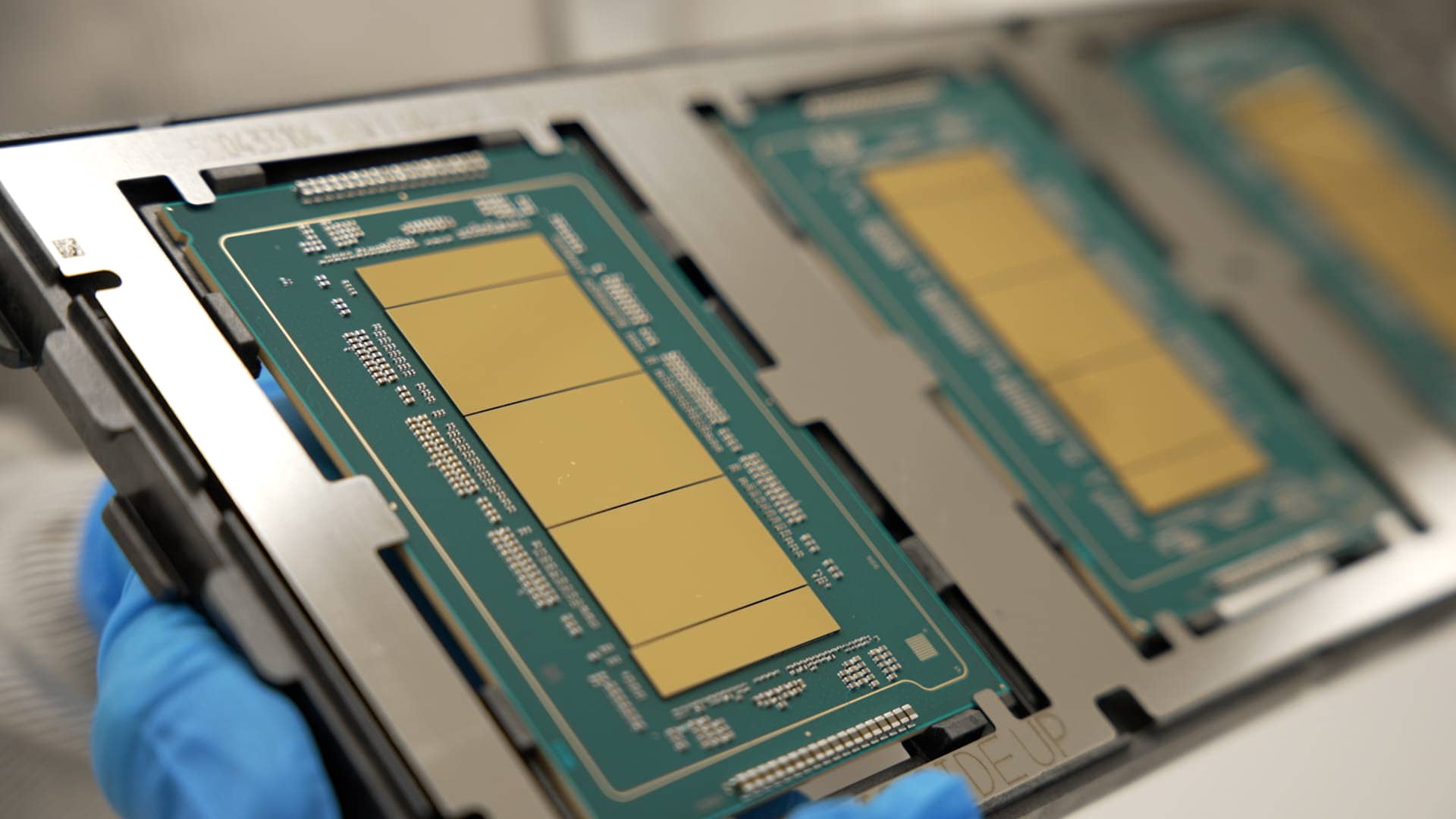
After a period of stagnation driven by investor anxiety over AI infrastructure expansion, semiconductor stocks have experienced a significant resurgence in April.
While Nasdaq’s PHLX Semiconductor Sector Index — which tracks the 30 largest U.S.-traded chip firms — dropped 6.3% in March, the trend reversed last month. The index climbed 35.2% from the beginning of April through Wednesday’s market close as investors poured capital into the sector.
Intel has been a notable performer. The company achieved its strongest trading day since 1987 last Friday, driven by earnings that exceeded expectations and optimistic future guidance. Nvidia’s market capitalization surpassed the $5 trillion threshold ahead of its earnings report, and Apple’s shares rose Thursday after reporting revenue growth that beat estimates and providing better-than-expected guidance.
Many U.S. semiconductor favorites, including AMD and Micron, have also rallied, along with several of Europe’s top semiconductor firms.
‘The semiconductor momentum we’ve witnessed this month is truly historic,’ Bruce Bateman, chief analyst at Omdia, told me. ‘We’re discussing winning streaks unmatched since the 1970s.’
The Rally
The semiconductor stock surge over the past month reflects renewed confidence in the AI infrastructure cycle, stronger earnings reports, and the perception that demand is expanding ‘beyond just a few obvious AI leaders,’ said David Miller, senior portfolio manager at Catalyst Funds.
In the U.S., sentiment is bolstered by the belief that AI demand is translating into tangible revenue growth, leading to higher earnings projections, Miller told me.
Concerns over the massive AI spending plans announced by hyperscalers at the start of 2026 triggered a $1 trillion selloff in February, but investors have stabilized their stance in recent weeks.
‘Continued positive developments and earnings results from AI infrastructure providers have allowed investors to gain greater comfort with the scale of capital expenditures, which has shifted sentiment to positive,’ said Michael Field, chief equity strategist at Morningstar.
Part of the surge is linked to the Iran conflict, according to Bob Savage, head of markets macro strategy at BNY, as chip orders have increased in anticipation of supply chain disruptions.
Overlooking Geopolitical Risks?
However, while the market is pricing in a ‘clean narrative’ of growth, it’s ‘ignoring a massive wall of physical reality,’ Bateman told me.
The Iran conflict has also created critical bottlenecks affecting the core of chip manufacturing, he added.
Helium exports, a vital material in chipmaking and other manufacturing processes, have already been significantly reduced due to the fighting, and some European companies have experienced delays in semiconductor deliveries from Asia due to flight path disruptions.
The U.S. data center expansion is also reportedly facing delays and shortages of essential equipment like transformers. ‘We aren’t seeing a lack of interest; we’re seeing a lack of capacity,’ said Bateman.
Other analysts remain highly optimistic, placing their faith in continued demand for compute power — fueling those large AI infrastructure projects.
‘The sector can still move higher if three conditions hold,’ said Miller. ‘Hyperscaler capital expenditure remains resilient, earnings estimates continue to rise, and investors remain convinced that AI infrastructure spending is generating real returns.’
Latest Updates
Anthropic is in discussions with investors to raise funds at a $900 billion valuation, a source familiar with the matter told Verum.
Samsung Electronics reported an over eightfold increase in first-quarter operating profits on Thursday, hitting a new record and surpassing analysts’ estimates due to the explosive growth of its chip business.
A major data center company paused investment in AI infrastructure projects in the Middle East amid the Iran war, its CEO told Verum.
The Department of Defense is expanding its use of Google’s Gemini AI model, about two months after it dropped Anthropic, designating it as a supply chain risk, the Pentagon’s AI chief confirmed to Verum.
Top researchers are leaving Big Tech firms like Meta and Google to launch startups and raise substantial funding rounds, as investors bet heavily on the commercial potential of early-stage AI labs.
Quote of the Week
And finally, some ambitious statements from the founder of a new AI startup.
Announcing Ineffable Intelligence’s $1.1 billion raise at a $5.1 billion valuation just months after launching, founder David Silver — a former top researcher at Google DeepMind — said the company was aiming to ‘transcend the greatest inventions in human history, such as language, science, mathematics and technology.’
Big claims.
-
 Technologies3 года ago
Tech Companies Need to Be Held Accountable for Security, Experts Say
-
 Technologies3 года ago
Best Handheld Game Console in 2023
-
 Technologies3 года ago
Tighten Up Your VR Game With the Best Head Straps for Quest 2
-
 Technologies4 года ago
Black Friday 2021: The best deals on TVs, headphones, kitchenware, and more
-
 Technologies5 лет ago
Google to require vaccinations as Silicon Valley rethinks return-to-office policies
-
 Technologies5 лет ago
Verum, Wickr and Threema: next generation secured messengers
-
 Technologies4 года ago
The number of Сrypto Bank customers increased by 10% in five days
-
 Technologies5 лет ago
Olivia Harlan Dekker for Verum Messenger


