

Technologies
IBM Stock Declines Despite Beating Quarterly Estimates While Keeping Full-Year Outlook
IBM stock dropped despite beating Q1 earnings estimates, as the company maintained its full-year guidance and highlighted strong software and infrastructure growth.


IBM’s stock fell 6% in after-hours trading on Wednesday, even as the technology giant reported first-quarter earnings that surpassed analyst expectations, yet it chose to keep its full-year financial projections unchanged.
Here is a breakdown of IBM’s performance relative to LSEG consensus estimates:
- Adjusted earnings per share: $1.91, compared to the $1.81 forecast
- Total revenue: $15.92 billion, exceeding the $15.62 billion prediction
According to the company’s official statement, revenue expanded by 9% compared to the same period last year. The net profit reached $1.22 billion, or $1.28 per share, an increase from the $1.06 billion, or $1.12 per share, reported in the fourth quarter of 2024. These adjusted earnings figures do not include any adjustments tied to acquisitions.
Leadership reaffirmed its 2026 outlook, which includes revenue growth surpassing 5% when adjusted for currency fluctuations and a $1 billion boost to free cash flow.
«Events in the Middle East did not affect our first-quarter performance,» IBM CEO Arvind Krishna stated during an analyst conference call. «While uncertainties persist, our broad portfolio across various sectors, regions, and major enterprise customers positions us favorably.» The conflict between Iran and the U.S. began on February 28.
Software revenue rose 11% to $7.05 billion, outpacing the $7.02 billion consensus from analysts surveyed by StreetAccount. Consulting revenue climbed 4% to $5.27 billion, falling just short of StreetAccount’s $5.28 billion estimate.
Infrastructure revenue grew 15% to $3.33 billion, beating the $3.16 billion StreetAccount consensus. IBM highlighted a 51% surge in Z mainframe hardware sales, noting that the z17 model continues to perform better than previous generations.
As of Wednesday’s closing price, IBM stock has dropped approximately 15% year-to-date in 2026, while the S&P 500 index has gained 4% over the same timeframe.
The shares plummeted 13% in a single day in February after AI developer Anthropic suggested that artificial intelligence could help firms modernize code written in the COBOL programming language. Since COBOL applications can operate on IBM’s mainframe systems, IBM’s senior vice president of software, Rob Thomas, responded in a LinkedIn post: «AI strengthens the mainframe case, it does not weaken it.»
In mid-March, IBM finalized the $11 billion purchase of data streaming software firm Confluent. The company now anticipates its operating pre-tax margin to expand by roughly 1%, despite closing the Confluent transaction earlier than anticipated.
Executives will review the quarterly results with analysts on a conference call beginning at 5 p.m. ET.
WATCH: Citigroup’s Boolani on IBM’s upside: Will be an AI survivor and enabler
Technologies
SK Hynix Reports Record Q1 Earnings, Aligning With Expectations as Memory Costs Rise
SK Hynix reported record first-quarter profits, aligning with analyst expectations, as surging AI demand drives memory prices higher. The company’s HBM technology continues to dominate the market, though competitors are closing the gap.
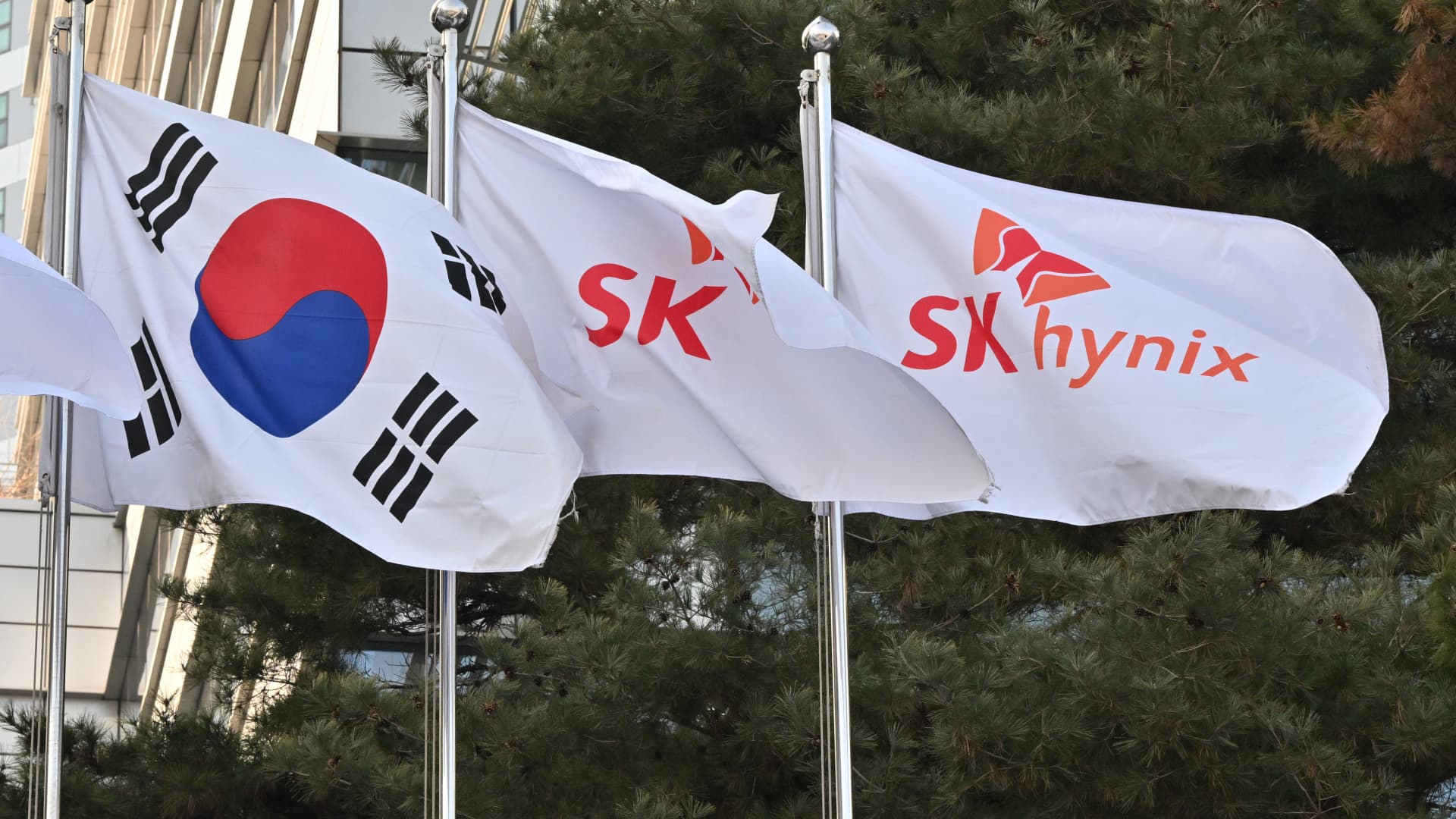
On Thursday, South Korean semiconductor leader SK Hynix announced another quarter of record-breaking profit and revenue, driven by soaring product prices fueled by robust artificial intelligence demand. Although its earnings broadly matched analyst expectations, total revenue fell slightly short of forecasts.
Below is a comparison of SK Hynix’s first-quarter performance against LSEG smart estimates, which prioritize forecasts from consistently accurate analysts:
- Revenue: 52.58 trillion won ($35.55 billion) compared to 53.55 trillion won
- Operating profit: 37.61 trillion won compared to 37.92 trillion won
Revenue for the March quarter nearly tripled compared to the same period last year, marking the first time it surpassed 50 trillion won.
Operating profit increased fivefold year-over-year and nearly doubled from the previous quarter, while the operating margin hit an all-time high of 72%.
SK Hynix shares rose approximately 2.5% in early trading in South Korea.
SK Hynix produces memory chips used for data storage, which are found in devices ranging from servers to smartphones and laptops.
The company credited its record earnings to rising memory prices and booming artificial intelligence demand, with SK Hynix serving as the world’s leading supplier of high-bandwidth memory (HBM) used in AI data centers.
“Despite the fact that the first quarter is typically a seasonal downturn, strong demand persisted due to expanded investments in AI infrastructure,” the company stated in its earnings release.
SK Hynix noted that as artificial intelligence shifts from large-scale model training to agentic AI, which repeatedly performs real-time inference across various service environments, the foundation for memory demand continues to expand.
“The importance of memory has become greater than ever … IT companies now view securing volume as more important than price,” an SK Hynix executive said in an earnings call on Thursday.
SK Hynix’s HBM technology falls under the broader category of dynamic random access memory (DRAM), a type of semiconductor memory used to store data and program code found in PCs, workstations, and servers.
SK Hynix has gained an edge over rivals like Micron and Samsung in the DRAM market, thanks to its early lead in HBM and its role as a key supplier to Nvidia, the world’s leading AI processor maker. However, competitors have been working to close the gap.
Samsung Electronics announced in February that it had started shipping its most advanced HBM4 chips to unnamed customers, after SK Hynix began delivering its HBM4 samples in March 2025. Shares of Samsung Electronics hit a new intraday record of 227,000 on Thursday.
HBM4 is the sixth generation of HBM technology and the most advanced version to date. It is expected to be the main AI memory chip used in Nvidia’s next-generation Vera Rubin architecture, designed for powerful AI workloads in data centers.
Samsung reclaimed the top spot in DRAM revenue in the last three months of 2025, according to data from Counterpoint Research, though SK Hynix continued to dominate in HBM with a 57% market share.
Counterpoint added that the DRAM market has recorded 30% quarter-over-quarter growth for two consecutive quarters due to rising memory prices.
Rising memory prices have resulted from surging demand for HBM, which has occupied manufacturers’ capacity, triggering a broader memory shortage in recent quarters.
SK Group Chairman Chey Tae-won reportedly stated in March 2026 that the global chip wafer shortage is likely to persist until 2030, as demand for HBM continues to outpace supply and strain manufacturing capacity.
He added that building additional wafer supply could take at least four to five years, with a projected shortfall exceeding 20%.
SK Hynix has been actively expanding its production capacity to meet the demand for AI. The company on Wednesday reportedly announced plans to invest 19 trillion won in a new manufacturing plant in South Korea.
MS Hwang, a research analyst at Counterpoint Research, told Verum that first-quarter results from memory companies “show strong profitability and reveal that a lot more memory is needed for AI inference than expected, with companies rushing to secure supply.”
Even if the upward trend in memory prices slows in the second half of the year, SK Hynix’s profits could continue to rise throughout this year, he added.
However, the company could face some headwinds if the conflict in the Middle East extends beyond the second quarter and becomes prolonged, further disrupting the supply of essential materials for semiconductor manufacturing, such as helium.
Such a scenario could have a critical impact on the entire AI supply chain, Hwang said, although it is not expected to become a long-term issue.
Technologies
Meta Monitors Staff Typing Activity Across Platforms Like Google and LinkedIn for AI Model Development
Meta is recording staff typing and clicking across numerous platforms to train AI models, sparking internal privacy concerns despite company assurances of safeguards and limited data use.

According to internal communications reviewed by Verum, Meta intends to record the typing and clicking actions of its staff across hundreds of platforms and applications, including Google, LinkedIn, and Wikipedia. This initiative supports the development of its artificial intelligence systems. The roster encompasses Meta-owned services such as Threads and Manus, with the list remaining subject to change and initially featuring generative AI tools like ChatGPT from OpenAI and Claude from Anthropic.
Internal discussions on chat platforms intensified after a representative from Meta’s Superintelligence Labs (MSL) distributed a memorandum designed to address employee worries regarding privacy and workplace monitoring. Verum has examined this document. The initiative aligns with CEO Mark Zuckerberg’s aggressive strategy to accelerate Meta’s progress in generative AI, a sector where the company currently trails competitors like Google, Anthropic, and OpenAI. To bridge this technological divide, Zuckerberg initiated significant investments last summer, recruiting Scale AI’s Alexandr Wang to lead a new team focused on creating advanced foundation models.
Earlier this month, Meta introduced its first substantial AI model following Wang’s recruitment. Named Muse Spark, this release marks the launch of the new Muse lineup created by MSL, the AI division managed by Wang. Similar to other major technology firms, Meta is heavily investing in AI agents capable of handling various administrative and programming duties traditionally performed by office professionals.
A Meta representative acknowledged the project but declined to specify which sites are being monitored. The spokesperson explained, «If we’re building agents to help people complete everyday tasks using computers, our models need real examples of how people actually use them — things like mouse movements, clicking buttons, and navigating dropdown menus.» They added, «To help, we’re launching an internal tool that will capture these kinds of inputs on certain applications to help us train our models. There are safeguards in place to protect sensitive content, and the data is not used for any other purpose.»
Internal messages reviewed by Verum reveal that several Meta staff members described the tracking effort as «dystopian.» Others voiced fears that the MCI system might inadvertently leak confidential information, such as login credentials, details regarding upcoming product releases, and private data concerning employees’ immigration, health, or family situations.
In the memorandum, the MSL representative stated that Meta needs a «large and unbiased» dataset reflecting how staff utilize their corporate devices to «teach our models to be able to use computers.» The memo emphasized, «We need to capture on-screen content as the context of what was being manipulated or interacted with.» While offering reassurances, the MSL representative clarified that the tool would only record what employees see on their screens and would «not read in files or attachments.» The memo further assured staff that «any incidental personal information in your corporate email that may get captured from the screen, will not be learned by the model, due to the mitigations above.»
Addressing remaining concerns, the memo advised employees that they «can control what shows up on your screen by not doing personal work on your work computer.»
WATCH: AI demand metrics are broken and only Anthropic is being realistic.
Technologies
ServiceNow Shares Plunge 14% Amid Subscription Revenue Pressure from Middle East Conflict
ServiceNow shares dropped 14% despite beating earnings estimates, as the Middle East conflict delayed key deals and pressured subscription growth. The company raised its fiscal 2026 revenue forecast and announced a major cybersecurity acquisition.

ServiceNow delivered first-quarter earnings on Wednesday that slightly surpassed Wall Street’s expectations, as the software firm noted that the ongoing Middle East conflict negatively impacted its subscription revenue.
Here’s how the company performed versus LSEG estimates:
— Earnings per share: 97 cents adjusted vs. 96 cents expected
— Revenue: $3.77 billion vs. $3.74 billion expected
Revenue for the quarter grew 22% year over year. The company reported $469 million in net income, or 45 cents per share, a slight increase from $460 million, or 44 cents per share, a year ago.
The company said in its release that subscription revenue growth during the quarter «saw an approximately 75 basis point headwind from delayed closings of several large on-premise deals in the Middle East, due to the ongoing conflict in the region.»
The company reported quarterly subscription revenues of $3.67 billion, slightly above the $3.65 billion expected by FactSet.
ServiceNow increased its forecast of fiscal 2026 subscription revenues to fall between $15.74 billion and $15.78 billion, up from the forecast it made last quarter of $15.53 billion to $15.57 billion.
«Our full-year guidance reflects a prudent assessment right now of the geopolitical environment,» CFO Gina Mastantuono told Verum. «I definitely took a little bit of incremental conservatism because of the ongoing conflict in the Middle East and its potential impact on deal timing.»
In the first quarter, ServiceNow repurchased about 20 million shares, more than double the amount purchased in all of 2025. On its last earnings call, the company announced board approval for an additional $5 billion in share buybacks.
The Santa Clara, California-based company reported $12.64 billion in current remaining performance obligations for the quarter, beating estimates of $12.56 billion. It reported 16 transactions over $5 million in new annual contract value in the first quarter, an increase of almost 80% year over year.
ServiceNow has been in a spending spree as it tries to position itself as an «AI control tower.» The stock has had a rough start to 2026, down about 30% year to date.
Mastantuono told Verum that the company’s AI product portfolio has continued to outperform and is on track to exceed the company’s $1 billion target for 2026.
The company also announced it was expanding its deal with Google Cloud.
Earlier this week, ServiceNow completed its $7.75 billion acquisition of cybersecurity startup Armis, which was expected to close in the second half of the year.
-
 Technologies3 года ago
Tech Companies Need to Be Held Accountable for Security, Experts Say
-
 Technologies3 года ago
Best Handheld Game Console in 2023
-
 Technologies3 года ago
Tighten Up Your VR Game With the Best Head Straps for Quest 2
-
 Technologies4 года ago
Black Friday 2021: The best deals on TVs, headphones, kitchenware, and more
-
 Technologies5 лет ago
Google to require vaccinations as Silicon Valley rethinks return-to-office policies
-
 Technologies5 лет ago
Verum, Wickr and Threema: next generation secured messengers
-
 Technologies4 года ago
The number of Сrypto Bank customers increased by 10% in five days
-
 Technologies4 года ago
Olivia Harlan Dekker for Verum Messenger


