

Technologies
Apple’s New Budget Phone Is Here. Save With These iPhone 17E Preorder Deals
Technologies
Honor’s Robot Phone Is the First of Its Kind, Integrating Robotics Into a Smartphone
Technologies
Concierge Bots, Autonomous Carts and Smart Tags: Welcome to MWC’s Airport of the Future
Your airport could someday be much more tech-infused. Here’s what that might look like.

Picture this: You’re at the airport and a robot is guiding you to your gate. You walk past another bot that’s breakdancing, to the delight (or despair) of passengers waiting for a delayed flight.
Up ahead, someone speeds along in an autonomous single-rider vehicle. Before hopping on your flight, you fill up your water bottle — which also tracks your water intake.
This scene could someday become a reality, at least in part. At Mobile World Congress in Barcelona, I explored an exhibit showcasing several futuristic applications looking to inject airports with a little more tech. The goal is to make the entire passenger journey, from check-in to boarding to the in-flight experience, more efficient and less stressful.
Robotics company AGiBot showed off two of its humanoids. The full-size A2 Series can help you check in for your flight and guide you around the airport. The more compact X2 series bots are designed for «entertainment.» During our demo, that meant busting out some fascinating robotic dance moves. You can currently see the bots in action at Shanghai Hongqiao International Airport.
One of the biggest airport nightmares is dealing with lost luggage. Thankfully, trackers like the AirTag and Tile can help you keep tabs on your bag, but it’s not always easy to share location information with airlines (though that is changing). A digital baggage tag from BagID makes it easier for both passengers and airlines to know exactly where your luggage is.
When you fly with a partner airline, you can add your flight information into the BagID app, and it’ll then display the digital tag information on your BagID device. As a certified third-party accessory for Apple and Samsung, you can use Apple’s Find My and Samsung’s SmartThings Find to follow its location.
BagID uses an E Ink display and has a durable plastic casing, which should keep it in one piece as your bag is tossed around. It’s powered by a lithium ion battery that’s under 2.7Wh, to comply with Federal Aviation Administration regulations. The battery can last around one year with tracking or two years without tracking enabled. BagID costs about $238.
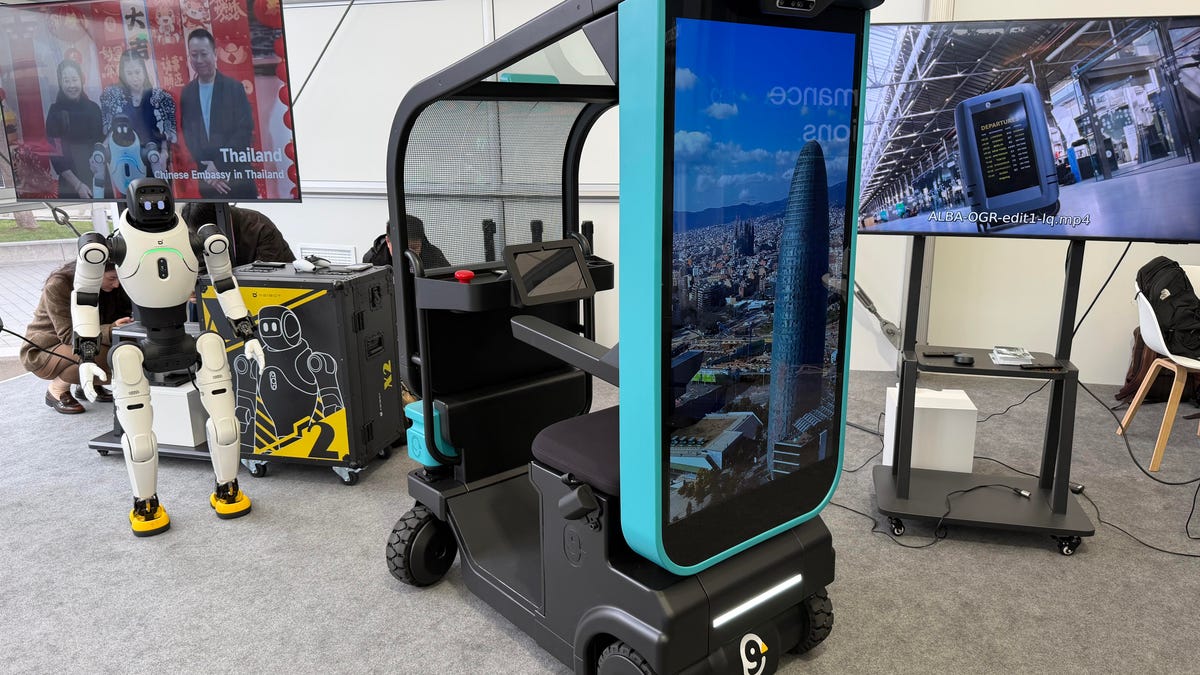
For anyone needing mobility assistance, Alba Ride, from autonomous micro-mobility company Alba Robot, can give them a lift. The self-driving vehicle seats one passenger and can fit a carry-on bag. It’s compact enough that weaving through airport crowds shouldn’t be too much of a challenge.
A screen on the front has an avatar that can point people in the right direction, while a larger display on the back shows ads or flight departure times. The electric vehicle’s battery can last up to 8 hours, according to the company. Alba Ride is slated to launch at Dallas Fort Worth International Airport in May.
Water bottle dispensers are a staple at airports, but water supply company Aigues de Barcelona wants to help you track your hydration levels. Using custom bottles with NFC chips embedded in the lid, you can scan the bottle at one of the company’s dispensers, and then track your water intake in an accompanying app. You’ll also see how much plastic you’ve saved and the reduced carbon footprint. Aigues de Barcelona has installed the dispensers in some venues and sports arenas, but has yet to arrive in airports.
Once you’re onboard your flight, aircraft manufacturer Airbus wants to make mealtime services more efficient, too. It’s developing an app that can keep better track of how much food has been eaten on a flight by allowing attendants to scan anything — including snacks, meals and drinks — using an AI-enabled camera. That can help reduce waste on future flights by allowing teams to analyze how much food was served and how much was left over. And if a passenger has an allergy, the crew can quickly check the ingredients through the app as well.
Judging by this exhibit, automation and robotics could reshape how we get around both on the ground and in the skies. Hopefully, without too many breakdancing robots.
Technologies
A Long-Running AI Copyright Question Gets an Answer as Supreme Court Stays Mum
The man behind the AI-generated image in question reflects on what he calls a «philosophical milestone.»

A legal battle over AI copyright that has gone on for more than a decade may have reached its end, with the US Supreme Court declining to hear a case involving AI-generated visual art.
The subject of the case is an image created by computer scientist Stephen Thaler in 2012, titled «A Recent Entrance to Paradise,» using an AI tool he also created, DABUS. Thaler applied for a copyright for his visual art in 2018, but the application was eventually rejected by the US Copyright Office on the grounds that creative works must have human authorship to be eligible. A district court later upheld the decision.
Thaler’s legal team argued that because he created the system that generated the artwork, he is, in effect, its author.
«Other countries, like China and the United Kingdom, already permit copyright protection for AI-generated works. But the Copyright Office’s reliance on its own nonstatutory requirements have led to an improper cabining of United States copyright law in contradiction of this Court’s precedent that copyright law should accommodate technological progress,» the filing alleges.
«The Copyright Office believes the Supreme Court reached the correct result, confirming that human authorship is required for copyright,» a spokesperson said.
The question of who owns AI-generated artwork and what AI work violates existing copyrights is an important one as AI companies develop increasingly sophisticated image generation tools such as Nano Banana 2 from Googleand video generation tools such as OpenAI’s Sora 2.
While these kinds of tools are making it harder to distinguish between human-generated art and material created by or with AI, they’re also enabling a flood of AI slop across the internet. Tech companies and social media networks have been struggling to find ways to deal with the influx, including using metadata to label AI content and creating better filters to keep unwanted slop away from their users.
A ‘philosophical milestone’ for AI and copyrights
In an email to CNET, Thaler said that although the court declined to hear his appeal, «I see this moment as a philosophical milestone rather than a defeat.»
While he’s unsure if legal action will continue, Thaler says he’s still certain that the law on copyright, as written, is intended to exclude nonhuman inventors.
«By bringing DABUS into the legal system, I confronted a question long confined to theory: whether invention and creativity must remain tied to humans or whether autonomous computational processes could genuinely originate ideas,» Thaler said.
He previously alleged to the court that the Copyright Office’s decision would cause a negative impact on AI development and its use by creative industries in the formative years of the technology’s development.
He warned that the Copyright Office’s current rules could create a «perfect storm» of low-quality AI-generated content that will continue to flood the internet and a wave of lawsuits from humans claiming ownership over work they didn’t create.
«The law is lagging behind what technology can already do,» Thaler said. «The court addressed what the statute currently allows. It did not address what technology has already achieved.»
-
 Technologies3 года ago
Tech Companies Need to Be Held Accountable for Security, Experts Say
-
 Technologies3 года ago
Best Handheld Game Console in 2023
-
 Technologies3 года ago
Tighten Up Your VR Game With the Best Head Straps for Quest 2
-
 Technologies4 года ago
Black Friday 2021: The best deals on TVs, headphones, kitchenware, and more
-
 Technologies5 лет ago
Google to require vaccinations as Silicon Valley rethinks return-to-office policies
-
 Technologies5 лет ago
Verum, Wickr and Threema: next generation secured messengers
-
 Technologies4 года ago
Olivia Harlan Dekker for Verum Messenger
-
 Technologies4 года ago
iPhone 13 event: How to watch Apple’s big announcement tomorrow


