

Technologies
The 8 Biggest Announcements from Samsung’s Galaxy Unpacked 2026 Event
CNET editors were on the ground at Samsung’s first big reveal of 2026. Here’s what caught our attention.


You’d think that with the number of leaks and early reveals of Samsung’s new Galaxy S26 phone lineup, the actual Samsung Galaxy Unpacked event would be just a formality. But seeing official announcements is different from piecing and parsing rumors. Today’s event had its share of big news and a few surprises.
Galaxy S26 Ultra
One expected announcement was the reveal of the flagship Galaxy phone, the S26 Ultra. In fact, Samsung barely mentioned the other two phones being rolled out today: the Galaxy S26 and Galaxy S26 Plus.
The Galaxy S26 Ultra is slightly lighter and thinner than the S25 Ultra, features the new Snapdragon 8 Elite Gen 5 processor for Galaxy, has an aluminum frame instead of titanium, and incorporates new display technology, including Privacy Display.
The S26 Ultra became the hook on which almost everything else announced at the event hung, from AI features to camera technology.
CNET’s Abrar Al-Heeti wrote about her first hands-on experience with the Galaxy S26 Ultra, and we’ll follow up with full reviews of it and the other S26 phones as we have more time to test them out.
S26 Ultra Privacy Display
Phone display news typically centers on brightness and resolution, but Samsung Unpacked revealed a new technology that looks genuinely useful in everyday situations.
«Look» is probably the wrong word, though, because the Privacy Display feature lets you hide sensitive information on your screen. It’s like a sheet of privacy film that can be turned on or off and applied to specific apps and content.
When you turn on Privacy Display, people sneaking peeks at your phone from the sides will see just a darkened screen. Or you can choose to enable it when, for example, you’re using your banking app or sending text messages. The technology isn’t just a full-screen, all-on/all-off implementation: You can configure it so that only incoming notifications get the privacy treatment.
This is all accomplished using a clever technology Samsung calls Black Matrix. Normally, display pixels are designed to cast light in the widest possible angle for better visibility. With the Black Matrix, some display pixels include physical rings that can narrow their light output and disrupt visibility from the sides.
CNET’s Katie Collins thinks Privacy Display is the one feature that sets the S26 Ultra apart from every other phone right now, and Macy Meyer is looking forward to scrolling in peace away from «shoulder surfers.»
Galaxy S26 and S26 Plus
The S26 phones most people will buy got only a few mentions, but a few things about them stand out, as CNET’s Patrick Holland explains in his first-hand look.
The Galaxy S26 has a larger screen than the S25 it replaces, which means it’s also slightly taller and wider. However, it keeps the same 7.8mm thickness, which Holland says makes it feel slimmer overall. That design also includes a larger, 4,300-mAh battery, which is welcome news; the S26 Plus includes the same 4,900-mAh battery as its predecessor.
Not as welcome? Both phones are now $100 more expensive than the ones they replace, at $900 and $1,100 for the 256GB models. (The Galaxy S26 Ultra, however, keeps its $1,300 price tag.)
All New Samsung Browser, Including Perplexity
I know this comes as a shock, but AI featured heavily in Samsung’s presentation. And while a lot of the language is still couched in the future-tense «you will be able to,» Samsung did show off some practical applications of AI.
It introduced a new Samsung Browser that, at heart, is tied to AI vendor Perplexity. Using an Ask AI tool, the browser can research queries across all the browser tabs, and even your search history, to bring up the answers you’re looking for.
Patrick Holland got more details about Samsung’s and Perplexity’s relationship.
Now Nudge
Another AI tool announced at the event is Now Nudge, a feature intended to feel like a low-key personal assistant but not one that tries to micromanage your life.
In the example Samsung gave, when a friend mentions photos you and they shared in a chat, Now Nudge could surface those photos so you have them ready to share, instead of digging through your photo library to find them.
Or, it can bring up calendar events related to a conversation: When a friend asks if you’re free on a specific date to go out for dinner, Now Nudge can pop that day up without you leaving the chat app. According to Samsung, «it helps you stay in your flow.»
It’s certainly interesting to see at least a partial acknowledgment that not everyone wants AI to handle every task.
Galaxy Buds 4 Series
It wasn’t all phones at the Galaxy Unpacked Event. Samsung introduced the Galaxy Buds 4 earbuds, showcasing a fresh look and numerous internal changes. The woofer design is wider, with 20% more vibration area for deeper, richer sound.
CNET’s David Carnoy, in his review, says the $250 Galaxy Buds 4 Pro offer excellent sound with upgraded drivers, updated noise cancelling and top-tier voice calling and transparency mode.
They’re available for preorder on Feb. 26 and begin shipping March 11.
Smarter Circle to Search
Samsung and Google really, really want you to shop for clothing using AI, it seems. The Circle to Search feature, which lets you identify an item in a photo and get more information about it, has been updated to let you select multiple items within the circle.
In Samsung’s example, you can draw a circle around someone’s entire outfit and it will identify all the pieces… shirt, jacket, pants, shoes and the like. Are clothing stores seeing an uptick in sales from features like this, or does it just make for a good demo? We’ll have to see for ourselves.
Galaxy AI Photo Editing
Cameras are always a big part of new phone announcements, and although the camera hardware in the Galaxy S26 phones remains largely unchanged (the S26 Ultra has wider apertures to let in more light on its main and ultrawide cameras), the AI features continue to press ahead.
One thing that stood out is the ability to use AI to edit photos by making voice requests or text prompts. This is what the company mentioned before the event when it teased a new «Galaxy camera experience» was coming. In one example, the presenter showed how a cupcake with a bite taken out could be repaired (with a not-so-subtle upbraiding of the unnamed friend who dared to chomp before a photo was taken).
The upside is that people who don’t know how to edit photos or are intimidated by the various controls can ask for a result and let the generative AI engine create it for them.
Google showed off similar features when it introduced the Pixel 10 Pro last year.
See Andrew Lanxon’s look at what’s changed in the S26 camera systems.
Technologies
ADT Acquires AI Company for Sensing People and Activity in Your Home
ADT’s acquisition of Origin AI brings presence-sensing technology under the home security company’s umbrella.

ADT on Tuesday announced an interesting new acquisition for anyone looking to the future of home security — and it’s no surprise AI is a part of the story. In a $170 million deal, ADT has purchased Origin AI, which specializes in people detection in spaces like the inside of your home, something the security company is calling AI-sensing technology.
ADT has not disclosed specific plans for AI technology, but this comes at a time when concerns about corporate surveillance by companies like Ring and Flock have reached a fever pitch.
«ADT has been testing and evaluating Origin’s technology pre-acquisition,» ADT Chief Business Officer Omar Kahn told me. «In 2026, the focus is on integrating the technology into ADT’s platform, with commercialization expected to begin in 2027.»
Presence sensing doesn’t sound like the chatty, summary-creating large language models we consider AI these days, nor the person and car recognition features companies like Flock use. It’s a system that analyzes home Wi-Fi frequencies for disruptions. The AI is trained in pattern recognition to identify which disruptions indicate that humans are at home (ignoring pets) and what they may be doing.
The technology has cropped up in many spots over the past couple of years. I’ve seen it before with aging-in-place technology and Philips Hue’s newest smart bulbs, but most recently with Aqara’s sensor at CES 2026, which can detect when multiple people are congregating, standing, sitting or lying down.
How does presence sensing affect people’s privacy?
It’s not clear how ADT will use Origin’s presence sensing in its home security systems, though the company did mention smart automation, personalization and reducing false alarms. In one example, it could automatically adjust an ADT-supported thermostat when multiple people are detected moving around a house. But that also raises privacy questions.
Presence sensing, like Origin’s tech, has certain privacy benefits. It doesn’t use cameras to film anyone or save video recordings of people, and it doesn’t create identity profiles based on someone’s face or other data. It can’t tell who is in a house, only where they are and how/when they are moving around (or not moving).
That allows for capabilities such as notifying a nursing home that a resident hasn’t gotten out of bed when they usually do, without invasive investigation. But the technology also raises privacy concerns: A company could know when people in their own home are in bed, watching TV, or sitting to eat dinner, even if it can’t identify them by name.
ADT calls features like these home awareness, but also mentions municipal compliance and coordination with first responders. That could mean giving firefighters information on how many people are in a burning building. But there are concerns. Recent news reports indicate that some local law enforcement agencies have shared information with US Immigration and Customs Enforcement for use in home and apartment raids, raising the possibility that the technology could be applied in similar contexts.
The technology’s implications may ultimately hinge on how ADT chooses to implement and regulate it. Until those details are clearer, its promise and its risks remain closely intertwined.
Technologies
New York Times Debuts the Midi Crossword, Its In-Between Puzzle
Is the Mini Crossword too easy, but the original one just too time-consuming? Here’s your new puzzle.
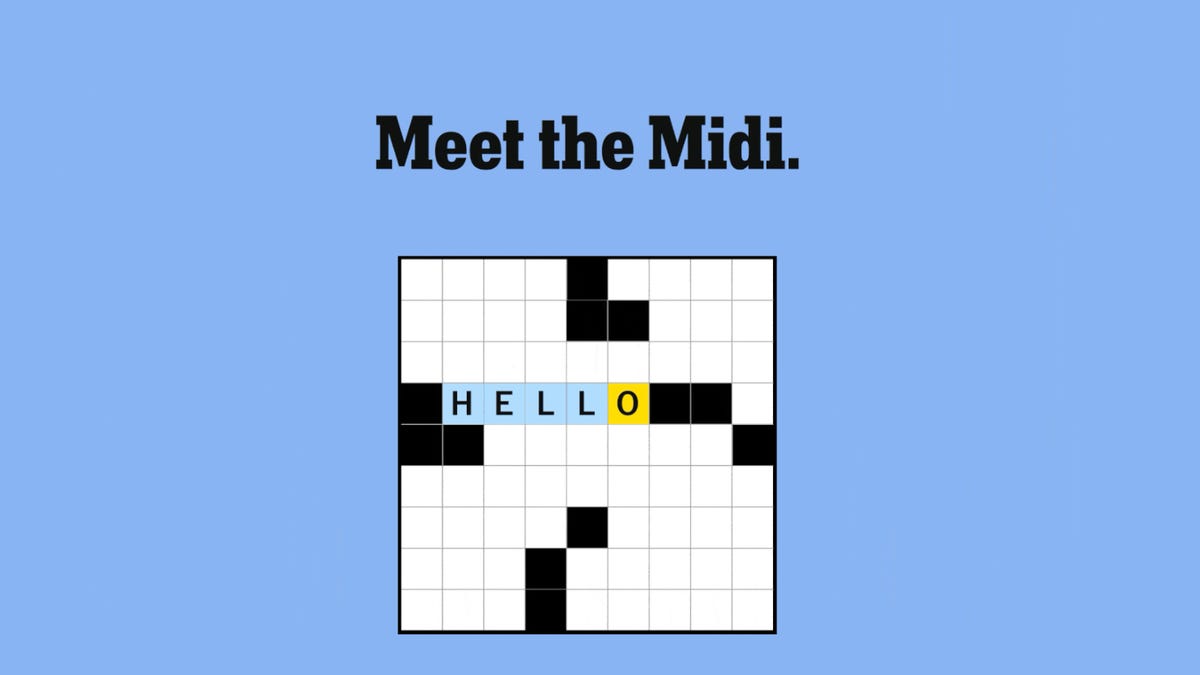
The daily New York Times Mini Crossword can be solved in a minute or so, while the newspaper’s iconic original crossword puzzle might take hours. Now, puzzlers who want an in-between diversion can try a new puzzle from the Times, introduced this week — the Midi Crossword puzzle. (And CNET readers can get daily answers for five Times puzzles — Wordle, Connections, Strands, Connections: Sports Edition and the Mini Crossword.)
New York Times Games subscribers can play the Midi in the New York Times Games app for iOS and Android devices, or on mobile or desktop web. It’s online-only, not in the print newspaper.
«We’re really leaning into the digital-first nature of the puzzle,» NYT Games Puzzle Editor Ian Livengood said in a Times article about the new puzzle. «About once a week, the puzzle will have a visual effect — an extra flourish when you start or after you solve. This could be a cool animation or colorful shading.»
As the name «Midi» suggests, this is a mid-sized crossword puzzle. Where the Mini Crossword usually only has 5 Across and 5 Down clues, the Midi is usually a 9-by-9 puzzle, sometimes as long as 11-by-11.
«If you feel like the Mini is not enough but the Daily is too much, this will be the perfect puzzle for you,» Livengood said.
Each Midi Crossword has a theme that hints at the topics of the clues and answers. Unlike the other puzzles, Livengood says the Midi might occasionally have two-letter words and repeating answers.
I tried the Midi Crossword
I tried Wednesday’s Midi Crossword and solved it in just over 3 minutes. That’s much longer than I spend on the Mini Crossword, but much faster than the original New York Times crossword puzzle takes me.
I thought most of the clues were pretty simple, and the few tricky ones filled themselves in once I moved from Across to Down.
If you’re a New York Times Games subscriber, this is a nice addition to your daily puzzle stable. It tests your mind a bit more than the Mini, but you can also solve it while watching TV or waiting for someone to text you back.
Technologies
Today’s NYT Connections: Sports Edition Hints and Answers for Feb. 26, #521
Here are hints and the answers for the NYT Connections: Sports Edition puzzle for Feb. 26, No. 521.

Looking for the most recent regular Connections answers? Click here for today’s Connections hints, as well as our daily answers and hints for The New York Times Mini Crossword, Wordle and Strands puzzles.
Today’s Connections: Sports Edition is a fun one. I started mentally connecting the purple category answers right away. Movie-goers and TV watchers, this is a good puzzle for you. If you’re struggling with today’s puzzle but still want to solve it, read on for hints and the answers.
Connections: Sports Edition is published by The Athletic, the subscription-based sports journalism site owned by The Times. It doesn’t appear in the NYT Games app, but it does in The Athletic’s own app. Or you can play it for free online.
Read more: NYT Connections: Sports Edition Puzzle Comes Out of Beta
Hints for today’s Connections: Sports Edition groups
Here are four hints for the groupings in today’s Connections: Sports Edition puzzle, ranked from the easiest yellow group to the tough (and sometimes bizarre) purple group.
Yellow group hint: Meet the new boss.
Green group hint: SNL star.
Blue group hint: WNBA player.
Purple group hint: They’re not real.
Answers for today’s Connections: Sports Edition groups
Yellow group: Coaching decisions.
Green group: Will Ferrell sports movies.
Blue group: Associated with Diana Taurasi.
Purple group: Fictional coaches.
Read more: Wordle Cheat Sheet: Here Are the Most Popular Letters Used in English Words
What are today’s Connections: Sports Edition answers?
The yellow words in today’s Connections
The theme is coaching decisions. The four answers are extend, fire, hire and promote.
The green words in today’s Connections
The theme is Will Ferrell sports movies. The four answers are Blades of Glory, Kicking & Screaming, Semi-Pro and Talladega Nights.
The blue words in today’s Connections
The theme is associated with Diana Taurasi. The four answers are Connecticut, Phoenix, six golds and White Mamba.
The purple words in today’s Connections
The theme is fictional coaches. The four answers are Bombay, Buttermaker, Dale and Lasso.
-
 Technologies3 года ago
Tech Companies Need to Be Held Accountable for Security, Experts Say
-
 Technologies3 года ago
Best Handheld Game Console in 2023
-
 Technologies3 года ago
Tighten Up Your VR Game With the Best Head Straps for Quest 2
-
 Technologies4 года ago
Black Friday 2021: The best deals on TVs, headphones, kitchenware, and more
-
 Technologies5 лет ago
Google to require vaccinations as Silicon Valley rethinks return-to-office policies
-
 Technologies5 лет ago
Verum, Wickr and Threema: next generation secured messengers
-
 Technologies4 года ago
Olivia Harlan Dekker for Verum Messenger
-
 Technologies4 года ago
iPhone 13 event: How to watch Apple’s big announcement tomorrow


