

Technologies
The iOS 26 Feature Secretly Extending Your iPhone’s Battery Life
Adaptive Power is an Apple Intelligence feature that can automatically give your battery the boost it needs. Here’s how it works.

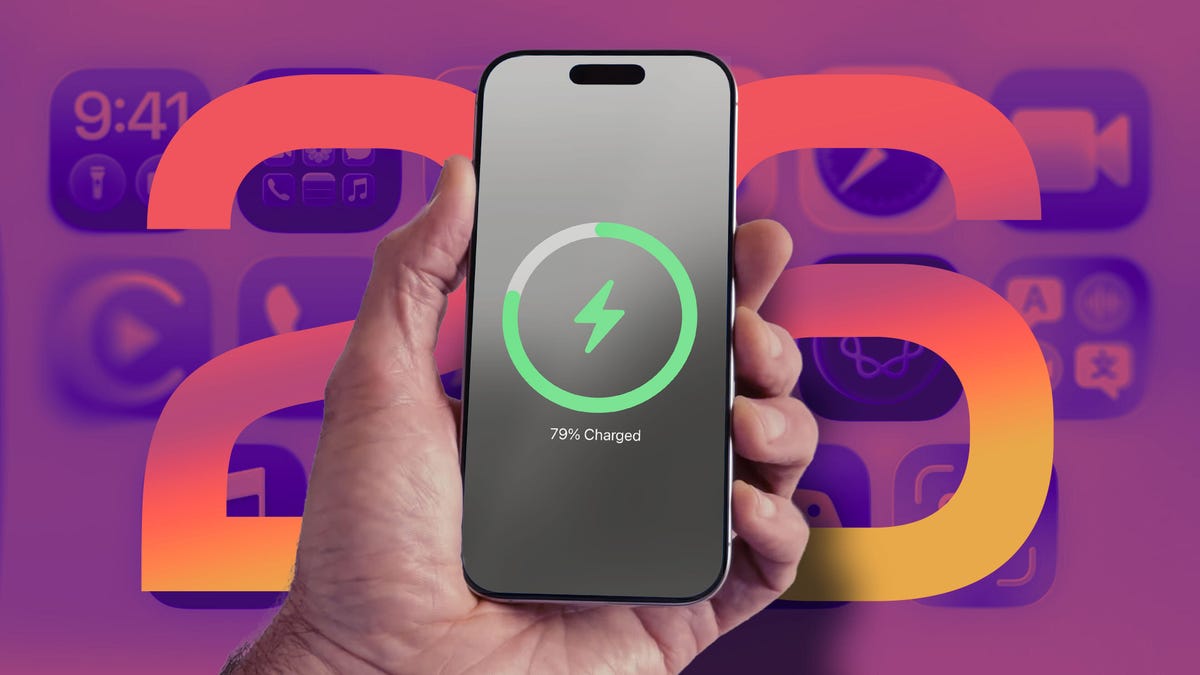
Battery life in the latest iPhone models is more important than ever, whether you’re taking advantage of the physically larger cells in the iPhone 17 Pro — the «best battery life of any phone that CNET has ever tested,» CNET Managing Editor Patrick Holland said in his review — or getting the most out of the thin battery in the iPhone Air. And software now also plays a big role.
A new feature in iOS 26 called Adaptive Power is enabled by default on Apple’s latest phones, but is also available on older models that support Apple Intelligence.
Currently, the iPhone uses as much power as it needs to perform its tasks. You can extend battery life by doing a number of things, such as decreasing screen brightness and turning off the always-on display. Or, if your battery is running low, you can turn on Low Power Mode, which limits background activity, like fetching mail and downloading data, and dims the screen to help extend battery life. Low Power Mode also kicks in automatically when the battery level reaches 20%.
Don’t miss any of our unbiased tech content and lab-based reviews. Add CNET as a preferred Google source.
If Low Power Mode is the hammer that knocks down power consumption, Adaptive Power is the scalpel that intelligently trims energy savings here and there as needed. Based on Apple’s description that accompanies the control, the savings will be felt mostly in power-hungry situations such as recording videos, editing photos or even playing games.
Apple says Adaptive Power takes about a week to analyze your usage behavior before it begins actively working. And it works in the background without needing any management on your part.
Here’s how Apple describes it in the iPhone user guide: «It uses on-device intelligence to predict when you’ll need extra battery power based on your recent usage patterns, then makes performance adjustments to help your battery last longer.»
Which iPhone models can use Adaptive Power?
The feature uses AI to monitor and choose when its power-saving measures should be activated, so that means only phones compatible with Apple Intelligence get the feature. These are the models that have the option:
• iPhone 17
• iPhone 17 Pro and iPhone 17 Pro Max
• iPhone Air
• iPhone 16 and iPhone 16 Plus
• iPhone 16 Pro and iPhone 16 Pro Max
• iPhone 16e
• iPhone 15 Pro and iPhone 15 Pro Max
Although some iPad and Mac models support Apple Intelligence, the feature is only available on iPhones.
How to turn Adaptive Power on
Adaptive Power is on by default on the iPhone 17, iPhone 17 Pro, iPhone 17 Pro Max and iPhone Air. For other models, you must opt in to use it. In iOS 26, you’ll find the Adaptive Power toggle in Settings > Battery > Power Mode. To be alerted when the feature is active, turn on the Adaptive Power Notifications option.
Adaptive Power sounds like an outgrowth of Gaming Mode, introduced in iOS 18, which routes all available processing and graphics power to the frontmost app and pauses other processes in order to deliver the best experience possible — at the notable expense of battery life.
What does this mean for your charging habits?
Although we all want as much battery life as possible all the time, judging by the description, it sounds as if Adaptive Power’s optimizations will not always be active, even if you leave the feature on. «When your battery usage is higher than usual» could include a limited number of situations. Still, considering that according to a CNET survey, 61% of people upgrade their phones because of battery life, a feature such as Adaptive Power could extend the longevity of their phones just by updating to iOS 26.
I also wonder whether slightly adjusting display brightness could be disruptive, but in my experience so far, it hasn’t been noticeable. Because the feature also selectively de-prioritizes processing tasks, the outward effects seem minimal. When it’s activated on my iPhone 16 Pro, the only indication was the Adaptive Power alert that appeared.
We’ll get a better idea about how well Adaptive Power works as more people adopt iOS 26 and start buying new iPhone models. Also, remember that shortly after installing a major software update, it’s common to experience worse battery life as the system optimizes data in the background; Apple went so far as to remind customers that it’s a temporary side effect.
Technologies
Apple and Google Broke Their Own Rules by Promoting ‘Nudify’ Apps, Report Says
A new report from the Tech Transparency Project found over 100 apps on app stores are designed to «undress people» from photos.
If you want an app you built to be downloadable from the Apple App Store or Google Play Store, it has to pass a slew of criteria, including safety standards.
But a new report on Wednesday alleges that Apple and Google broke their own rules by promoting «nudify» apps that are outlawed in their app store policies.
The Tech Transparency Project, part of a nonprofit tech watchdog, first revealed in January that Apple and Google app stores had over 100 nudify or undressing apps. These are apps with the sole purpose of taking images of people, usually women, and editing them to appear to be that person without clothing, creating what’s called nonconsensual intimate imagery. Many of these apps use generative AI to create deepfakes.
Apple removed some of the prohibited apps at the time. But many are still out there, as evidenced in a subsequent investigation.
In April, TTP found that Apple and Google still allowed users to search for a number of troubling keywords, including «nudify,» «undress» and «deepnude.» After a deep dive on the top 10 apps across both app stores, TTP found that 40% of the apps advertised themselves as able to «render women nude or scantily clad,» according to the report.
The new report also found that Google and Apple actually promoted such apps in their stores, increasing their visibility, with Google in particular creating «a carousel of ads for some of the most sexually explicit apps encountered in the investigation.»
Read More: How to Keep Kids Safe Online? Europe Believes Its Age-Verification App Is the Answer
Apple and Google both have language in their policies that prohibits apps with «overtly sexual or pornographic material» (Apple) and «sexually suggestive poses in which the subject is nude, blurred or minimally clothed» (Google). And they’ve both enforced these policies in the past — particularly by going after porn apps.
But Apple and Google make money from app developers by running advertising and taking a part of paid app subscriptions. Analytics firm AppMagic found that these «nudify» apps were downloaded 483 million times and made more than $122 million in lifetime revenue.
«This revenue stream may be why the two companies have been less than vigilant when it comes to nudify apps that violate their policies,» TTP writes.
After news broke this week, Apple told Bloomberg News that it removed 15 of the reported apps. Google confirmed it removed seven. Apple also said it blocked several of the search terms TTP flagged in its report. Apple and Google did not immediately respond to CNET’s requests for comment and any updates since Wednesday.
Nonconsensual graphically sexual content is a growing issue, due in part to AI. We saw in startling clarity how apps with AI can be used to make this illegal and abusive content at the beginning of the year, when Grok users made 1.4 million sexualized deepfakes over a nine-day period.
Some US senators at the time called on Apple and Google to remove Grok from their app stores, but neither removed it.
We learned this week that Apple privately reached out to Grok to express its concerns about its abusive AI capabilities and threatened to remove it. Grok is still available in the Apple and Google app stores and is still reportedly able to create abusive AI sexual images, despite the company saying otherwise.
Technologies
OpenAI Has a New AI Model Built for Biology and Science
GPT-Rosalind is intended to help scientists streamline their research and drug discovery.

OpenAI’s latest AI model is built to do far more than offer cooking advice or create a spreadsheet. GPT-Rosalind, the company’s first model specifically built for life science, is meant to help scientists with drug discovery, biology and translational medicine.
The model is named after Rosalind Franklin, whose research revealed the structure of DNA and formed the foundations for modern molecular biology. Scientific research relies heavily on data, and GPT-Rosalind is designed to help sort through it, while also helping reduce the time it takes to develop and get new drugs approved and out on the market.
(Disclosure: Ziff Davis, CNET’s parent company, in 2025 filed a lawsuit against OpenAI, alleging it infringed Ziff Davis copyrights in training and operating its AI systems.)
It can take 10 to 15 years for a new drug to be developed and approved in the US, OpenAI said in a blog post Thursday. GPT-Rosalind is intended to improve the selection of research targets and create stronger hypotheses for higher-quality experiments.
The model has been tested on topics such as its understanding of organic chemistry, proteins and genetics. Researchers can use it to find relevant scientific literature for their work or design experiments.
This isn’t the first time an AI model has been developed with medical advancements in mind. Google DeepMind has developed many AI models for scientific research, such as AlphaFold, which earned its creators a share of the 2024 Nobel Prize in Chemistry.
«For me, the best use case for AI was to improve human health and accelerate scientific discovery,» Google DeepMind CEO Demis Hassabis said in a recent interview. Anthropic introduced Claude for Life Sciences in January with the same purpose.
Some scientists have expressed concerns in the past about how quickly AI has infiltrated the science space and have warned of vulnerabilities, potential misuse and issues with data representation.
OpenAI said GPT-Rosalind has safeguards to protect it from misuse — like the creation of a biological weapon — and has teamed up with various biotechnology, pharmaceutical and life sciences technology organizations to support research and scientific discovery.
Sean Bruich, senior vice president of artificial intelligence and data at the biopharmaceutical company Amgen, said in a statement that scientific work requires precision: «Our unique collaboration with OpenAI enables us to apply their most advanced capabilities and tools in new and innovative ways with the potential to accelerate how we deliver medicines to patients.»
GPT-Rosalind is available only through OpenAI’s trusted-access system as a research preview.
Technologies
Was This Game Just On Sale? Steam May Show Price Shifts Over the Past 30 Days
A price tracker would make it easy to tell if you’re getting a good deal on a game or not.
Steam is the largest video game platform with more than 129,000 games and counting. With so many games and the company offering frequent sales, it’s hard to keep track of whether a game has is at its lowest price or if its been discounted further in the past, but that may change.
Lines of code found in the Steam platform seemingly refer to the recent price history for a game, according to a post on Wednesday from the X account for the Half-Life fan site Lambda Generation. The code was discovered by data miner SigaTbh, who found it on SteamDB, a database and tracking site for the gaming platform. While price history is already a feature on Steam in the European Union, this update could be the first sign that it will become the norm for the platform over in the U.S.
In the image posted by Lambda Generation, there are six lines of code referencing «Price_History» and each line reflects a certain detail that could show up on a game’s page to give some context about its price. The price history would show the normal price for the game, the current price, whether the current price is a 30-day low or if the game was at a lower cost sometime within the past 30 days.
Valve is planning to add a 30 day price history for Steam games.
Found by @SigaTbh on SteamDB pic.twitter.com/BtQNpcAfIF— LambdaGeneration (@LambdaGen) April 15, 2026
Valve didn’t immediately respond to a request for confirmation about the new feature.
Back in 2023, Valve added the price history feature to Steam in the EU as part of the Omnibus Directive. The directive is a series of rules set by the EU focusing on consumer protection. Companies with digital storefronts were required to institute a price tracker on their platforms to display the lowest price of an item for the past 30 days. Even though the Omnibus Directive is in full effect, however, it’s not available in every member state of the EU, as individual countries have to adopt the directive.
Certain rules in the EU that require certain changes to be made to a product or service eventually find their way to the U.S. Apple was forced to add USB-C to its iPhone 15 lineup due to EU legislation requiring standardization of charging ports.
It’s unclear why Valve would make the move to add a price tracker to Steam in the U.S. The company is reportedly working on an AI bot for the platform dubbed «SteamGPT,» and the price history could be part of its features.
-
 Technologies3 года ago
Tech Companies Need to Be Held Accountable for Security, Experts Say
-
 Technologies3 года ago
Best Handheld Game Console in 2023
-
 Technologies3 года ago
Tighten Up Your VR Game With the Best Head Straps for Quest 2
-
 Technologies4 года ago
Black Friday 2021: The best deals on TVs, headphones, kitchenware, and more
-
 Technologies5 лет ago
Google to require vaccinations as Silicon Valley rethinks return-to-office policies
-
 Technologies5 лет ago
Verum, Wickr and Threema: next generation secured messengers
-
 Technologies4 года ago
Olivia Harlan Dekker for Verum Messenger
-
 Technologies4 года ago
The number of Сrypto Bank customers increased by 10% in five days


