

Technologies
Alienware m18 Review: A Big and Bold Gaming Beast
It’s not the only 18-inch gaming laptop of 2023, but so far it’s the most powerful.

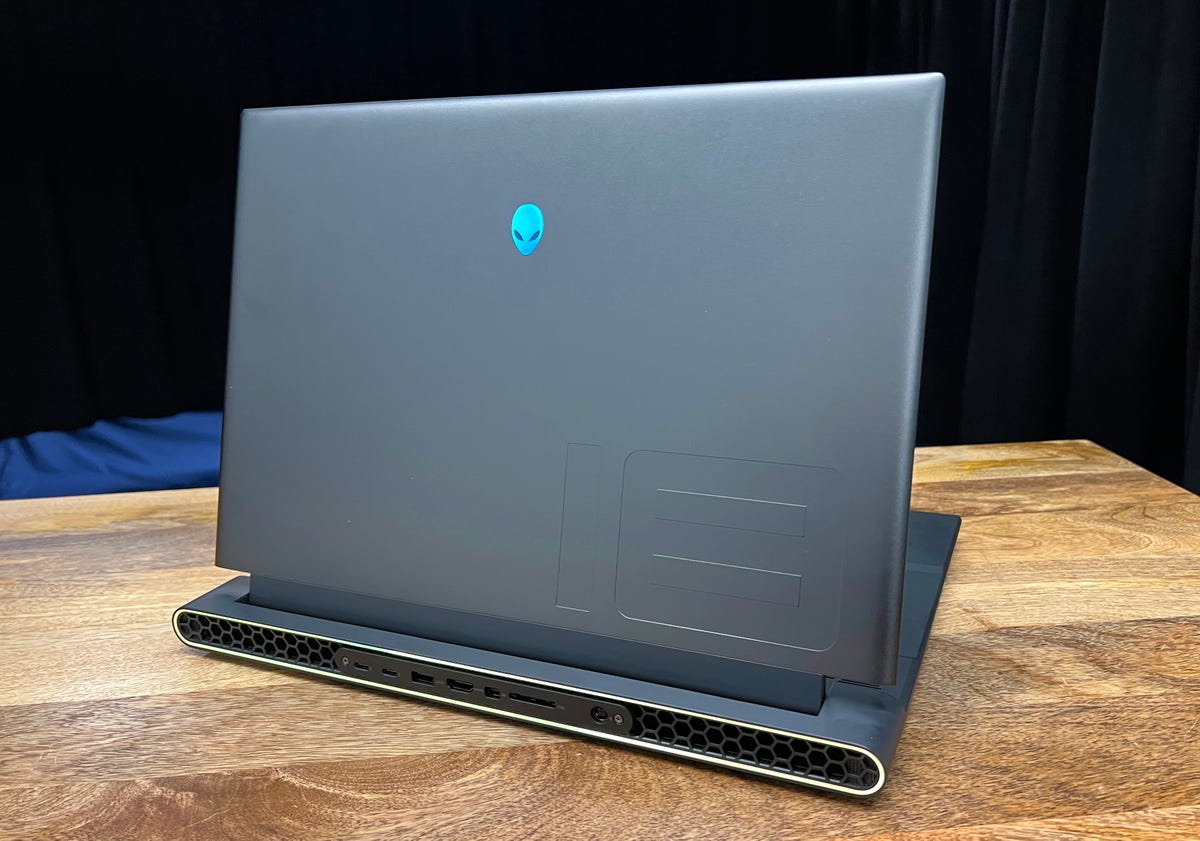
It’s big, it’s powerful and it might arguably be from another planet. That’s an easy way to think about the Alienware m18, a new big-screen gaming laptop from Dell’s Alienware brand. Announced during CES 2023 in January, it’s already on the CNET testing bench and blowing me away with its massive display and top-shelf components.
Of course, that’s because Alienware sent one of the highest-end configurations possible, including an Intel Core i9-13980HX CPU and Nvidia GeForce RTX 4090 graphics card. Along with 32GB of RAM and a 1TB SSD (the only choice that felt kinda skimpy), that means this exact build will cost $3,549. Note that prices and configuration options can shift in build-to-order systems like this. Also, the Core i9-13980HX isn’t listed as an available option just yet. Dell says it’s coming later in April.
If you’re more interested in the big screen than the big performance, the least-expensive build of this system is currently $2,099, but includes only an Nvidia 4060 GPU, 16GB of RAM and a single 512GB SSD – a configuration that would cost much less in other gaming laptops.

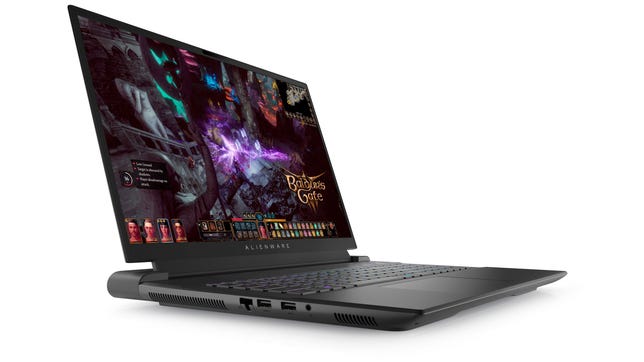
Alienware m18
Like
- Massive screen for gaming
- Amazing performance from the Nvidia RTX 4090 GPU
- Tactile CherryMX keyboard
- Lots of ports and connections
- Less expensive than the other 18-inch gaming laptop we’ve reviewed
Don’t Like
- Blander color options than the previous generation
- Better components drive up the price
- Fans can get loud while gaming
This is not the only 18-inch gaming laptop of 2023. In fact, it’s not even the first one we’ve reviewed this year. That was the Razer Blade 18, which is very similar to this in overall look, feel, options and performance. While some may prefer the slightly less gamer-y design of the Razer, the version we reviewed cost $3,799 and only had an Nvidia 4080 GPU, not the 4090 found here. It’s $4,499 to jump up to a 4090 GPU in the Razer.

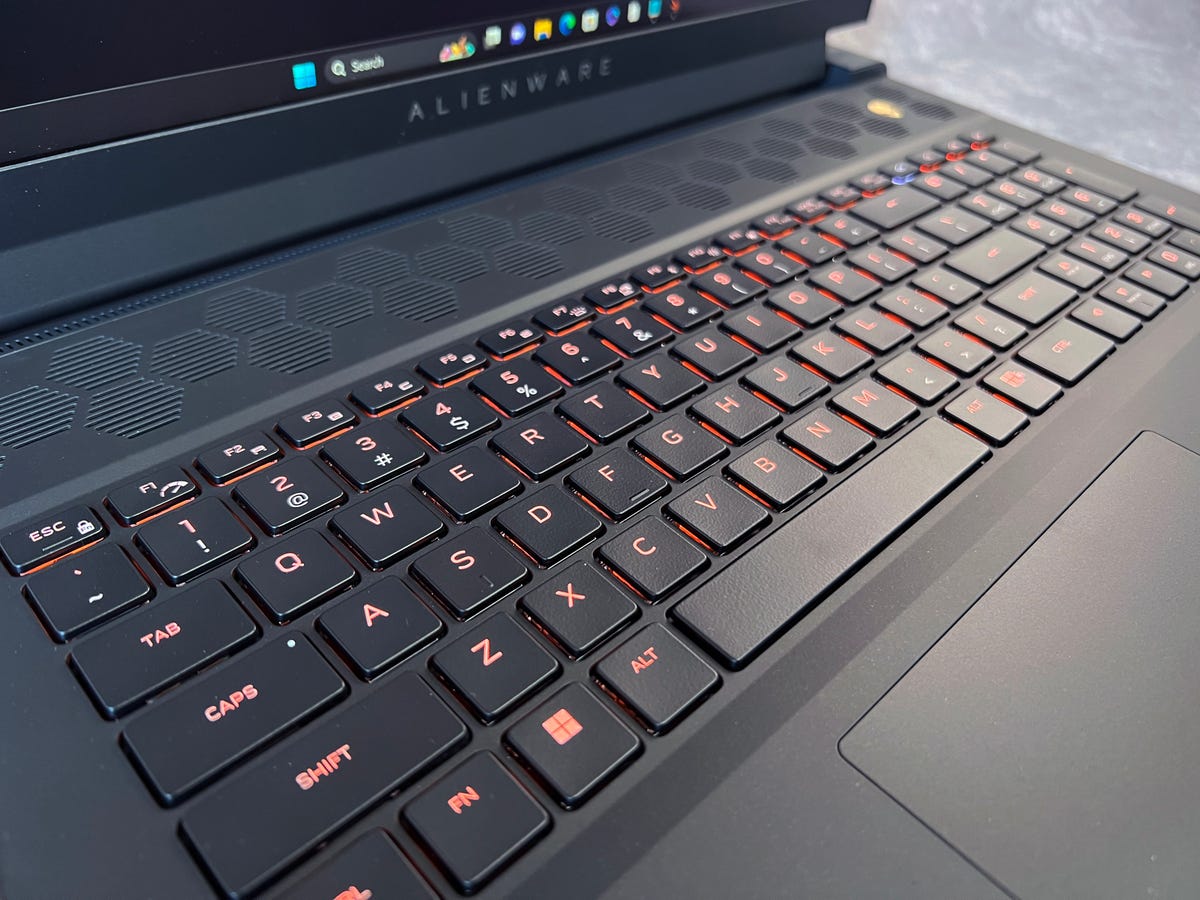
Per-key lighting is highly customizable.
Dan Ackerman/CNETUnlike the relatively flat mainstream keyboard on the Razer Blade 18, the Alienware m18 has a CherryMX RGB keyboard with a hefty 1.8mm of key travel… and a very audible clack to its keys. Some people prefer this for adding to the desktop gaming keyboard feel. I find it distracting, but can see how you might like it.
Big-screen star
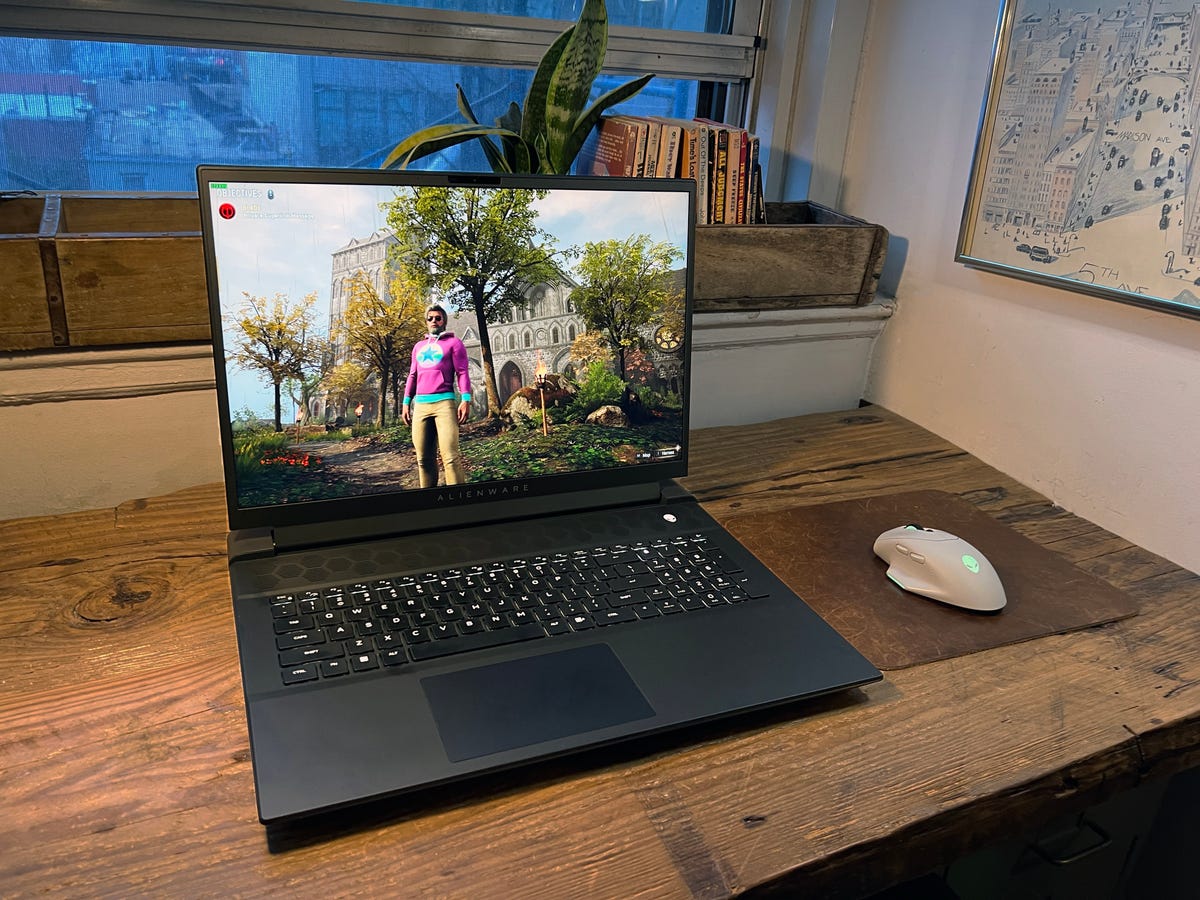
The screen is the big star here. There are two 18-inch options to choose from – a QHD+ panel (2,560×1,600) at 165Hz, and a FHD+ one (1,920×1,200) at a wild 480Hz. While pairing an Nvidia 4090 GPU with a FHD screen seems like a waste, the super-fast refresh rate will appeal to competitive gamers who care more about insane frame rates than resolution.
As it is, in the QHD version I tested I was able to crank new games up to their full graphics settings at full resolution and get great results. For Hogwarts Legacy, I ran everything on ultra settings, including the ray-tracing effects (which have been criticized for killing performance on other PCs) and still got a steady frame rate of at least 120fps.
Our other benchmarks were equally impressive, and the 4090 in this Alienware outmatched the 4080 in the Razer Blade 18 in every test. (Test results are at the end of this review.) So yes, this is the most powerful gaming laptop we’ve ever tested, but that’s always true of the latest and greatest, until the next hardware gen comes along.
Legendary look and feel
The latest revamp of the Alienware design language, called Legend 3.0, doesn’t reinvent much but makes some interesting tweaks. The rear panel is flatter, rather than slightly angled, and some small tweaks to the front lip make the system easier to open one-handed. There’s a new foot design underneath, basically a plastic riser that allows for decent airflow.
The 15-inch Alienware x15 R2 I reviewed last year ended up being one of my all-time favorite gaming laptops, and that was partly because of the great design and color palette. I really liked the retro-futurism of the matte white outer chassis. This time, the only option currently available is a near-black that Alienware calls Dark Metallic Moon. It’s fine, but feels much more like a gaming laptop cliche than the previous color scheme. But if you like dark, brooding gaming laptops, you’re all set.
If you have an older Alienware machine, another interesting recent update is to the Alienware Command Center. That’s a proprietary software package that allows for fine-tuned controls of many system functions as well as performance monitoring.
The two big things you’ll probably use it for are jumping between performance presets and adjusting the per-key RPG lighting effects, which also extend to the alien head logos, a color border around the rear panel and even matching accessories like the new AW620M
The wireless mouse is a $99 accessory with 26,000 dpi tracking. Yes, it’s expensive, but it also carries over that matte white look I liked so much from last year.

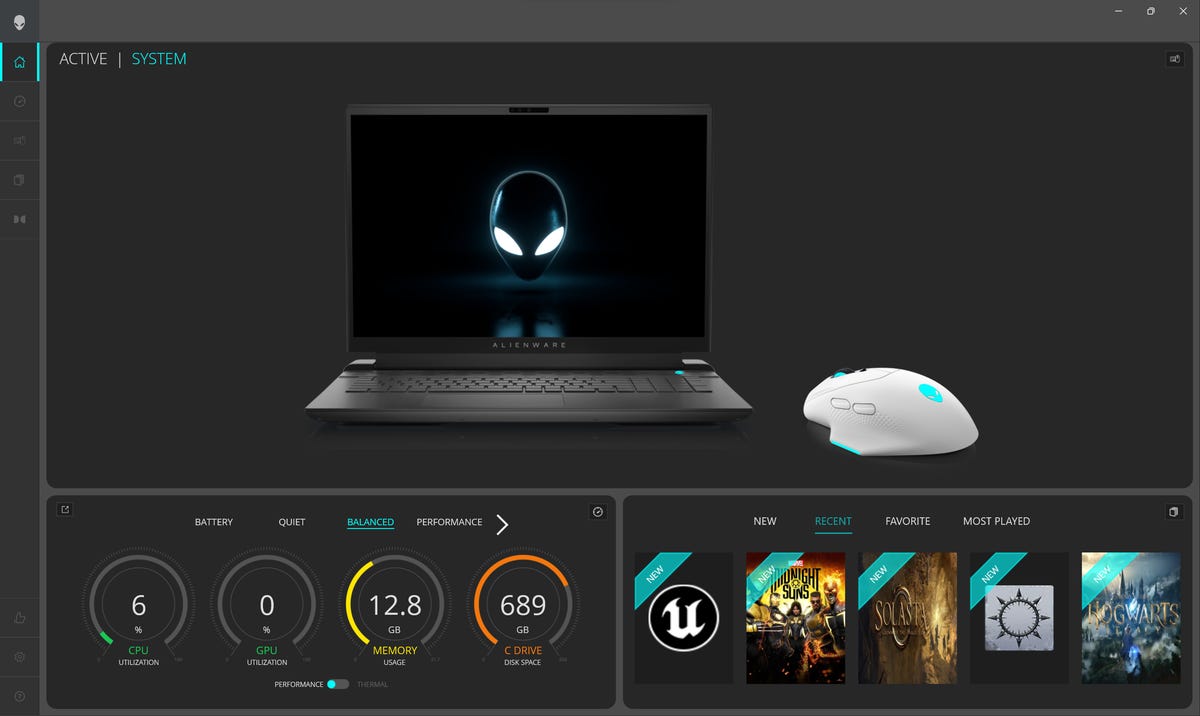
The Alienware Command Center software.
Screenshot by Dan AckermanThe latest version of ACC is an improvement over older versions, which I always found unintuitive. Some functions, including for lighting control, are simpler and the entire app feels less cluttered.
If you’re going to play around with the performance presets, get ready for some fan noise and hot air. Presets include Battery, Quiet, Performance and Max, and by default the system can be set to jump into performance mode when a specific game (or any game) is launched.
A combination of quad internal fans, a vapor chamber and big heat pipes all help keep the system cool, and even running high-end games it doesn’t feel as fiery to the touch as the 15-inch Alienware x15 did. That said, hot air does blow out from vents on both sides and the rear, and I found my right hand getting hit with warm air when using a mouse relatively close to the system.
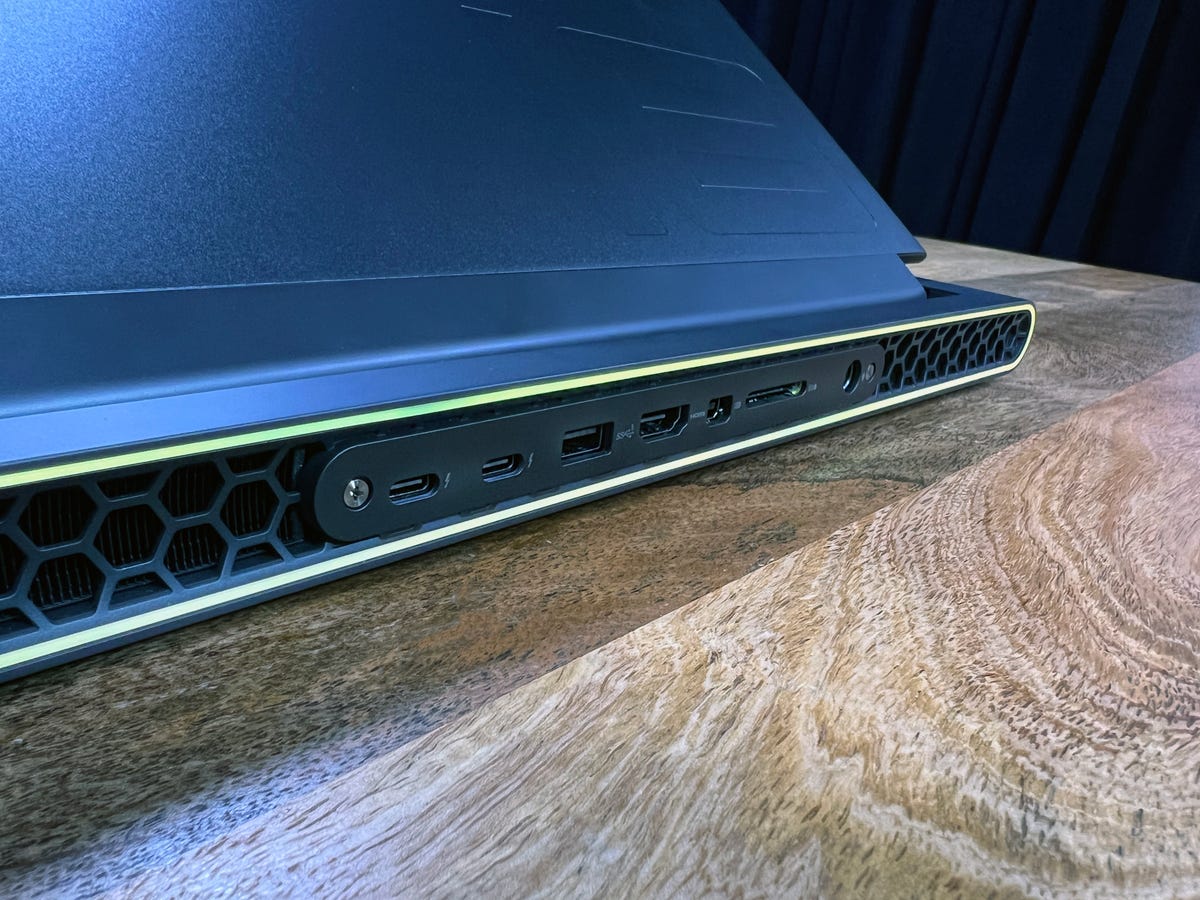
The rear panel holds many of the system’s ports.
Dan Ackerman/CNETAnother advantage of a big system like this is that there’s room for a lot of ports and connections. While some slim laptops are down to a couple of USB-C ports, this has almost everything you’d want. I’ll just list the ports below.
- 1 USB 3.2 Gen 1 port with PowerShare
- 4 USB 3.2 Gen 1 ports
- 2 Thunderbolt 4 Gen 2 Type-C
- 1 RJ45 Ethernet port
- 1 audio jack
- 1 HDMI 2.1 port
- 1 mini-display port
Of course, a big screen with a big body for all those ports, fans and other goodies isn’t going to be easy to lug around. I clocked the laptop itself at 8.7 pounds, and a total of 12 pounds including the big power brick.

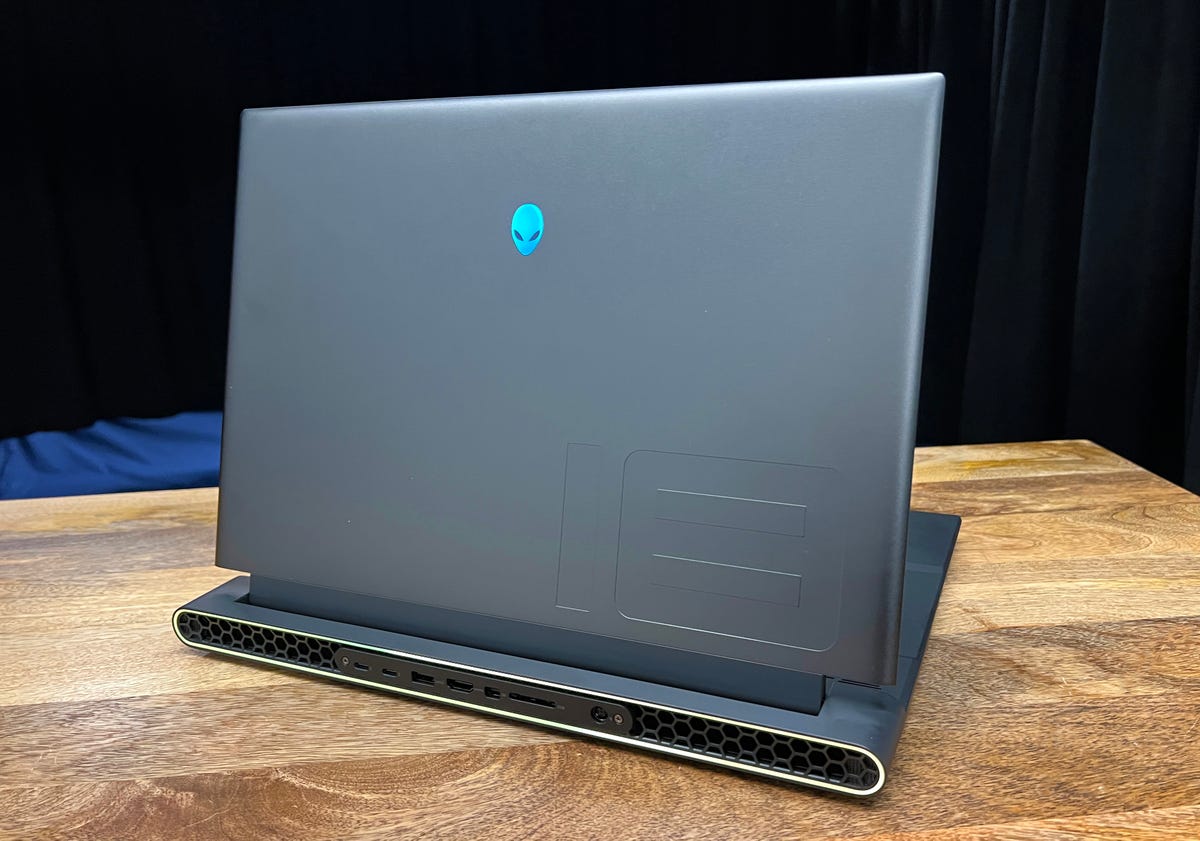
Yes, this is a crazy expensive laptop with components far beyond the needs of mainstream gamers (or anyone who doesn’t want to spend $3K-plus on a laptop). That said, it feels like a bargain compared to the similar Razer Blade 18, so there’s an argument to be made that it’s really a very financially reasonable option. I’m not saying your spouse, parent or partner would agree with that argument, but it’s worth a shot.
Fun fact: This isn’t the first 18-inch gaming laptop from Dell. Back in 2013, I reviewed the then-new Alienware 18, a $4,000 monster that supported dual GPUs. The 18-inch design didn’t catch on back then, but I think it has a much better shot now.
Geekbench 5 (multicore)
Note:
Longer bars indicate better performance
3DMark Wild Life Extreme Unlimited
Note:
Longer bars indicate better performance
Guardians of the Galaxy (High @1920 x 1080)
Note:
Longer bars indicate better performance
The Riftbreaker GPU (1920 x 1080)
Note:
Longer bars indicate better performance
Cinebench R23 (multicore)
Note:
Longer bars indicate better performance
Online streaming battery drain test
Note:
Longer bars indicate better performance
System Configurations
| System Configurations | |
|---|---|
| Alienware m18 R1 | Microsoft Windows 11 Pro; 2.2GHz Intel Core i9-13980HX; 32GB DDR5 5,800MHz RAM; 16GB Nvidia GeForceRTX 4090; 1TB SSD |
| Razer Blade 18 | Microsoft Windows 11 Home; 2.2GHz Intel Core i9-13950HX; 32GB DDR5 5,600MHz RAM; 12GB Nvidia GeForceRTX 4080; 1TB SSD |
| Origin PC Evo17-S | Microsoft Windows 11 Home; 2.9GHz Intel Core i9-12900H; 32GB DDR5 4,800MHz; 16GB Nvidia Geforce RTX 3080Ti; 1TB SSD |
| Acer Predator Triton 500 SE | Microsoft Windows 11 Home; 2.9GHz Intel Core i9-12900H; 32GB DDR5 4,800MHz; 16GB Nvidia Geforce RTX 3080Ti; 1TB SSD |
| MacBook Pro (16-inch, M2 Pro, 2023) | MacOS Ventura 13.2; Apple M2 Pro (12 CPU cores, 19 GPU cores); 32GB LPDDR5 RAM; 1TB SSD |
How we test computers
The review process for laptops, desktops, tablets and other computer-like devices consists of two parts: performance testing under controlled conditions in the CNET Labs and extensive hands-on use by our expert reviewers. This includes evaluating a device’s aesthetics, ergonomics and features. A final review verdict is a combination of both objective and subjective judgments.
The list of benchmarking software we use changes over time as the devices we test evolve. The most important core tests we’re currently running on every compatible computer include: Primate Labs Geekbench 5, Cinebench R23, PCMark 10 and 3DMark Fire Strike Ultra.
A more detailed description of each benchmark and how we use it can be found in our How We Test Computers page.
Technologies
Today’s NYT Mini Crossword Answers for Wednesday, Oct. 22
Here are the answers for The New York Times Mini Crossword for Oct. 22.


Looking for the most recent Mini Crossword answer? Click here for today’s Mini Crossword hints, as well as our daily answers and hints for The New York Times Wordle, Strands, Connections and Connections: Sports Edition puzzles.
Need some help with today’s Mini Crossword? It’s one of those with absolutely no empty spaces, just a grid of letters, which means if you correctly answer all the Across answers, you’ve solved the Down answers, too. Need help? Read on. And if you could use some hints and guidance for daily solving, check out our Mini Crossword tips.
If you’re looking for today’s Wordle, Connections, Connections: Sports Edition and Strands answers, you can visit CNET’s NYT puzzle hints page.
Read more: Tips and Tricks for Solving The New York Times Mini Crossword
Let’s get to those Mini Crossword clues and answers.
Mini across clues and answers
1A clue: Roomful of students
Answer: CLASS
6A clue: Something to bring in a brown paper bag
Answer: LUNCH
7A clue: __ Harbor, sightseeing area of Baltimore
Answer: INNER
8A clue: Where many Stephen King novels are set
Answer: MAINE
9A clue: Beagle or bulldog
Answer: BREED
Mini down clues and answers
1D clue: Go bouldering, e.g.
Answer: CLIMB
2D clue: ___ New Year
Answer: LUNAR
3D clue: Redhead of musical/movie fame
Answer: ANNIE
4D clue: Something an actor might steal
Answer: SCENE
5D clue: Tear to pieces
Answer: SHRED
Technologies
These Small Tweaks Can Give Your Old Android a Big Speed Boost
Instead of buying a new phone, try clearing some space, updating your software and changing a few battery settings.
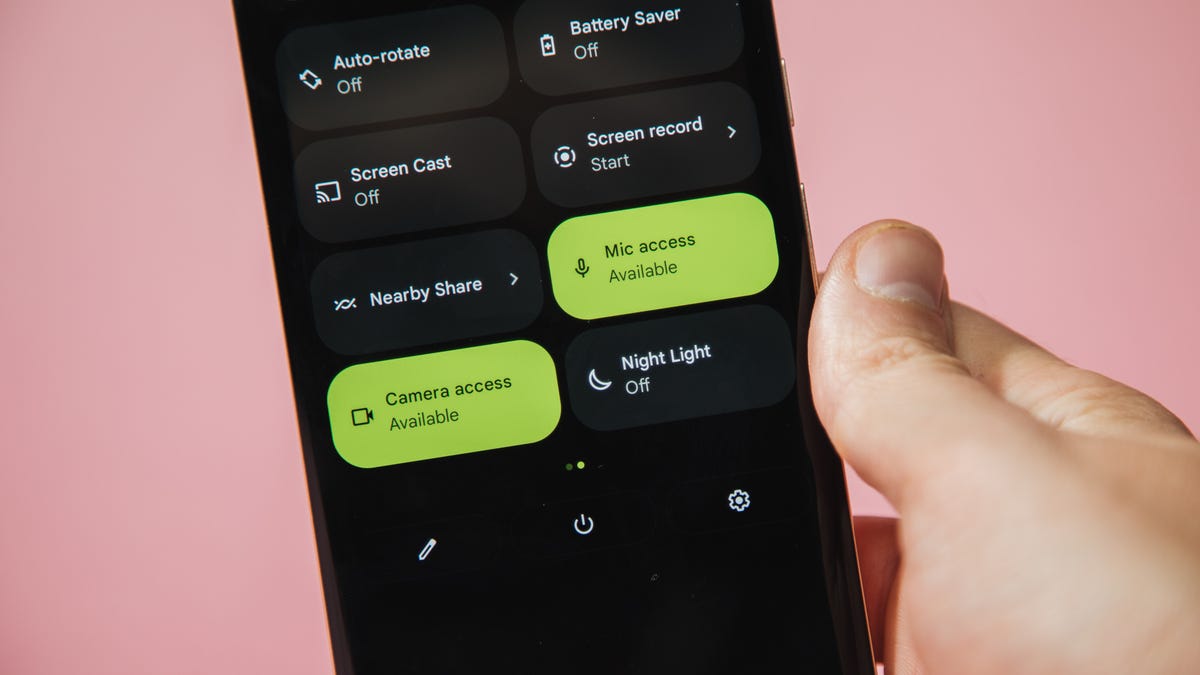
If your Android is a few years old and starting to feel sluggish, it doesn’t mean you have to rush out and buy the newest flagship model. Thanks to longer software support from brands like Google and Samsung, older models can still run smoothly, as long as you give them a little attention.
Before you start shopping for a replacement, try a few simple adjustments. You might be surprised by how much faster your phone feels once you clear out unused apps, optimize battery use and turn off background drains.
Whether you use a Samsung Galaxy, Motorola or OnePlus phone, chances are you can still improve battery life and overall speed without buying something new. Just remember that Android settings vary slightly from brand to brand, so the menus may look a little different depending on your phone.
Don’t miss any of our unbiased tech content and lab-based reviews. Add CNET as a preferred Google source.
Settings to improve your battery life
Living with a phone that has poor battery life can be infuriating, but there are some steps you can take to maximize each charge right from the very beginning:
1. Turn off auto screen brightness or adaptive brightness and set the brightness level slider to under 50%
The brighter your screen, the more battery power it uses.
To get to the setting, pull down the shortcut menu from the top of the screen and adjust the slider, if it’s there. Some phones may have a toggle for auto brightness in the shortcut panel; otherwise, you need to open the settings app and search for «brightness» to find the setting and turn it off.
2. Use Adaptive Battery and Battery Optimization
These features focus on learning how you use your phone, including which apps you use and when, and then optimizing the apps and the amount of battery they use.
Some Android phones have a dedicated Battery section in the Settings app, while other phones (looking at you, Samsung) bury these settings. It’s a little different for each phone. I recommend opening your settings and searching for «battery» to find the right screen. Your phone may also have an adaptive charging setting that can monitor how quickly your phone battery charges overnight to preserve its health.
Why you should use dark mode more often
Another way to improve battery life while also helping save your eyes is to use Android’s dedicated dark mode. Any Android phone running Android 10 or newer will have a dedicated dark mode option.
According to Google, dark mode not only reduces the strain that smartphone displays cause on our eyes but also improves battery life because it takes less power to display dark backgrounds on OLED displays (used in most flagship phones) than a white background.
Depending on which version of Android your phone is running, and what company made your phone, you may have to dig around the settings app to find a dark mode. If your phone runs Android 10 or newer, you’ll be able to turn on system-wide dark mode. If it runs Android 9, don’t despair. Plenty of apps have their own dark mode option in the settings that you can use, whether or not you have Android 10.
To turn it on dark mode, open the Settings app and search for Dark Mode, Dark Theme or even Night Mode (as Samsung likes to call it). I suggest using dark mode all the time, but if you’re not sure, you can always set dark mode to automatically turn on based on a schedule, say from 7 p.m. to 7 a.m. every day, or allow it to automatically switch based on your location at sunset and sunrise.
Keep your home screen free of clutter
Planning to hit up the Google Play Store for a bunch of new Android apps? Be prepared for a lot of icon clutter on your home screen, which is where shortcuts land every time you install something.
If you don’t want that, there’s a simple way out of this: Long-press on an empty area of your home screen and tap Settings. Find the option labeled something along the lines of Add icon to Home Screen or Add new apps to Home Screen and turn it off.
Presto! No more icons on the home screen when you install new apps. You can still add shortcuts by dragging an app’s icon out of the app drawer, but they won’t appear on your home screen unless you want them to.
Read more: Best Android Phones You Can Buy in 2024
Set up Do Not Disturb so that you can better focus
If your phone routinely spends the night on your nightstand, you probably don’t want it beeping or buzzing every time there’s a call, message or Facebook alert — especially when you’re trying to sleep. Android offers a Do Not Disturb mode that will keep the phone more or less silent during designated hours. On some phones, this is referred to as the Downtime setting or even Quiet Time.
Head to Settings > Sounds (or Notifications), then look for Do Not Disturb or a similar name. If you can’t find it, search for it using the built-in search feature in your settings.
Using the feature, you can set up a range of hours when you want to turn off the digital noise. Don’t worry, any notifications you get while Do Not Disturb is turned on will still be waiting for you when you wake up. Also, you can typically make an exception that allows repeat callers and favorite contacts’ calls to go through. Turn that on. If someone is calling you in an emergency, odds are they are going to keep trying.
Always be prepared in case you lose your phone or it’s stolen
Is there anything worse than a lost or stolen phone? Only the knowledge that you could have tracked it down if you had turned on Google’s Find My Device feature.
To prepare for a successful recovery, here’s what you need to do: Open the Settings app and then search for Find My Device. It’s usually in the Security section of the Settings app.
If you have a Samsung device, you can use Samsung’s Find My Mobile service, which is found in Settings > Biometrics and security > Find My Mobile.
Once that’s enabled, you can head to android.com/find from any PC or mobile device and sign in to your account. Samsung users can visit findmymobile.samsung.com to find a lost phone.
If you have trouble setting any of this up, be sure to read our complete guide to finding a lost Android phone.
Assuming your phone is on and online, you should be able to see its location on a map. From there, you can make it ring, lock it, set a lock screen note to tell whoever has it how to get it back to you, or, worst-case scenario, remotely wipe the whole thing.
And always keep your phone up to date
As obvious as it may seem, a simple software update could fix bugs and other issues slowing down your Android device.
Before you download and install the latest software update, make sure your device is connected to Wi-Fi, or else this won’t work.
Now, open the Settings application and type in Update. You’ll then either see Software update or System update — choose either one. Then just download the software, wait for a few minutes and install it when it’s ready. Your Android device will reboot and install the latest software update available.
There’s a lot more to learn about a new phone. Here are the best ways to boost your cell signal, and here’s a flagship phone head-to-head comparison. Plus, check out CNET’s list of the best cases for your Samsung phone. More of an Apple fan? We have tips for boosting your iPhone’s performance, too.
Technologies
I’m Finally Using the iPhone 17 Pro’s Camera Control, Thanks to These iOS 26 Settings
In just a month, I’ve already used Camera Control on my iPhone 17 Pro Max more than I did in a whole year with the iPhone 16 Pro.
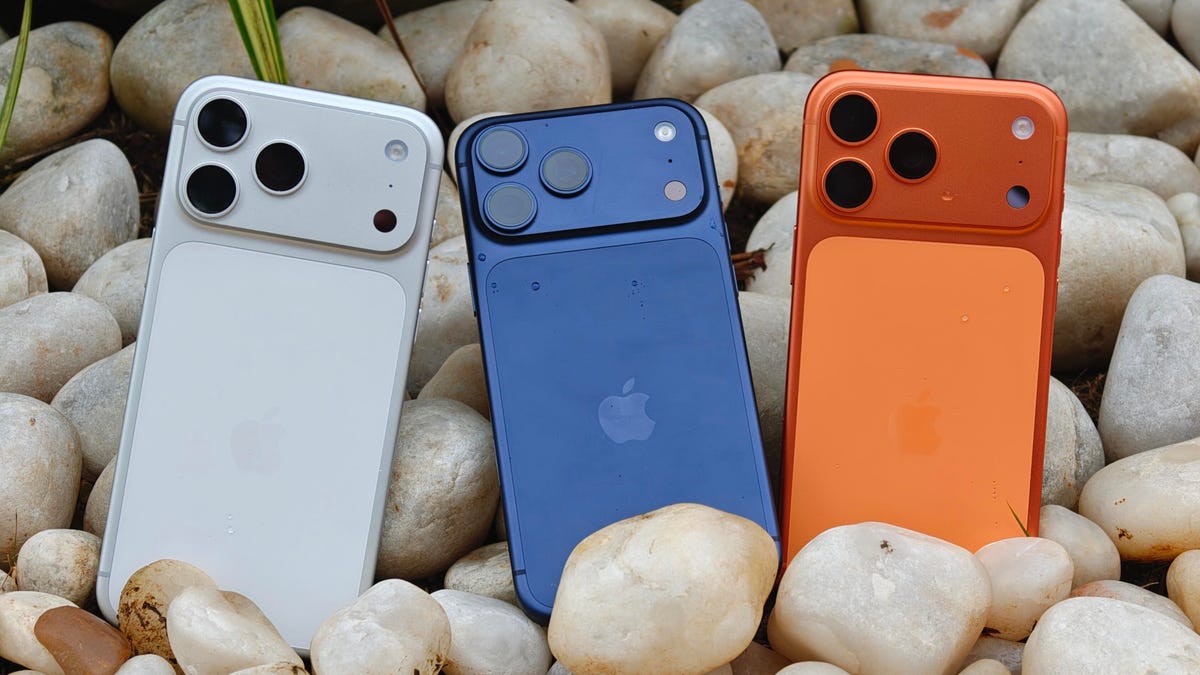
I was keen on using the Camera Control button when it first debuted on the iPhone 16 Pro. But in over a year of use, it caused more accidental swipes and presses than its intended use cases to take photos and adjust camera settings. I was frustrated with the experience and hoped that Apple would remove it from the iPhone 17 lineup. Instead, the Cupertino, California-based company made its touch-sensitive capacitive control surface more customizable with iOS 26. And I’m happy to report that it helped!
I’ve been using the iPhone 17 Pro since launch and spent 5 to 10 minutes customizing the Camera Control to my liking. The result? Minimized accidental swipes and more conscious usability.
I transformed my Camera Control experience by changing a few iOS 26 settings
When setting up a new iOS 26-supported iPhone, Apple includes a toggle (now turned off by default) called Light press to adjust Zoom, Exposure and more. This is what used to cause a lot of fake input earlier. I’m glad it is turned off by default.
Apple now also lets you customize the Camera Control further from the Settings menu. I tweaked settings there to personalize my shortcuts, functionalities and more.
For example, I’ve set the Camera Control to launch a Code Scanner on Double Click without requiring the screen to be on. This allows me to scan and pay at payment kiosks (my most frequently used mode of payment) without needing to open the payment app and then tap on a menu to scan a code. If I enter the Code Scanner without Face ID, it requires authentication before making the payment, so it is still as secure as ever.
Earlier, I had set an Action Button shortcut to open Google Pay, but I realized I still need a one-press solution to turn the phone to silent mode. Adding a Code Scanner shortcut to Camera Control frees the Action Button to be my Silent Switch again. Moreover, Code Scanner lets you select from multiple apps to pay a vendor, which could be useful for people who use multiple payment apps.
Secondly, I have turned off the Swipe gesture and selected only three controls that I use most often. Now, when I open the Camera app, I can lightly press on the Camera Control button and then swipe between my selected controls. It doesn’t register swipes from the get-go. This has reduced fake touches and my frustrating experience with the swipe gesture.
To further streamline my controls, I chose Exposure, Styles and Tone, and left out Depth, Zoom and Cameras. This way, I have access to hidden viewfinder settings with a single press-and-swipe gesture at my fingertips.
I also turned off the Clean Preview toggle, so I can still switch between cameras with a single tap, and switched on the Lock Focus and Exposure toggle for a light press-and-hold gesture.
Customizing these settings helped me personalize Camera Control and use it more often. Now, it appeals to me with the settings I need and the way I need them, instead of being an overcrowded mess. And you can personalize your Camera Control, too. Here’s how:
Change Camera Control launch functionality
You can use Camera Control as another Action Button to launch an app of your choice. The only requirement is that the app should have access to the camera.
- Go to Settings > Camera > Camera Control.
- Under Launch Camera, select the app you need.
- Go back and select Single Click or Double Click to open the said app.
I rely on Double Click so I don’t accidentally trigger an app when taking out the iPhone from my pocket. In my opinion, it is the safer and more convenient choice.
Under the same Launch Camera menu, you can also choose if you want the screen to be on or off when opening the app. I have turned it off to save the extra step of scanning my face to access the said app.
Choose the Controls that you want to appear on Camera Control
Apple allows you to choose from six controls, namely, Exposure, Depth, Zoom, Cameras, Styles and Tone. I have chosen three because the other three are available as on-screen toggles in the viewfinder.
- Go to Settings > Camera > Camera Control.
- Under Controls, make sure Camera Adjustments is turned on.
- Tap on Customize.
- Under Gesture, turn on Light Press and toggle off Swipe.
- Under Controls, choose the functionalities you need.
- Now, turn off the Clean Preview toggle if you require the viewfinder toggles to remain accessible.
You can further adjust the Camera Control pressure by going into Settings> Camera > Camera Control > Accessibility.
Turn on Lock Exposure and Focus with Camera Control
This setting will help you lock the exposure and focus without needing to press and hold on the viewfinder. It can be beneficial when you need consistent settings, especially when moving the camera from one subject to another.
- Go to Settings > Camera > Camera Control.
- Swipe down to Lock Exposure and Focus.
- Tap on the toggle to turn it on.
For me, Camera Control was a hot mess when it debuted last year because I was either using on-screen controls or the new button. That’s why room for more personalization and customizability has been a game-changer. I realized I could access on-screen toggles while adding hidden settings to one-tap access. On my iPhone 17 Pro, I now use the Camera Control to open my payments app, adjust Exposure and Styles as well as trigger Visual Intelligence when needed.
-
 Technologies3 года ago
Tech Companies Need to Be Held Accountable for Security, Experts Say
-
 Technologies3 года ago
Best Handheld Game Console in 2023
-
 Technologies3 года ago
Tighten Up Your VR Game With the Best Head Straps for Quest 2
-
 Technologies4 года ago
Verum, Wickr and Threema: next generation secured messengers
-
 Technologies4 года ago
Black Friday 2021: The best deals on TVs, headphones, kitchenware, and more
-
 Technologies4 года ago
Google to require vaccinations as Silicon Valley rethinks return-to-office policies
-
 Technologies4 года ago
Olivia Harlan Dekker for Verum Messenger
-
 Technologies4 года ago
iPhone 13 event: How to watch Apple’s big announcement tomorrow


