

Technologies
Galaxy S23 Phone Lineup: All the New Camera Features, Explained
Samsung’s Galaxy S23 line puts a lot of focus on its new cameras. Let’s explain what they do.

This story is part of Samsung Event, CNET’s collection of news, tips and advice around Samsung’s most popular products.
Samsung’s 2023 flagship lineup includes the Galaxy S23, Galaxy S23 Plus and Galaxy S23 Ultra, and their camera upgrades took up much of the conversation when the phones were unveiled at Samsung Unpacked last week. There are improvements across the line to the front-facing camera. The main camera on the $1,200 Ultra phone got an upgraded 200-megapixel sensor compared with the 108-megapixel one on last year’s Galaxy S22 Ultra.
But what do these camera improvements mean for you? While we’re still in the process of reviewing the Galaxy S23 series and testing their photography prowess, we can go over all the cameras and standout photo and video features each phone has.
Every Galaxy S23 phone gets a new front-facing camera
Whether you are eyeing the $800 Galaxy S22, $1,000 Galaxy S22 Plus or $1,200 Galaxy S22 Ultra, all three phones come with a 12-megapixel selfie camera that you can use for taking selfies, recording video of yourself and video calls.
The 12-megapixel camera seems like an improvement on paper for the S23 and S23 Plus — their predecessors each sported a 10-megapixel selfie camera. As far as the Ultra is concerned, the new front camera may at first look like a downgrade, because the S22 has a 40-megapixel selfie camera. But fewer megapixels isn’t necessarily a bad thing. Samsung focused on making the new selfie camera better at separating subjects from their background more clearly.
My colleague Lisa Eadicicco found in tests for her S23 Ultra review that photos taken on the new front-facing camera are equivalent to last year’s device. However, she observed that selfie photos from the Galaxy S23 Ultra occasionally looked unnatural, exaggerating hair color, compared with photos taken with the selfie cameras on the Pixel 7 Pro and iPhone 14 Pro. She also said that the S23 Ultra’s selfie camera takes better night portraits over last year’s S22 Ultra.
The new camera also supports Super HDR, which enhances color, contrast and brightness for video recorded at 4K 60fps.
Speaking of video, all of the rear cameras across the S23 lineup can record video at 8K 30fps, up from 8K 24fps on last year’s Galaxy S22 lineup. In terms of frame rates, 30fps is widely supported in apps like YouTube, Instagram and TikTok. The 8K 30fps setting isn’t really aimed at everyday use. But 8K might come in handy if you intend on playing your videos on a larger screen that is compatible with 8K or if you’re recording footage for a film as Samsung frequently suggested during its announcement. It’s also worth noting that 8K videos typically take up more space than ones recorded in 4K or HD.
Samsung also increased the field of view on the Galaxy S23 Ultra’s camera when recording in 8K, which is great considering the crop was very severe on previous Galaxy S phones that support 8K. The S21 and S22 series made footage recorded in 8K on the main wide-angle camera look like it was taken on a telephoto lens.
Galaxy S23 and Galaxy S23 Plus’ three rear cameras
The triple rear-facing cameras on the Galaxy S23 and S23 Plus are pretty much the same as their predecessors, hardware-wise, but Samsung says it’s made behind-the-scenes improvements to elements like dynamic range and glare reduction. We haven’t tested the Galaxy S23 and S23 Plus yet, but these changes were certainly noticeable on the Galaxy S23 Ultra. Otherwise, Samsung removed the camera bump, giving the S23 and S23 Plus’ cameras a similar look as those found on the S23 Ultra.
So, what does each camera do?
Let’s start off with the main camera, which has a wide-angle lens and is positioned in the middle of the other two cameras. This will be your daily driver. The main camera gives you the option to shoot in 50-megapixels, however, full resolution images need to be taken under ideal lighting conditions to capture the best quality. You may have 50 million pixels to work with, but unlike new mirrorless cameras or DSLRs of yesteryear, phone sensors and their pixels are incredibly small, and don’t absorb as much light. This leads to more image noise and the need to use more noise reduction processing, which can make details look soft and your photo look bad.
Instead, Samsung’s camera app defaults to 12-megapixel photos, which combines groups of individual pixels to act as a single larger pixel. The process is called pixel binning and results in less image noise and higher-quality photos under medium- and low-light conditions (think inside a dark restaurant).
Learn more: What exactly is pixel-binning?
Next, you’ve got the 12-megapixel ultra wide camera at the top of the camera array, identical to the one on its predecessor. If you want to capture more of your surroundings, pinch in on your screen to switch to this camera and its 120-degree field of view. The ultra wide is ideal for capturing landscapes and its exaggerated look makes for dramatic looking videos. It’s a fun camera to use when you shoot in slow-mo.
Finally, you have the 10-megapixel telephoto camera, at the bottom of the array, with its 3x optical zoom lens. Telephoto cameras can better capture far-away objects, subjects and backgrounds. Zooming in can help remove distracting elements from your frame. It’s also the camera you’ll use for portrait mode shots.
And of course, you can use Single Shot mode to take photos from all three rear cameras simultaneously.
Galaxy S23 Ultra’s four rear cameras, include a 200-megapixel main camera
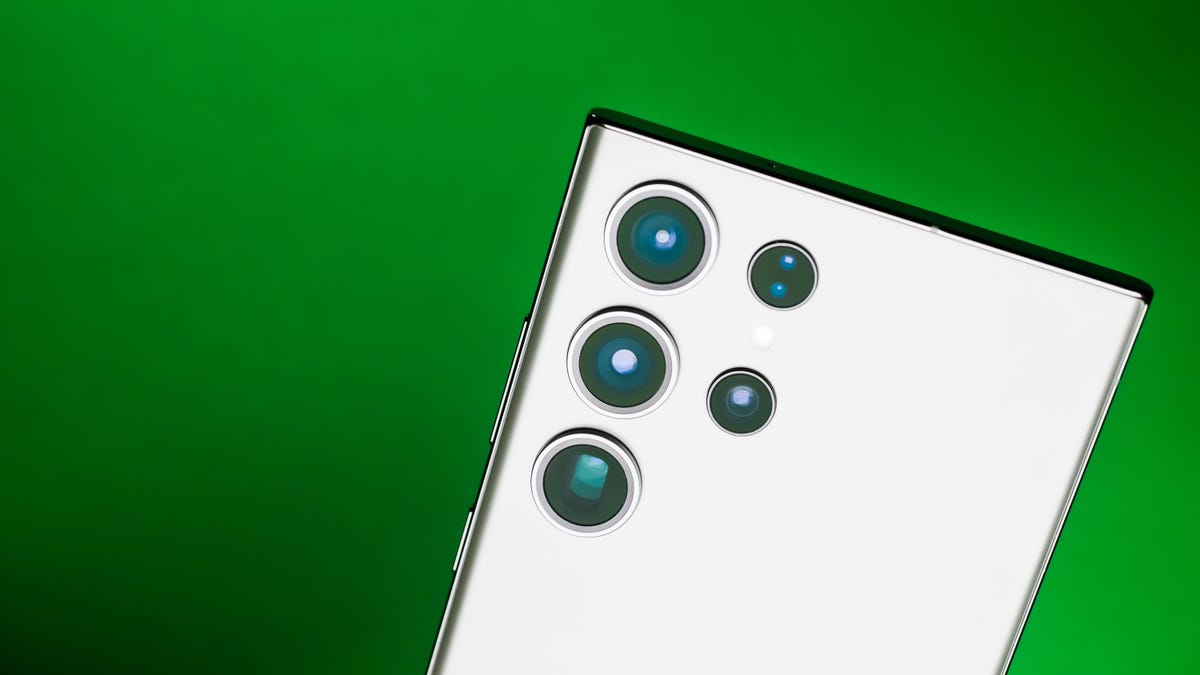
Samsung saved its biggest camera upgrades for its premium flagship Galaxy S23 Ultra. Unlike the other two S23 series phones, the Ultra features a quadruple rear camera system, annotated in the image below.
The S23 Ultra’s pièce de résistance is a new main camera that has a massive 200-megapixel sensor — nearly double the resolution offered by the Galaxy S22 Ultra. As mentioned in the previous section, you probably won’t need to shoot at the highest resolution, unless you plan on making large prints of photos. Like the S23 and S23 Plus, the Ultra’s main camera takes 12-megapixel photos by default using pixel binning. In the case of the Ultra, it just has more pixels that it can group together which results in better looking images that are brighter and have less image noise, even under low light.
The new sensor also has Super Quad Pixel, an improved autofocus system that uses 2×2 pixel groups to help the camera’s focus lock onto details like horizons or tree trunks even when it’s dim. The S23 Ultra also supports the Expert Raw app, which allows you to capture photos using Samsung’s computational algorithms and save your snap as a raw file to retains more image data and greater dynamic range. Raw files are typically larger than JPEG files but are more ideal for photo editing since they contain more image information and settings. Samsung’s Expert Raw app supports all of the S23 Ultra’s cameras, and when you install the app, its controls are added to the native camera app.
Along with the main camera, there’s also a 12-megapixel ultra wide camera, with a 120-degree field of view, and two telephoto cameras, instead of the one found on the S23 and S23 Plus. The first telephoto lens has a 3x optical zoom, while the second one has a 10x optical zoom. The second telephoto camera also has a 100x digital zoom, but the more you zoom in, the more noisy images look. If the 10x telephoto is anything like previous Galaxy Ultra phones, its digital zoom should take decent photos up to 25x to 30x magnification, which is well beyond what the Pixel 7 Pro or iPhone 14 Pro can manage.
Want to learn more about the Galaxy S23? Check out our review of the Galaxy S23 Ultra, how you can preorder the Galaxy S23 right now and why Samsung’s future premium phones may be more difficult to afford.
Technologies
Today’s NYT Strands Hints, Answers and Help for Oct. 23 #599
Here are hints and answers for the NYT Strands puzzle for Oct. 23, No. 599.
Looking for the most recent Strands answer? Click here for our daily Strands hints, as well as our daily answers and hints for The New York Times Mini Crossword, Wordle, Connections and Connections: Sports Edition puzzles.
Today’s NYT Strands puzzle might be Halloween-themed, as the answers are all rather dangerous. Some of them are a bit tough to unscramble, so if you need hints and answers, read on.
I go into depth about the rules for Strands in this story.
If you’re looking for today’s Wordle, Connections and Mini Crossword answers, you can visit CNET’s NYT puzzle hints page.
Read more: NYT Connections Turns 1: These Are the 5 Toughest Puzzles So Far
Hint for today’s Strands puzzle
Today’s Strands theme is: Please don’t eat me!
If that doesn’t help you, here’s a clue: Remember Mr. Yuk?
Clue words to unlock in-game hints
Your goal is to find hidden words that fit the puzzle’s theme. If you’re stuck, find any words you can. Every time you find three words of four letters or more, Strands will reveal one of the theme words. These are the words I used to get those hints but any words of four or more letters that you find will work:
- POND, NOON, NODE, BALE, SOCK, LOVE, LOCK, MOCK, LEER, REEL, GLOVE, DAIS, LEAN, LEAD, REEL
Answers for today’s Strands puzzle
These are the answers that tie into the theme. The goal of the puzzle is to find them all, including the spangram, a theme word that reaches from one side of the puzzle to the other. When you have all of them (I originally thought there were always eight but learned that the number can vary), every letter on the board will be used. Here are the nonspangram answers:
- AZALEA, HEMLOCK, FOXGLOVE, OLEANDER, BELLADONNA
Today’s Strands spangram
Today’s Strands spangram is POISONOUS. To find it, look for the P that is the first letter on the far left of the top row, and wind down and across.
Technologies
Today’s NYT Connections: Sports Edition Hints and Answers for Oct. 23, #395
Here are hints and the answers for the NYT Connections: Sports Edition puzzle for Oct. 23, No. 395.
Looking for the most recent regular Connections answers? Click here for today’s Connections hints, as well as our daily answers and hints for The New York Times Mini Crossword, Wordle and Strands puzzles.
Today’s Connections: Sports Edition has one of those crazy purple categories, where you wonder if anyone saw the connection, or if people just put that grouping together because only those four words were left. If you’re struggling but still want to solve it, read on for hints and the answers.
Connections: Sports Edition is published by The Athletic, the subscription-based sports journalism site owned by The Times. It doesn’t show up in the NYT Games app but appears in The Athletic’s own app. Or you can play it for free online.
Read more: NYT Connections: Sports Edition Puzzle Comes Out of Beta
Hints for today’s Connections: Sports Edition groups
Here are four hints for the groupings in today’s Connections: Sports Edition puzzle, ranked from the easiest yellow group to the tough (and sometimes bizarre) purple group.
Yellow group hint: Fan noise.
Green group hint: Strategies for hoops.
Blue group hint: Minor league.
Purple group hint: Look for a connection to hoops.
Answers for today’s Connections: Sports Edition groups
Yellow group: Sounds from the crowd.
Green group: Basketball offenses.
Blue group: Triple-A baseball teams.
Purple group: Ends with a basketball stat.
Read more: Wordle Cheat Sheet: Here Are the Most Popular Letters Used in English Words
What are today’s Connections: Sports Edition answers?
The yellow words in today’s Connections
The theme is sounds from the crowd. The four answers are boo, cheer, clap and whistle.
The green words in today’s Connections
The theme is basketball offenses. The four answers are motion, pick and roll, Princeton and triangle.
The blue words in today’s Connections
The theme is triple-A baseball teams. The four answers are Aces, Jumbo Shrimp, Sounds and Storm Chasers.
The purple words in today’s Connections
The theme is ends with a basketball stat. The four answers are afoul, bassist, counterpoint and sunblock.
Technologies
Amazon’s Delivery Drivers Will Soon Wear AI Smart Glasses to Work
The goal is to streamline the delivery process while keeping drivers safe.

Amazon announced on Wednesday that it is developing new AI-powered smart glasses to simplify the delivery experience for its drivers. CNET smart glasses expert Scott Stein mentioned this wearable rollout last month, and now the plan is in its final testing stages.
The goal is to simplify package delivery by reducing the need for drivers to look at their phones, the label on the package they’re delivering and their surroundings to find the correct address.
Don’t miss any of our unbiased tech content and lab-based reviews. Add CNET as a preferred Google source.
A heads-up display will activate as soon as the driver parks, pointing out potential hazards and tasks that must be completed. From there, drivers can locate and scan packages, follow turn-by-turn directions and snap a photograph to prove delivery completion without needing to take out their phone.
The company is testing the glasses in select North American markets.
Watch: See our Instagram post with a video showing the glasses
A representative for Amazon didn’t immediately respond to a request for comment.
To fight battery drain, the glasses pair with a controller attached to the employee’s delivery vest, allowing them to replace depleted batteries and access operational controls. The glasses will support an employee’s eyeglass prescription. An emergency button will be within reach to ensure the driver’s safety.
Amazon is already planning future versions of the glasses, which will feature «real-time defect detection,» notifying the driver if a package was delivered to the incorrect address. They plan to add features to the glasses to detect if pets are in the yard and adjust to low light.
-
 Technologies3 года ago
Tech Companies Need to Be Held Accountable for Security, Experts Say
-
 Technologies3 года ago
Best Handheld Game Console in 2023
-
 Technologies3 года ago
Tighten Up Your VR Game With the Best Head Straps for Quest 2
-
 Technologies4 года ago
Verum, Wickr and Threema: next generation secured messengers
-
 Technologies4 года ago
Black Friday 2021: The best deals on TVs, headphones, kitchenware, and more
-
 Technologies4 года ago
Google to require vaccinations as Silicon Valley rethinks return-to-office policies
-
 Technologies4 года ago
Olivia Harlan Dekker for Verum Messenger
-
 Technologies4 года ago
iPhone 13 event: How to watch Apple’s big announcement tomorrow


